Sie sind bereits eingeloggt. Klicken Sie auf 2. tolino select Abo, um fortzufahren.
Bitte loggen Sie sich zunächst in Ihr Kundenkonto ein oder registrieren Sie sich bei bücher.de, um das eBook-Abo tolino select nutzen zu können.
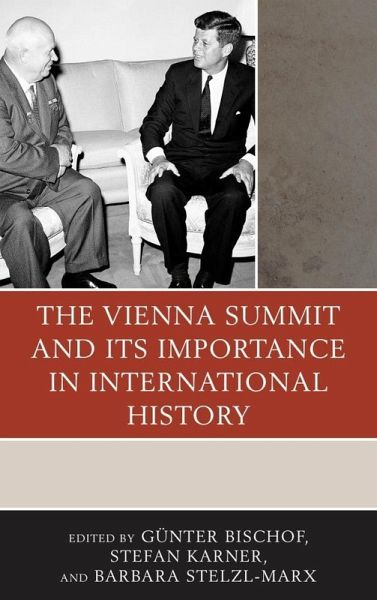
At the beginning of June 1961, the tensions of the Cold War were supposed to abate as both sides sought a resolution. The two most important men in the world, John F. Kennedy and Nikita Khrushchev, met for a summit in Vienna. Yet the high hopes were disappointed. Within months the Cold War had become very hot: Khrushchev built the Berlin Wall and a year later he sent missiles to Cuba to threaten the United States directly. Despite the fact that the Vienna Summit yielded barely any tangible results, it did lead to some very important developments. The superpowers came to see for the first…mehr
At the beginning of June 1961, the tensions of the Cold War were supposed to abate as both sides sought a resolution. The two most important men in the world, John F. Kennedy and Nikita Khrushchev, met for a summit in Vienna. Yet the high hopes were disappointed. Within months the Cold War had become very hot: Khrushchev built the Berlin Wall and a year later he sent missiles to Cuba to threaten the United States directly.
Despite the fact that the Vienna Summit yielded barely any tangible results, it did lead to some very important developments. The superpowers came to see for the first time that there was only one way to escape from the atomic hell of their respective arsenals: dialogue. The "peace through fear" and the "hotline" between Washington and Moscow prevented an atomic confrontation. Austria successfully demonstrated its new role as neutral state and host when Vienna became a meeting place in the Cold War. In The Vienna Summit and Its Importance in International History international experts use new Russian and Western sources to analyze what really happened during this critical time and why the parties had a close shave with catastrophe.
Die Herstellerinformationen sind derzeit nicht verfügbar.
Autorenporträt
Günter Bischof is a university research professor and director of CenterAustria at the University of New Orleans, Louisiana. Stefan Karner is head of the Department of Economic, Social, and Business History at the University of Graz and director of the Ludwig Boltzmann Institute for Research of War Consequences, Graz-Vienna. Barbara Stelzl-Marx is deputy director of the Ludwig Boltzmann Institute for Research of War Consequences and lecturer at the University of Graz.
Inhaltsangabe
Part I: Introduction and Historical Context 1. Introduction: The Vienna Summit and Its Importance in International History Günter Bischof, Stefan Karner, Barbara Stelzl-Marx 2. Summitry in the Twentieth Century: An Overview David Reynolds Part II: Contextualizing the Vienna Summit United States, France, and Great Britain3. "The First Test of [. . .] Détente Will Be the Berlin Negotiation": Berlin, Disarmament, and the 1960 Paris Summit Richard D. Williamson 4. "Vienna, a City that is Symbolic of the Possibility of Finding Equitable Solutions": John F. Kennedy and His European Summitry in Early June 1961 Günter Bischof and Martin Kofler 5. Great Britain and the Vienna Summit of June 1961 Anne Deighton 6. Paris as Beneficiary of the Unsuccessful Vienna Summit Georges-Henri Soutou Soviet Union7. Soviet-American Relations in the Early 1960s Vladimir Pechatnov 8. Between Pragmatism and Ideology: The U.S. -Soviet Negotiating Process in the Khrushchev Era Ol'ga Pavlenko Asia and Africa9. Casting a Long Shadow over Vienna: The Chinese Factor in the Vienna Summit Michail Prozumenshchikov 10. Laos and the Vienna Summit Lawrence Freedman Part III: The Summit 11. Two Days of Drama: Preparation and Execution of the Vienna Summit Barbara Stelzl-Marx 12. A Difficult Education: John F. Kennedy and Nikita S. Khrushchev in Vienna Timothy Naftali 13. "Summit Ladies": Gender Arrangements, Media Staging, and Symbolic Scenes of the 1961Vienna Summit Talks Ingrid Bauer 14. Moral Masculinity: Gender, Power, and the Kennedy-Khrushchev Relationship Jennifer Lynn Walton 15. On the Significance of Austrian Neutrality for Soviet Foreign Policy under Nikita S. Khrushchev Peter Ruggenthaler 16. The Personal Recollections of a Presidential Adviser in Vienna Ted Sorensen 17. The Personal Recollections of Khrushchev's Interpreter in Vienna Viktor Sukhodrev Part IV: The Berlin Crisis 18. Khrushchev, the Berlin Wall, and the Demand for a Peace Treaty, 1961-1963 Gerhard Wettig 19. The Vienna Summit and the Construction of the Berlin Wall Manfred Wilke Appendices Appendix 1: Soviet Kennedy Profile Appendix 2: CIA Profile of Krushchev in Kennedy's Briefing Papers Appendix 4:Krushchev's Presidium Statement before the Vienna Trip Appendix 3-1:Memorandum of Conversation, Vienna, 3 June 1961, 12:45 p.m. Appendix 3-2:Memorandum of Conversation, Vienna, 3 June 1961, 3 p.m. Appendix 3-3:Memorandum of Conversation, Vienna, 4 June 1961, 10:15 a.m. BibliographyAbout the Contributors
Es gelten unsere Allgemeinen Geschäftsbedingungen: www.buecher.de/agb
Impressum
www.buecher.de ist ein Internetauftritt der buecher.de internetstores GmbH
Geschäftsführung: Monica Sawhney | Roland Kölbl | Günter Hilger
Sitz der Gesellschaft: Batheyer Straße 115 - 117, 58099 Hagen
Postanschrift: Bürgermeister-Wegele-Str. 12, 86167 Augsburg
Amtsgericht Hagen HRB 13257
Steuernummer: 321/5800/1497
USt-IdNr: DE450055826