8,60 €
8,60 €
inkl. MwSt.
Sofort per Download lieferbar

0 °P sammeln
8,60 €
Als Download kaufen
8,60 €
inkl. MwSt.
Sofort per Download lieferbar
0 °P sammeln
Jetzt verschenken
Alle Infos zum eBook verschenken
8,60 €
inkl. MwSt.
Sofort per Download lieferbar
Alle Infos zum eBook verschenken
0 °P sammeln

Andere Kunden interessierten sich auch für
") Fennel Explained (eBook, ePUB)9,23 €
Fennel Explained (eBook, ePUB)9,23 €") Programming MQL5 for Algorithmic Trading (eBook, ePUB)8,47 €
Programming MQL5 for Algorithmic Trading (eBook, ePUB)8,47 €") CryptoVelix Hybrid Trading System (eBook, ePUB)8,49 €
CryptoVelix Hybrid Trading System (eBook, ePUB)8,49 €") Full Stack Development Explained (eBook, ePUB)6,33 €
Full Stack Development Explained (eBook, ePUB)6,33 €") Getting Started with Forex Trading Using Python (eBook, ePUB)27,59 €
Getting Started with Forex Trading Using Python (eBook, ePUB)27,59 €") Azure Architecture Explained (eBook, ePUB)35,99 €
Azure Architecture Explained (eBook, ePUB)35,99 €") Zero to Hero in Cryptocurrency Trading (eBook, ePUB)25,19 €
Zero to Hero in Cryptocurrency Trading (eBook, ePUB)25,19 €






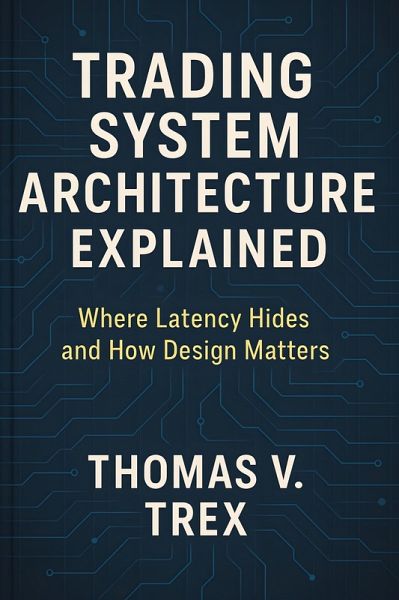
"Trading System Architecture Explained: Where Latency Hides and How Design Matters" Electronic trading is now a race measured in microseconds, where architecture choices quietly decide who wins before the strategy ever sees the market. This book is written for quantitative developers, trading technologists, and technically inclined traders who need to understand not just how to write strategies, but how the entire stack beneath them creates or destroys edge. It connects market microstructure, networks, hardware, and software design into a coherent view of where latency truly hides. Across the chapters, you will learn how orders traverse fragmented markets, how to define and measure latency rigorously, and how to design architectures that minimize both average and tail delays. The book walks through market data pipelines, order gateways, kernel-bypass networking, CPU and OS tuning, and end-to-end observability. You will see how economic incentives, protocol details, and implementation patterns interact-translating design decisions into fill rates, queue position, and execution quality. The text assumes familiarity with basic programming (C++/Java/C# or similar) and fundamental finance concepts, but it does not require prior experience in high-frequency trading. With a strong emphasis on concrete engineering trade-offs, practical measurement, and failure modes, it serves as both a conceptual map for newcomers and a systems-level checklist for experienced practitioners seeking to harden and accelerate their trading infrastructure.
Dieser Download kann aus rechtlichen Gründen nur mit Rechnungsadresse in A, B, BG, CY, CZ, D, DK, EW, E, FIN, F, GR, H, IRL, I, LT, L, LR, M, NL, PL, P, R, S, SLO, SK ausgeliefert werden.