37,95 €
37,95 €
inkl. MwSt.
Sofort per Download lieferbar

19 °P sammeln
37,95 €
Als Download kaufen
37,95 €
inkl. MwSt.
Sofort per Download lieferbar
19 °P sammeln
Jetzt verschenken
Alle Infos zum eBook verschenken
37,95 €
inkl. MwSt.
Sofort per Download lieferbar
Alle Infos zum eBook verschenken
19 °P sammeln

Andere Kunden interessierten sich auch für
") Understanding Humanism (eBook, ePUB)37,95 €
Understanding Humanism (eBook, ePUB)37,95 €") Humanism (eBook, PDF)22,95 €
Humanism (eBook, PDF)22,95 € (eBook, PDF)") Humanist Essays (Routledge Revivals) (eBook, PDF)39,95 €
Humanist Essays (Routledge Revivals) (eBook, PDF)39,95 €") Sociology of Religion (eBook, PDF)37,95 €
Sociology of Religion (eBook, PDF)37,95 €") The Political Humanism of Hannah Arendt (eBook, PDF)36,95 €
The Political Humanism of Hannah Arendt (eBook, PDF)36,95 €") Philosophical Issues in Counseling and Psychotherapy (eBook, PDF)69,95 €
Philosophical Issues in Counseling and Psychotherapy (eBook, PDF)69,95 €") The Revolution of Values (eBook, PDF)30,95 €
The Revolution of Values (eBook, PDF)30,95 €






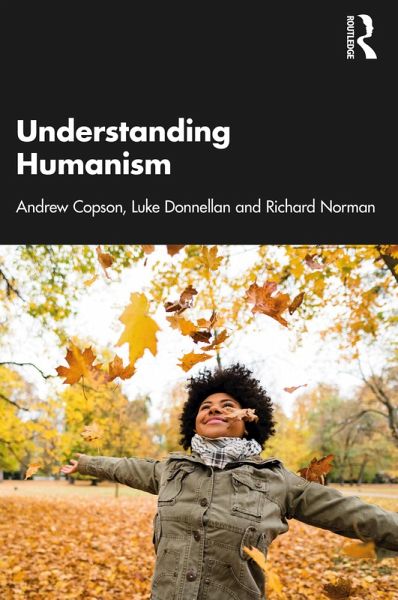
Understanding Humanism is an easy-to-read and informative overview of the beliefs, practices, and values of humanism as a non-religious worldview. This short and lively book explores humanism both as a broad historical tradition of thought and as a stance embodied in organised institutions. It sets out clearly and systematically the beliefs and values of humanism as well as the reality and personal experience of living as a humanist today.
Questions discussed in this book include:
Understanding Humanism provides a reliable and easily digestible introduction to the field. By exploring these questions and inviting readers to engage with the arguments, it serves as the ideal textbook for those approaching the topic of humanism for the first time.
Questions discussed in this book include:
- How do humanists see the relation between science and religious belief?
- Is humanism wedded to science as the only valid form of knowledge?
- What value do humanists place on the arts, and can they value religious art?
- Does the emphasis on human responsibility depend on an untenable belief in 'free will', and is this undermined by psychology and neuroscience?
- Do humanists think that life is sacred?
- What account would humanists give of the basis of human rights, and why they are important?
- Does humanism entail that human life is meaningless and pointless?
- Can humanists meet the challenge of nihilism?
Understanding Humanism provides a reliable and easily digestible introduction to the field. By exploring these questions and inviting readers to engage with the arguments, it serves as the ideal textbook for those approaching the topic of humanism for the first time.
Dieser Download kann aus rechtlichen Gründen nur mit Rechnungsadresse in A, B, BG, CY, CZ, D, DK, EW, E, FIN, F, GR, HR, H, IRL, I, LT, L, LR, M, NL, PL, P, R, S, SLO, SK ausgeliefert werden.
"There has rarely been a time when a clear statement of Humanist values has been so necessary. In intellectual life, these include a respect for evidence, the independence to follow any argument to where it leads, and an enlightened suspicion of claims to be authoritatively in possession of truth - religious or otherwise. In morality, they include an emphasis upon our fundamental equality and a respect for human rights, including the right to lead one's own life in one's own way. These values are united within the framework of a world view, premised on the recognition we each have only one life to lead, and that it is each person's own responsibility - no-one else's - to live that life to the fullest possible extent. In this welcome book, the Humanist framework is set out in terms which are both thorough and clear."
Alan Haworth, author of Political Philosophy After 1945 (2022), Totalitarianism and Philosophy (2019), and Understanding the Political Philosophers: From Ancient to Modern Times (2012).
"A great choice for students and teachers wanting a thorough modern account of humanism."
Jim Al-Khalili, Vice President of Humanists UK.
"An easy-to-read and informative overview of humanism. The manual for those wishing to delve deeper into this broad tradition of historical thought."
Shaparak Khorsandi, Vice President of Humanists UK.
Alan Haworth, author of Political Philosophy After 1945 (2022), Totalitarianism and Philosophy (2019), and Understanding the Political Philosophers: From Ancient to Modern Times (2012).
"A great choice for students and teachers wanting a thorough modern account of humanism."
Jim Al-Khalili, Vice President of Humanists UK.
"An easy-to-read and informative overview of humanism. The manual for those wishing to delve deeper into this broad tradition of historical thought."
Shaparak Khorsandi, Vice President of Humanists UK.