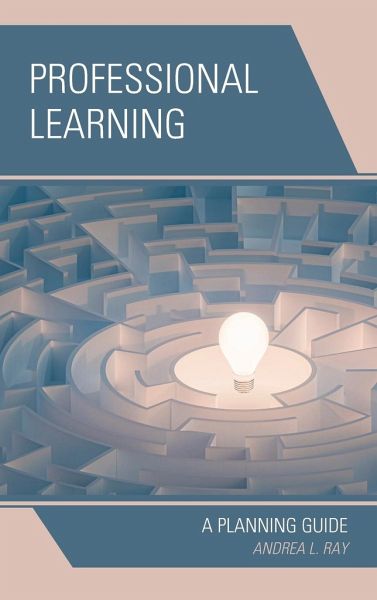
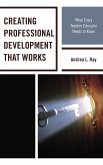
The templates in Professional Learning: A Planning Guide have a strong research-based foundation that increases a teacher educator’s ability to develop relevant learning activities.
The templates in Professional Learning: A Planning Guide have a strong research-based foundation that increases a teacher educator’s ability to develop relevant learning activities.
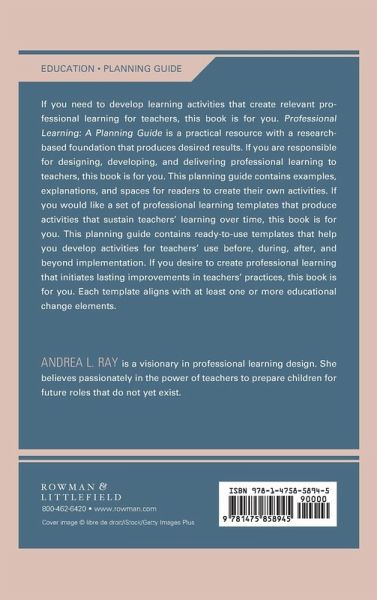
Andrea L Ray is a visionary in professional learning design. She believes passionately in the power of teachers to prepare children for future roles that do not yet exist.
Inhaltsangabe
INTRODUCTION Welcome to the World PART ONE: YES, I COME WITH AN OWNER'S MANUAL Chapter One: Design Framework Chapter Two: The Five-Step Process Chapter Three: Identify and Define Borders Chapter Four: Focal Points and Instructional Goals Chapter Five: Is There Anything Else We Should Know? PART TWO: AN EXAMPLE Chapter Six: How to Create Relevant Activities Chapter Seven: How to Design and Develop Activity 1 Chapter Eight: How to Assess Activity 1 PART THREE: CLASSROOM-CENTERED ACTIVITIES Chapter Nine: Learning Activity 1 Chapter Ten: Learning Activity 2 Chapter Eleven: Learning Activity 3 PART FOUR: LEARNING-CENTERED ACTIVITIES Chapter Twelve: Learning Activity 4 Chapter Thirteen: Learning Activity 5 Chapter Fourteen: Learning Activity 6 PART FIVE: UNDERSTANDING-CENTERED ACTIVITIES Chapter Fifteen: Learning Activity 7 Chapter Sixteen: Learning Activity 8 Chapter Seventeen: Learning Activity 9 PART SIX: PROGRESS-CENTERED ACTIVITIES Chapter Eighteen: Learning Activity 10 Chapter Nineteen: Learning Activity 11 Chapter Twenty: Learning Activity 12 APPENDICES Appendix A: Principles of Adult Learning Appendix B: Attributes of Innovations that Affect Their Rate of Adoption Appendix C: Content Word Family, Definitions and Focal Points Appendix D: Processing Word Family, Definitions and Focal Points Appendix E: Classroom Ecosystem Word Family, Definitions and Focal Points
INTRODUCTION Welcome to the World PART ONE: YES, I COME WITH AN OWNER'S MANUAL Chapter One: Design Framework Chapter Two: The Five-Step Process Chapter Three: Identify and Define Borders Chapter Four: Focal Points and Instructional Goals Chapter Five: Is There Anything Else We Should Know? PART TWO: AN EXAMPLE Chapter Six: How to Create Relevant Activities Chapter Seven: How to Design and Develop Activity 1 Chapter Eight: How to Assess Activity 1 PART THREE: CLASSROOM-CENTERED ACTIVITIES Chapter Nine: Learning Activity 1 Chapter Ten: Learning Activity 2 Chapter Eleven: Learning Activity 3 PART FOUR: LEARNING-CENTERED ACTIVITIES Chapter Twelve: Learning Activity 4 Chapter Thirteen: Learning Activity 5 Chapter Fourteen: Learning Activity 6 PART FIVE: UNDERSTANDING-CENTERED ACTIVITIES Chapter Fifteen: Learning Activity 7 Chapter Sixteen: Learning Activity 8 Chapter Seventeen: Learning Activity 9 PART SIX: PROGRESS-CENTERED ACTIVITIES Chapter Eighteen: Learning Activity 10 Chapter Nineteen: Learning Activity 11 Chapter Twenty: Learning Activity 12 APPENDICES Appendix A: Principles of Adult Learning Appendix B: Attributes of Innovations that Affect Their Rate of Adoption Appendix C: Content Word Family, Definitions and Focal Points Appendix D: Processing Word Family, Definitions and Focal Points Appendix E: Classroom Ecosystem Word Family, Definitions and Focal Points
Es gelten unsere Allgemeinen Geschäftsbedingungen: www.buecher.de/agb
Impressum
www.buecher.de ist ein Internetauftritt der buecher.de internetstores GmbH
Geschäftsführung: Monica Sawhney | Roland Kölbl | Günter Hilger
Sitz der Gesellschaft: Batheyer Straße 115 - 117, 58099 Hagen
Postanschrift: Bürgermeister-Wegele-Str. 12, 86167 Augsburg
Amtsgericht Hagen HRB 13257
Steuernummer: 321/5800/1497
USt-IdNr: DE450055826