84,99 €
inkl. MwSt.
Versandkostenfrei*Erscheint vorauss. 24. Februar 2026
Melden Sie sich
hier
hier
für den Produktalarm an, um über die Verfügbarkeit des Produkts informiert zu werden.

42 °P sammeln
Andere Kunden interessierten sich auch für
 Citizen Science in Maritime Archaeology84,99 €
 Indigenizing Archaeology84,99 €
 Digital Heritage and Archaeology in Practice84,99 €
 Historical Archaeology in the Twenty-First Century84,99 €
 The Market for Mesoamerica85,99 €
 Digital Heritage and Archaeology in Practice84,99 €
 Pedagogy and Practice in Heritage Studies89,99 €
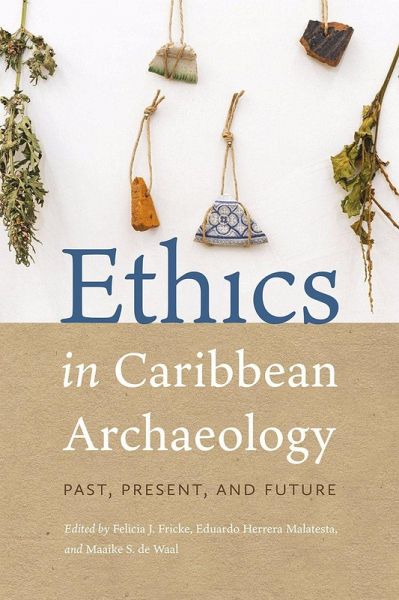
This book will be freely available in an open access edition thanks to generous support from the Max-Planck-Institute for Evolutionary Anthropology, the Wenner-Gren Foundation, Marie Sklodowska Curie Action (grant agreement #101062882), and the IN THE SAME SEA history project funded by the European Research Council under the European Union’s Horizon 2020 research and innovation program (grant agreement #851871). Insights and strategies for transforming the ethics of archaeological practices in the Caribbean and helping the discipline flourish The first book to focus on ethical archaeological practices in the context of the Caribbean, Ethics in Caribbean Archaeology presents current and past case studies as well as regional overviews to equip researchers with tools for challenging persistent colonial structures that often underpin work in the region. With contributions from both longtime specialists and early-career voices, this volume brings together a wide range of approaches and includes perspectives spanning firsthand experience to large-scale observation and critiques. These chapters address current issues in subfields such as material culture analysis, museum curation, biomolecular archaeology, biological anthropology, and digital archaeology. The strategies and insights offered relate to topics such as community engagement with African-descended and Indigenous peoples, the ethical handling of ancestral remains, and best practices for storing or returning materials held in collections. This book is a crucial resource for archaeologists around the world, especially those working in island settings, providing encouragement as they endeavor to change entrenched norms and asymmetrical relationships. Together, these chapter authors are positive about a future for the discipline that is culturally sensitive, politically aware, empathic, and dynamic.