

Andere Kunden interessierten sich auch für
 Sustainability in Banks38,99 €
 Sustainable Entrepreneurship46,99 €
 Corporate Social Responsibility in a Dynamic Global Environment129,99 €
 Current Global Practices of Corporate Social Responsibility166,99 €
 Current Global Practices of Corporate Social Responsibility166,99 €
 Corporate Social Responsibility in a Dynamic Global Environment129,99 €
 Integrated Reporting113,99 €




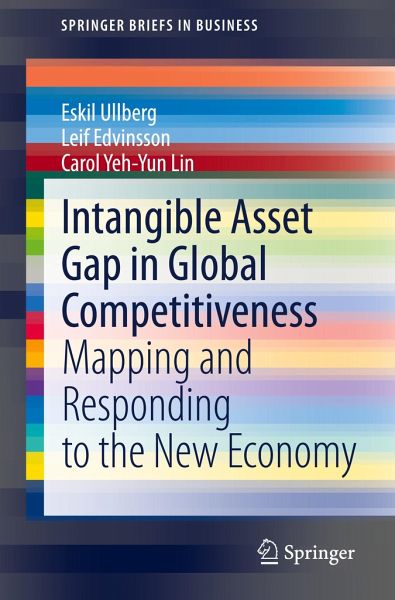
This book examines the role of intangible assets (IA) in companies and countries for achieving sustainable economic growth. The authors particularly focus on Sweden and other Nordic countries to analyse the IA gap using a systematized "IA metrics" approach. They also discuss the incentives needed for strategic investments into useful IA to gain national competitiveness from an economic, social and environmental policy perspective.
The authors contend that despite the increasing importance of IA and intellectual capital (IC) in the economy, the current discussion has only been centered on intellectual property, which is one of the more prominent forms of intangibles. As this book demonstrates, IC and IA encompass wider dimensions of human, process, market, and renewal capital, among others. Featuring real case examples from Spotify, Minecraft and Izettle, this book offers a strategy for the resurrection of competitive advantage in the globalized economy and the advancement of some key United Nations Sustainable Development Goals (SDGs).
The authors contend that despite the increasing importance of IA and intellectual capital (IC) in the economy, the current discussion has only been centered on intellectual property, which is one of the more prominent forms of intangibles. As this book demonstrates, IC and IA encompass wider dimensions of human, process, market, and renewal capital, among others. Featuring real case examples from Spotify, Minecraft and Izettle, this book offers a strategy for the resurrection of competitive advantage in the globalized economy and the advancement of some key United Nations Sustainable Development Goals (SDGs).