22,95 €
22,95 €
inkl. MwSt.
Sofort per Download lieferbar

11 °P sammeln
22,95 €
Als Download kaufen
22,95 €
inkl. MwSt.
Sofort per Download lieferbar
11 °P sammeln
Jetzt verschenken
Alle Infos zum eBook verschenken
22,95 €
inkl. MwSt.
Sofort per Download lieferbar
Alle Infos zum eBook verschenken
11 °P sammeln

Andere Kunden interessierten sich auch für
") Gitlow v. New York (eBook, ePUB)18,95 €
Gitlow v. New York (eBook, ePUB)18,95 €") Rutgers v. Waddington (eBook, ePUB)22,95 €
Rutgers v. Waddington (eBook, ePUB)22,95 €") Mapp v. Ohio (eBook, ePUB)22,95 €
Mapp v. Ohio (eBook, ePUB)22,95 €") Plessy v. Ferguson (eBook, ePUB)22,95 €
Plessy v. Ferguson (eBook, ePUB)22,95 €") Goldwater v. Carter (eBook, ePUB)22,95 €
Goldwater v. Carter (eBook, ePUB)22,95 €") Griswold v. Connecticut (eBook, ePUB)18,95 €
Griswold v. Connecticut (eBook, ePUB)18,95 €") Justice Robert H. Jackson's Unpublished Opinion in Brown v. Board (eBook, ePUB)37,95 €
Justice Robert H. Jackson's Unpublished Opinion in Brown v. Board (eBook, ePUB)37,95 €





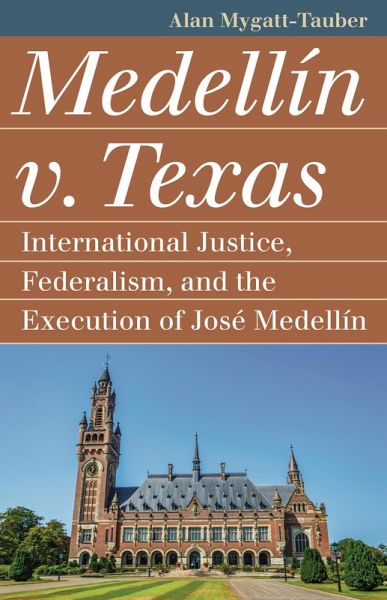
In 1993, José Medellín, an eighteen-year-old Mexican national who lived most of his life in the United States, was arrested for his participation in the gang rape and murder of two girls in Houston, Texas. Despite telling police that he was born in Mexico, he was never informed of his rights to contact the Mexican Consulate, a right guaranteed to him by Article 36 of the Vienna Convention on Consular Relations. The Mexican government filed suit against the United States in the International Court of Justice (ICJ), which ruled that the United States had violated the rights of both Mexico and Medellín, along with fifty-one other Mexican nationals in other cases. The ICJ instructed the United States to provide review and reconsideration of the convictions and sentences of the fifty-two Mexican nationals.
Armed with this new decision, Medellín sought a writ of habeas corpus, which was denied by the lower courts. He petitioned for a writ of certiorari, which the Supreme Court granted, twice. While President George W. Bush sided with the ICJ, the State of Texas, under Solicitor General Ted Cruz, argued against the president. Despite a nearly universal belief among court watchers and legal scholars that Texas would lose, the Court in a 6-3 decision ruled in favor of Texas and against Medellín in June 2008. Medellín was executed just two months later.
In this volume Alan Mygatt-Tauber tells the story of Medellín v. Texas, showing how the Court's 2008 ruling grappled with the complex question of how a united republic that respects the dual sovereignty of its constituent parts struggles to comply with its international obligations. But this is also a story of international human rights and the anomalous position of the United States regarding the death penalty compared to other nations. In the closing chapters, the author explores the aftermath of the execution, including the continued effort of Mexico to seek justice for its nationals.
Mygatt-Tauber offers a detailed examination of the case at every stage of proceedingstrial, appeal, at the International Court of Justice, and in both trips to the Supreme Court. He provides never-before-revealed information about the thinking of the Bush White House in the decision to comply with the ICJ's judgment and to withdraw from the Optional Protocol to the Vienna Convention which granted the ICJ jurisdiction.
Armed with this new decision, Medellín sought a writ of habeas corpus, which was denied by the lower courts. He petitioned for a writ of certiorari, which the Supreme Court granted, twice. While President George W. Bush sided with the ICJ, the State of Texas, under Solicitor General Ted Cruz, argued against the president. Despite a nearly universal belief among court watchers and legal scholars that Texas would lose, the Court in a 6-3 decision ruled in favor of Texas and against Medellín in June 2008. Medellín was executed just two months later.
In this volume Alan Mygatt-Tauber tells the story of Medellín v. Texas, showing how the Court's 2008 ruling grappled with the complex question of how a united republic that respects the dual sovereignty of its constituent parts struggles to comply with its international obligations. But this is also a story of international human rights and the anomalous position of the United States regarding the death penalty compared to other nations. In the closing chapters, the author explores the aftermath of the execution, including the continued effort of Mexico to seek justice for its nationals.
Mygatt-Tauber offers a detailed examination of the case at every stage of proceedingstrial, appeal, at the International Court of Justice, and in both trips to the Supreme Court. He provides never-before-revealed information about the thinking of the Bush White House in the decision to comply with the ICJ's judgment and to withdraw from the Optional Protocol to the Vienna Convention which granted the ICJ jurisdiction.
Dieser Download kann aus rechtlichen Gründen nur mit Rechnungsadresse in A, D ausgeliefert werden.