42,95 €
42,95 €
inkl. MwSt.
Erscheint vor. 29.12.25

21 °P sammeln
42,95 €
Als Download kaufen
42,95 €
inkl. MwSt.
Erscheint vor. 29.12.25
21 °P sammeln
Jetzt verschenken
Alle Infos zum eBook verschenken
42,95 €
inkl. MwSt.
Erscheint vor. 29.12.25
Alle Infos zum eBook verschenken
21 °P sammeln

Andere Kunden interessierten sich auch für
") Sacred Orientation in Late Antiquity and Early Islam (eBook, ePUB)42,95 €
Sacred Orientation in Late Antiquity and Early Islam (eBook, ePUB)42,95 €") Sino-Muslims, Networking, and Identity in Late Imperial China (eBook, PDF)42,95 €
Sino-Muslims, Networking, and Identity in Late Imperial China (eBook, PDF)42,95 €") Knowledge, Authority, and Islamic Education in the West (eBook, PDF)42,95 €
Knowledge, Authority, and Islamic Education in the West (eBook, PDF)42,95 €") Devotional Islam in Contemporary South Asia (eBook, PDF)45,95 €
Devotional Islam in Contemporary South Asia (eBook, PDF)45,95 €") The Qur'an and Late Antiquity (eBook, PDF)42,95 €
The Qur'an and Late Antiquity (eBook, PDF)42,95 €") Routledge Handbook on Early Islam (eBook, PDF)47,95 €
Routledge Handbook on Early Islam (eBook, PDF)47,95 €") Islam in Historical Perspective (eBook, PDF)37,95 €
Islam in Historical Perspective (eBook, PDF)37,95 €






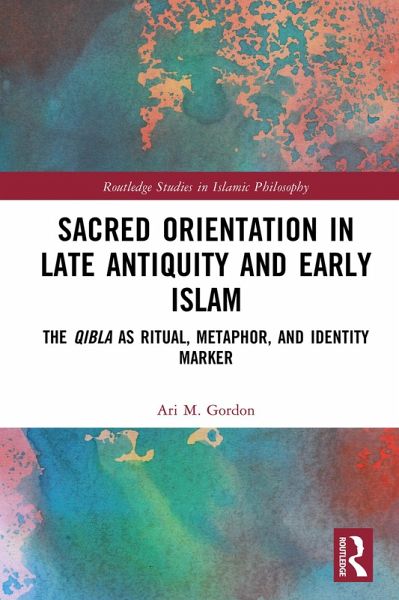
Sacred Orientation in Late Antiquity and Early Islam: The Qibla as Ritual, Metaphor, and Identity Marker offers a groundbreaking study of how the qibla-Islam's ritual direction of prayer-served not only as a sacred practice but also as a powerful marker of communal identity in Islam's formative centuries.
Situating the qibla within the wider ritual culture of Late Antiquity, this book examines how sacred orientation shaped the evolving boundaries of religious belonging across the early Islamic world. It traces how the Qur¿an's treatment of prayer direction emerged within a shared ritual discourse with Judaism and Christianity, and how the qibla became an embodied metaphor for inclusion and unity within an increasingly diverse Muslim community. The volume also explores interreligious polemics, legal and theological debates, and the symbolic significance of mosque architecture, maps, and scientific instruments, portraying the qibla as a dynamic vehicle for both religious expression and communal cohesion. From medieval controversies to contemporary technologies, Sacred Orientation argues that the qibla remains an "inexhaustible" ritual symbol- constantly evolving, yet deeply rooted in the construction and performance of Islamic identity.
Essential reading for scholars of Islamic studies, religious studies, ritual theory, and Late Antiquity, this book offers a fresh and richly contextualized perspective on one of Islam's most enduring and meaningful practices.
Situating the qibla within the wider ritual culture of Late Antiquity, this book examines how sacred orientation shaped the evolving boundaries of religious belonging across the early Islamic world. It traces how the Qur¿an's treatment of prayer direction emerged within a shared ritual discourse with Judaism and Christianity, and how the qibla became an embodied metaphor for inclusion and unity within an increasingly diverse Muslim community. The volume also explores interreligious polemics, legal and theological debates, and the symbolic significance of mosque architecture, maps, and scientific instruments, portraying the qibla as a dynamic vehicle for both religious expression and communal cohesion. From medieval controversies to contemporary technologies, Sacred Orientation argues that the qibla remains an "inexhaustible" ritual symbol- constantly evolving, yet deeply rooted in the construction and performance of Islamic identity.
Essential reading for scholars of Islamic studies, religious studies, ritual theory, and Late Antiquity, this book offers a fresh and richly contextualized perspective on one of Islam's most enduring and meaningful practices.
Dieser Download kann aus rechtlichen Gründen nur mit Rechnungsadresse in A, B, BG, CY, CZ, D, DK, EW, E, FIN, F, GR, HR, H, IRL, I, LT, L, LR, M, NL, PL, P, R, S, SLO, SK ausgeliefert werden.