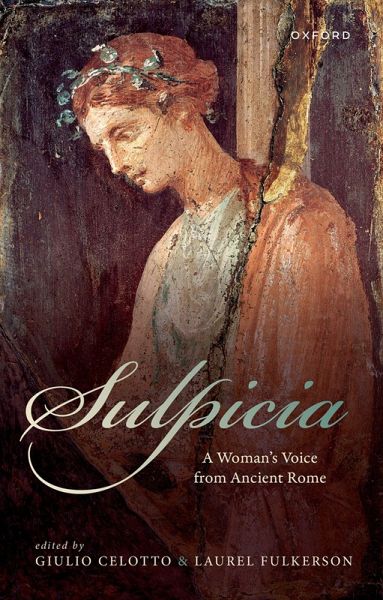
The main challenge in writing the history of Roman women is their silence, for they either did not themselves write, or what writing they did was not kept and transmitted. There are, however, a few welcome exceptions, such as the work of the Roman elegiac poet Sulpicia. This volume aims to bring the voice of the to the foreground: by acknowledging her as the author of part of Corpus Tibullianum 3, by appreciating the artistry of her work in terms of both poetic technique and engagement with previous literature, and by highlighting the pointedly feminine features of her poetry, which serve as…mehr
The main challenge in writing the history of Roman women is their silence, for they either did not themselves write, or what writing they did was not kept and transmitted. There are, however, a few welcome exceptions, such as the work of the Roman elegiac poet Sulpicia. This volume aims to bring the voice of the to the foreground: by acknowledging her as the author of part of Corpus Tibullianum 3, by appreciating the artistry of her work in terms of both poetic technique and engagement with previous literature, and by highlighting the pointedly feminine features of her poetry, which serve as interpretive keys to better understand not only her position in the elegiac tradition, but, more in general, the role of women in Augustan Rome. The chapters address a variety of topics: Sulpicia's commentary on and use of activities and characteristics traditionally considered feminine; Sulpicia's sophisticated style, particularly her allusive engagement with other poets; the question of what works can be attributed to Sulpicia; and the reception of Sulpicia's work in musical adaptations and possible future directions in the study of Latin elegy more broadly.
Giulio Celotto is Assistant Professor of Classics, General Faculty at the University of Virginia. He received his PhD in Classics from Florida State University in 2017. His primary research interests focus on imperial Latin literature, that of the Neronian and Flavian age in particular. He is the author of Amor Belli: Love and Strife in Lucan's Bellum civile (2022), as well as he has articles on a variety of authors, such as Catullus, Vergil, Livy, Ovid, Seneca, Lucan, Persius, Statius, Juvenal, and Tacitus. He is the director of The Siren Project. Laurel Fulkerson was a faculty member at the Florida State University in Tallahassee from 2000 until her retirement in 2022. She received her degrees from Columbia University. Her scholarly work focuses on Latin poetry, ancient gender studies, and emotions in antiquity. She was editor of The Classical Journal 2010-2016, and is currently co-editor of the Journal of the International Ovidian Society. She has received fellowships from the NEH, Loeb Classical Library, and Margo Tytus, and has spent time as a Visiting Fellow at Exeter, St Anne's, and Wadham Colleges, Oxford. She has won graduate and undergraduate teaching awards at national and university levels.
Inhaltsangabe
* 1: Giulio Celotto: Reclaiming Sulpicia's Female Poetic Voice * 2: Kristina Milnor: Between a Toga and a Woolbasket: Sulpicia and Materiality * 3: K. Sara Myers: Wool-Working in Roman Love Elegy: Tibullus, Propertius, and Sulpicia 3.16 * 4: Erin M. Hanses: Sulpicia the Siren, Cerinthus the Epicurean * 5: Judith Peller Hallett: Exorata Cytherea . . . Camenis: Appealing to Vergil's Venus in the Eleven Sulpicia-Elegies * 6: Alison Keith: Sulpicia and Propertius * 7: Eva Werner: Power and Narration: The Enigmatic Figure of Sulpicia in Elegies 3.8 and 3.9 * 8: Jacqueline Fabre-Serris: Etymology and Metaliterary Perspective: New Approaches to Petale's Funerary Epigram * 9: Mary Maxwell: Making Sulpicia Known * 10: Laurel Fulkerson: Center and Margin: The Future of Sulpician Studies
* 1: Giulio Celotto: Reclaiming Sulpicia's Female Poetic Voice * 2: Kristina Milnor: Between a Toga and a Woolbasket: Sulpicia and Materiality * 3: K. Sara Myers: Wool-Working in Roman Love Elegy: Tibullus, Propertius, and Sulpicia 3.16 * 4: Erin M. Hanses: Sulpicia the Siren, Cerinthus the Epicurean * 5: Judith Peller Hallett: Exorata Cytherea . . . Camenis: Appealing to Vergil's Venus in the Eleven Sulpicia-Elegies * 6: Alison Keith: Sulpicia and Propertius * 7: Eva Werner: Power and Narration: The Enigmatic Figure of Sulpicia in Elegies 3.8 and 3.9 * 8: Jacqueline Fabre-Serris: Etymology and Metaliterary Perspective: New Approaches to Petale's Funerary Epigram * 9: Mary Maxwell: Making Sulpicia Known * 10: Laurel Fulkerson: Center and Margin: The Future of Sulpician Studies
Es gelten unsere Allgemeinen Geschäftsbedingungen: www.buecher.de/agb
Impressum
www.buecher.de ist ein Internetauftritt der buecher.de internetstores GmbH
Geschäftsführung: Monica Sawhney | Roland Kölbl | Günter Hilger
Sitz der Gesellschaft: Batheyer Straße 115 - 117, 58099 Hagen
Postanschrift: Bürgermeister-Wegele-Str. 12, 86167 Augsburg
Amtsgericht Hagen HRB 13257
Steuernummer: 321/5800/1497
USt-IdNr: DE450055826