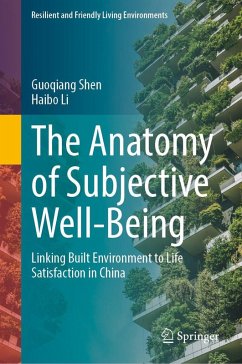
How does the high-density urban environment shape the subjective well-being of millions? This book tackles this pressing question in the context of China's unprecedented urbanization. Through a rigorous case study of Guangzhou, it employs quantitative methods to dissect the complex links between the built environment and subjective well-being. Its groundbreaking contribution lies in systematically revealing the underlying mechanisms via perceived quality, perceived safety, social capital, and health that mediate this relationship, offering a fresh perspective on the urban "Easterlin Paradox."…mehr
How does the high-density urban environment shape the subjective well-being of millions? This book tackles this pressing question in the context of China's unprecedented urbanization. Through a rigorous case study of Guangzhou, it employs quantitative methods to dissect the complex links between the built environment and subjective well-being. Its groundbreaking contribution lies in systematically revealing the underlying mechanisms via perceived quality, perceived safety, social capital, and health that mediate this relationship, offering a fresh perspective on the urban "Easterlin Paradox." Bridging theory and practice, the book translates these insights into actionable strategies for urban planners, policymakers, and community managers. Essential reading for scholars, students, and practitioners shaping the future of cities.
Dr. Li Haibo is an Associate Professor and Head of the Design Department at Guangdong University of Petrochemical Technology. His research encompasses healthy urban planning and design, community-built environments, and sustainable human settlements. His scholarly record includes over 30 publications in peer-reviewed journals, one academic monograph, and leadership or participation in multiple provincial/ministerial research projects. A strong advocate for practice-oriented education, Dr. Li has successfully supervised students to achieve top honors in recognized competitions such as the IAI Design Award, China Habitat Design Annual Award, and the Asian Design Award. Dr.Shen Guoqiang is an endowed Professor and the Chair of the Department of Regional and Urban Planning, College of Civil Engineering and Architecture, Zhejiang University. He holds a Bachelor of Architecture degree from Tsinghua University, a Master degree in Landscape Architecture/Geography from Peking University, and a PhD in City and Regional Planning from The Ohio State University, USA. He once served as a tenured full professor and department chair/director in Urban Planning and Public Administration at the University of Texas Arlington, the University of Oklahoma, and East Carolina University in the United States, in colleges of architecture, civil engineering, public affairs,and technology. He also concurrently held adjunct professorship in Industrial and Systems Engineering and Business School at the University of Oklahoma. His research interests include Architectural Design, Urban Planning and Design, Urban Economics, Transportation & Logistics, Geographic Information Systems (GIS), and Management Science. He emphasizes on critical thinking and practical innovation. Professor Shen has published more than 100 papers in top academic journals and has served as the principal investigator for research projects with a total funding of over USD$30 million. He has personally directed and participated in more than 30 domestic and international projects, including civic, commercial, residential, cultural designs and has won bids and received awards for multiple planning and design competitions or commissioned contacts.
Inhaltsangabe
Part I. Foundations of Well Being. Chapter 1. Introduction. Chapter 2. Understanding Well Being: An Interdisciplinary Synthesis. Chapter 3. Measuring Well Being: A Multidimensional Framework. Chapter 4. Factors Influencing Subjective Well Being: Key Dimensions and Research Evolution. Part II. Empirical Investigations: The Built Environment and Well Being in High Density Cities. Chapter 5. Multidimensional Environmental Influences on Subjective Well being. Chapter 6. Research Design and Methodology. Chapter 7. Descriptive Patterns and Initial Insights. Chapter 8. Key Factors Linking Built Environment and Well Being. Chapter 9. Unveiling the Mechanisms: Mediating Pathways from the Objective Built Environment to Life Satisfaction. Part III. Synthesis, Implications, and Future Directions. Chapter 10. Synthesis Discussion: Theoretical Integration and Research Implications. Chapter 11. Conclusion, Policy Implications and Future Directions.
Part I. Foundations of Well Being. Chapter 1. Introduction. Chapter 2. Understanding Well Being: An Interdisciplinary Synthesis. Chapter 3. Measuring Well Being: A Multidimensional Framework. Chapter 4. Factors Influencing Subjective Well Being: Key Dimensions and Research Evolution. Part II. Empirical Investigations: The Built Environment and Well Being in High Density Cities. Chapter 5. Multidimensional Environmental Influences on Subjective Well being. Chapter 6. Research Design and Methodology. Chapter 7. Descriptive Patterns and Initial Insights. Chapter 8. Key Factors Linking Built Environment and Well Being. Chapter 9. Unveiling the Mechanisms: Mediating Pathways from the Objective Built Environment to Life Satisfaction. Part III. Synthesis, Implications, and Future Directions. Chapter 10. Synthesis Discussion: Theoretical Integration and Research Implications. Chapter 11. Conclusion, Policy Implications and Future Directions.
Es gelten unsere Allgemeinen Geschäftsbedingungen: www.buecher.de/agb
Impressum
www.buecher.de ist ein Internetauftritt der buecher.de internetstores GmbH
Geschäftsführung: Monica Sawhney | Roland Kölbl | Günter Hilger
Sitz der Gesellschaft: Batheyer Straße 115 - 117, 58099 Hagen
Postanschrift: Bürgermeister-Wegele-Str. 12, 86167 Augsburg
Amtsgericht Hagen HRB 13257
Steuernummer: 321/5800/1497
USt-IdNr: DE450055826