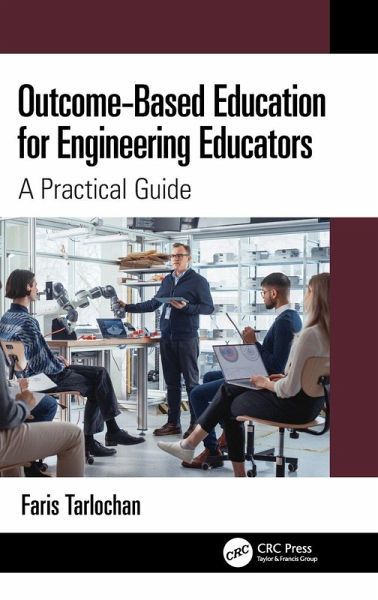
Outcome-Based Education for Engineering Educators presents a student-centered approach that aims to produce graduates with a well-rounded skill set, ready to contribute effectively to the engineering profession and adapt to the dynamic nature of technology and industry. It places an emphasis on preparing students for real-world applications and ensuring they acquire the necessary skills and knowledge to excel in their future careers. Instead of focusing on fulfilling accreditation requirements, the book discusses the constructive alignment between learning outcomes, authentic assessments, and…mehr
Outcome-Based Education for Engineering Educators presents a student-centered approach that aims to produce graduates with a well-rounded skill set, ready to contribute effectively to the engineering profession and adapt to the dynamic nature of technology and industry. It places an emphasis on preparing students for real-world applications and ensuring they acquire the necessary skills and knowledge to excel in their future careers. Instead of focusing on fulfilling accreditation requirements, the book discusses the constructive alignment between learning outcomes, authentic assessments, and teaching-learning activities. It demonstrates how defined learning outcomes should be aligned with the broader goals and objectives of the engineering program that reflect industry needs, technological advancements, and professional standards. The book shows how curriculum may integrate theoretical knowledge with practical applications, hands-on projects, and real-world problem-solving exercises. The book is intended for engineering educators studying and incorporating evidence-based teaching practices. It will also interest graduate students taking courses in engineering management and higher education pedagogy.
Dr. Faris Tarlochan is a Professor in the Department of Mechanical and Industrial Engineering at the College of Engineering, Qatar University, Qatar. He is also an Affiliate Professor with the Technology Innovation and Engineering Education unit of the (remove the) Qatar University. Previously, Dr. Faris had spent 12 years in the field of academia (changed it to academia) in Malaysia. He obtained his degrees from Purdue University, USA, (added comma after USA) and University Putra Malaysia, Malaysia. His research and teaching areas are in the fields of design, additive manufacturing, applied mechanics, road safety, (add comma after safety) and engineering education. Dr. Tarlochan also served as the Chairman of the (add in the) UK's Institution of Mechanical Engineers (IMechE - Malaysian Chapter 2012-2013) and the Secretary (2008 -2010), Deputy Chairman (2010-2012), and Chairman (2012-2013) for the Institution of Engineers Malaysia's Engineering Education Technical Division. He was appointed to the Malaysian Engineering Accreditation Council as a Program Evaluator for the Mechanical Engineering programs across universities in Malaysia from 2011 - 2013. Due to his involvement in engineering education, he has been invited as an external program reviewer to several universities.
Inhaltsangabe
1. Teaching Engineering in a University. 2. Teaching for Quality Learning. 3. Engineering Competencies. 4. Outcome Based Education - Shifting Focus from Teaching to Competency. 5. Student-Centered Education. 6. Assessments and Grading. 7. Constructive Alignment. 8. Designing a Curriculum (Program Level) 9. Designing Constructive Alignment (Course Level). 10. Quality Assurance and Continuous Improvement. 11. Digital Technology Integration in Education. 12. Challenges and Barriers toward Implementing OBE.