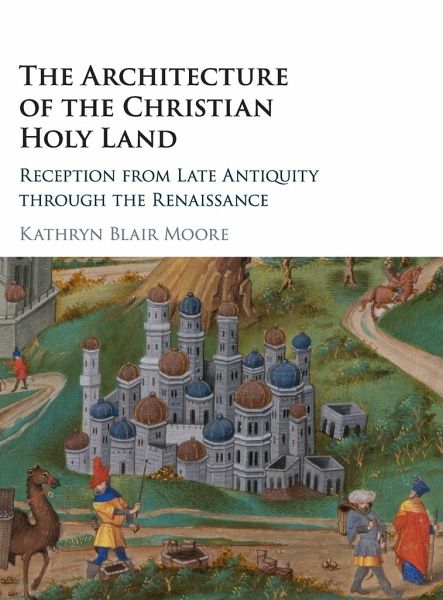
In the absence of the bodies of Christ and Mary, architecture took on a special representational role during the Christian Middle Ages, marking out sites associated with the bodily presence of the dominant figures of the religion. Throughout this period, buildings were reinterpreted in relation to the mediating role of textual and pictorial representations that shaped the pilgrimage experience across expansive geographies. In this study, Kathryn Blair Moore challenges fundamental ideas within architectural history regarding the origins and significance of European recreations of buildings in…mehr
In the absence of the bodies of Christ and Mary, architecture took on a special representational role during the Christian Middle Ages, marking out sites associated with the bodily presence of the dominant figures of the religion. Throughout this period, buildings were reinterpreted in relation to the mediating role of textual and pictorial representations that shaped the pilgrimage experience across expansive geographies. In this study, Kathryn Blair Moore challenges fundamental ideas within architectural history regarding the origins and significance of European recreations of buildings in Jerusalem, Bethlehem, and Nazareth. From these conceptual foundations, she traces and re-interprets the significance of the architecture of the Holy Land within changing religious and political contexts, from the First Crusade and the emergence of the Franciscan Custody of the Holy Land to the anti-Islamic crusade movements of the Renaissance, as well as the Reformation.
Kathryn Blair Moore teaches medieval and Renaissance art history at Texas State University, San Marcos. She received her art historical training at the Institute of Fine Arts, New York University. Fellowships and grants from the American Council of Learned Societies, the American Academy in Rome, and the University of Hong Kong (where she previously taught) have supported extensive research throughout Europe, Western Asia, and North Africa. Her scholarly work explores the intersection of architectural, pictorial, and textual cultures, with a particular emphasis upon larger religious and political contexts, from pilgrimage to religious wars, that shaped the experience of buildings across Europe and the Mediterranean world.
Inhaltsangabe
Preface Abbreviations List of illustrations Introduction Part I. The Symbolization of Holy Land Architecture: 1. Fragmentary inscriptions and material presence 2. Rome and Constantinople 3. Architectural inscriptions in Adomnán's De Locis Sanctis 4. Recreations of the Holy Sepulcher and Benedictine monasticism Part II. Triumphal Restoration and Recreation in the Crusades: 5. The Crusader conquest and triumphal recreation 6. The restoration of the Temple of Solomon 7. Recreating the city of Jerusalem 8. True portraits/true Jerusalems Part III. The Franciscan Custody of the Holy Land: 9. Formation of the Franciscan Custody 10. Assisi as a New Jerusalem 11. Franciscan books on the Holy Land pilgrimage 12. Signs of Christianity and Islam Part IV. Imagined Pilgrimages and Crusades in the Renaissance: 13. The ephemeral architecture of Philip the Good's crusading ambitions 14. The conspicuous nobility of dedication to Holy Land architecture 15. The Franciscan Order, papacy, and symbolic possession of the Holy Land 16. Protestant Reformation, Ottoman conquest, and Catholic renewal after 1517 Epilogue Bibliography Notes.
Es gelten unsere Allgemeinen Geschäftsbedingungen: www.buecher.de/agb
Impressum
www.buecher.de ist ein Internetauftritt der buecher.de internetstores GmbH
Geschäftsführung: Monica Sawhney | Roland Kölbl | Günter Hilger
Sitz der Gesellschaft: Batheyer Straße 115 - 117, 58099 Hagen
Postanschrift: Bürgermeister-Wegele-Str. 12, 86167 Augsburg
Amtsgericht Hagen HRB 13257
Steuernummer: 321/5800/1497
USt-IdNr: DE450055826