
Andere Kunden interessierten sich auch für
 The Universal Common Sense Cookery Book. Practical Recipes for Household use ..31,99 €
 The Evolution of Foreign Banking Institutions in the United States88,99 €
 A Short Poem, Containing a Descant on the Universal Plan16,99 €
 Universal Banking195,99 €
 The Universal Cook, and City and Country Housekeeper36,99 €
 The Bank of the United States and the American Economy70,99 €
 Exploring the connected dots in Stock market with Universal Rules27,99 €


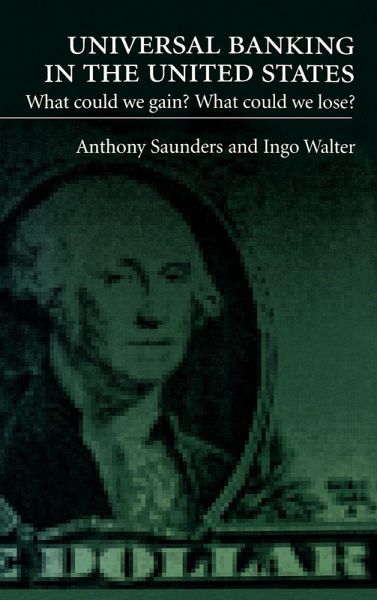
In 1933 and 1956, the United States sharply limited the kinds of securities, commercial, and insurance activities banks could engage in. These regulations remain in place despite profound changes in the economic environment, in the structure of the national and international financial markets, and in technology. This book evaluates the case for and against eliminating these barriers. The authors study the consequences of bank regulation in the US as it relates to competition in international financial markets. They examine universal banking systems in other countries, especially Germany, Switzerland, and the UK, and how they work. They then apply the lessons to US banking, paying particular attention to the benchmarks of stability, equity, efficiency, and competitiveness against which the performance of national financial systems should be measured. They propose a level playing field on which any number of forms of organization can grow in the financial services sector, in which universal banking is one of the permitted structures, and where regulation is linked to function.
The purpose of this book is to evaluate the case for and against eliminating the barriers that have so long existed between banking and other types of financial services in the U.S. Universal banking systems in other countries are examined.
The purpose of this book is to evaluate the case for and against eliminating the barriers that have so long existed between banking and other types of financial services in the U.S. Universal banking systems in other countries are examined.