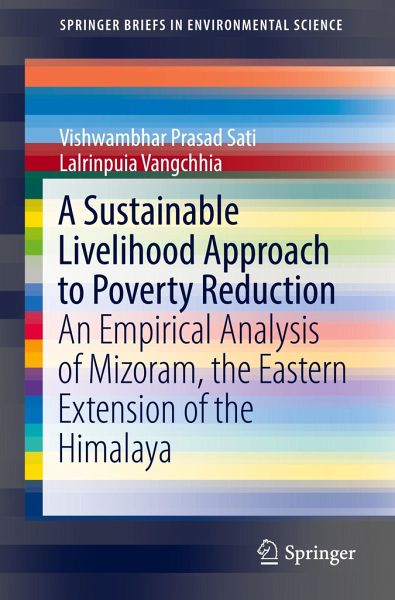
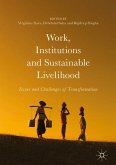
This book presents a socio-economic and livelihood analysis of agriculturally-dependent communities of Mizoram, the eastern extension of the Himalaya, using the sustainable livelihood approach. Such an approach to poverty reduction is inevitable, particularly, in areas where livelihoods depend largely on biomass-based agriculture and livestock production. Mizoram possesses abundant natural resources - land, water and forest - but those resources are largely unused. The region suffers from chronic poverty and malnutrition, and climate change has further influenced livelihood patterns. This work…mehr
This book presents a socio-economic and livelihood analysis of agriculturally-dependent communities of Mizoram, the eastern extension of the Himalaya, using the sustainable livelihood approach. Such an approach to poverty reduction is inevitable, particularly, in areas where livelihoods depend largely on biomass-based agriculture and livestock production. Mizoram possesses abundant natural resources - land, water and forest - but those resources are largely unused. The region suffers from chronic poverty and malnutrition, and climate change has further influenced livelihood patterns. This work studies all the aspects of natural potentials and livelihood status in Mizoram. It also discusses the major driving forces that influence livelihood patterns. Based on a detailed analysis of empirical data, several policy measures are suggested to cope with chronic poverty and malnutrition. The book is therefore highly useful for all stakeholders; students, researchers, academicians, policymakers and politicians involved in rural/community development.
Vishwambhar Prasad Sati (b. 1966), D.Litt. and Ph.D., a Senior Professor of Geography and Resource Management, is currently working at the Mizoram University (A Central University), Aizawl, India. With a teaching career of about three decades, he has served in several higher education institutions within and outside India, some of them being 'Eritrea Institute of Technology', Asmara, Eritrea (NE Africa), 'Institute of Mountain Hazards and Environment', Chengdu, China, 'Madhya Pradesh Higher Education', and 'HNB Garhwal University', Srinagar Garhwal. In the same field, he has deeply been involved in research, and has worked as a Visiting Professor and Visiting Scholar in the world's various renowned research and academic institutions, including 'The World Academy of Sciences', 'Chinese Academy of Sciences', 'Indian National Science Academy', 'Indian Council of Social Science Research', and 'Indian Institute of Advanced Studies'. Currently, he is a Senior Global Fellow of the Grassroots Institute, Canada. Besides, he has travelled widely - 40 countries and all over India. He has impactful expertise in the fields of Natural Resource Management, Environment-Development Interface, Climate Change, Rural Livelihoods, Disaster-Related issues, and Culture of the Himalayan region. He has developed several models and action plans for environmental conservation and economic development of the fragile Himalayan ecosystems/landscapes. More than a dozen of national individual projects and projects with international collaboration have been conducted by him. With more than 180 research papers and articles, and about three dozen books published, his academic contribution is well-documented at national and international levels.
Inhaltsangabe
Preface.- List of Tables.- List of Figures.-Acronym and Abbreviation .-List of Illustration.- Chapter 1.- Introduction.- Chapter 2.- Geographical Backdrop and Sustainable Livelihoods.- Chapter 3.-Geo-Strategic Location.- Chapter 4.- Population and Socio-Economic Development.- Chapter 5.-Agriculture and Livestock Farming.- Chapter 6.- Livelihood Analysis.- Chapter 7.- Climate Change: People's Perception, Adaptation and Resilience.- Chapter 8.- Food Security and Poverty.- Chapter 9.- Sustainable Livelihood Approach to Poverty Reduction.- Chapter 10.- Illustrations: Natural and Cultural Landscapes.- Chapter 11.- Conclusion.- Appendices (I, II, III).
Preface.- List of Tables.- List of Figures.-Acronym and Abbreviation .-List of Illustration.- Chapter 1.- Introduction.- Chapter 2.- Geographical Backdrop and Sustainable Livelihoods.- Chapter 3.-Geo-Strategic Location.- Chapter 4.- Population and Socio-Economic Development.- Chapter 5.-Agriculture and Livestock Farming.- Chapter 6.- Livelihood Analysis.- Chapter 7.- Climate Change: People's Perception, Adaptation and Resilience.- Chapter 8.- Food Security and Poverty.- Chapter 9.- Sustainable Livelihood Approach to Poverty Reduction.- Chapter 10.- Illustrations: Natural and Cultural Landscapes.- Chapter 11.- Conclusion.- Appendices (I, II, III).
Es gelten unsere Allgemeinen Geschäftsbedingungen: www.buecher.de/agb
Impressum
www.buecher.de ist ein Internetauftritt der buecher.de internetstores GmbH
Geschäftsführung: Monica Sawhney | Roland Kölbl | Günter Hilger
Sitz der Gesellschaft: Batheyer Straße 115 - 117, 58099 Hagen
Postanschrift: Bürgermeister-Wegele-Str. 12, 86167 Augsburg
Amtsgericht Hagen HRB 13257
Steuernummer: 321/5800/1497
USt-IdNr: DE450055826