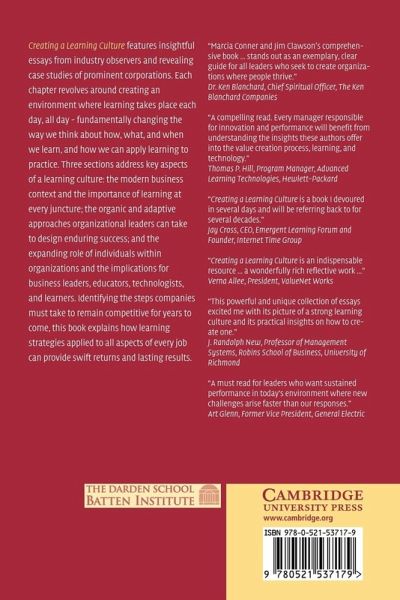
Chapters on strategy, practice, and technology demonstrate how to achieve immediate lasting results by encouraging curiosity and learning at all levels of the organization. Profiles of organizations (including General Motors, Home Depot, and WD-40 Company) using learning-focused approaches, accompany leading-edge research into how and why people best work together when learning as they work. This book is intended for business leaders and educators seeking innovative approaches to cultural transformation, with learning at the center of their corporate strategy.
Chapters on strategy, practice, and technology demonstrate how to achieve immediate lasting results by encouraging curiosity and learning at all levels of the organization. Profiles of organizations (including General Motors, Home Depot, and WD-40 Company) using learning-focused approaches, accompany leading-edge research into how and why people best work together when learning as they work. This book is intended for business leaders and educators seeking innovative approaches to cultural transformation, with learning at the center of their corporate strategy.
James G. Clawson is Professor at the Darden Graduate School of Business Administration, University of Virginia. He is the author of Self-Assessment and Career Development, An MBA's guide to Self-Assessment and Career Development, and Level Three Leadership: Getting Below the Surface. Marcia Conner is managing director of Ageless Learner, a think-tank and advisory services practice and a fellow of the Batten Institute, Darden Graduate School of Business Administration, University of Virginia. She is the author of Learn More Now: 10 Simple Steps to Learning Better, Smarker, and Faster (2004).
Inhaltsangabe
Foreword Douglas K. Smith; Introduction John Seely Brown and Estee Solomon Gray; Part I. Perspectives on a Changing World: 1. Leading and learning with nobody in charge Harlan Cleveland; 2. Our world as a learning system: a communities-of-practice approach William M. Snyder and Etienne Wenger; 3. Developing talent in a highly regulated industry Karen Kocher; 4. The invisible dogma Mitch Ratcliffe; 5. Looking back on technology to look forward on collaboration and learning David Grebow; 6. Using measurement to foster culture and sustainable growth Laurie Bassi, Karen L. McGraw and Dan McMurrer; Part II. Adaptive Approaches to Organizational Design: 7. Innovative cultures and adaptive organizations Edgar H. Schein; 8. A relational view of learning: how who you know affects what you know Rob Cross, Lisa Abrams and Andrew Parker; 9. Improved performance: that's our diploma Wendy L. Coles; 10. The real and appropriate role of technology to create a learning culture Marc J. Rosenberg; 11. The agility factor Eileen Clegg and Clark N. Quinn; 12. Tools and methods to support learning networks Dori Digenti; Part III. Expanding Individual Responsibility: 13. Envisioning a learning culture: history, self-governing citizens, and no dancing elephants Brook Manville; 14. Individual competencies and partnerships: the primary cultural influencers Brenda Wilkins; 15. Learning culture in a global context Gunnar Brückner; 16. Learning in the company of maniacs Garry O. Ridge; 17. Trust, identity, reputation, and learning in organizations Cliff Figallo; Afterword Marcia L. Conner and James G. Clawson; Index.
Foreword Douglas K. Smith; Introduction John Seely Brown and Estee Solomon Gray; Part I. Perspectives on a Changing World: 1. Leading and learning with nobody in charge Harlan Cleveland; 2. Our world as a learning system: a communities-of-practice approach William M. Snyder and Etienne Wenger; 3. Developing talent in a highly regulated industry Karen Kocher; 4. The invisible dogma Mitch Ratcliffe; 5. Looking back on technology to look forward on collaboration and learning David Grebow; 6. Using measurement to foster culture and sustainable growth Laurie Bassi, Karen L. McGraw and Dan McMurrer; Part II. Adaptive Approaches to Organizational Design: 7. Innovative cultures and adaptive organizations Edgar H. Schein; 8. A relational view of learning: how who you know affects what you know Rob Cross, Lisa Abrams and Andrew Parker; 9. Improved performance: that's our diploma Wendy L. Coles; 10. The real and appropriate role of technology to create a learning culture Marc J. Rosenberg; 11. The agility factor Eileen Clegg and Clark N. Quinn; 12. Tools and methods to support learning networks Dori Digenti; Part III. Expanding Individual Responsibility: 13. Envisioning a learning culture: history, self-governing citizens, and no dancing elephants Brook Manville; 14. Individual competencies and partnerships: the primary cultural influencers Brenda Wilkins; 15. Learning culture in a global context Gunnar Brückner; 16. Learning in the company of maniacs Garry O. Ridge; 17. Trust, identity, reputation, and learning in organizations Cliff Figallo; Afterword Marcia L. Conner and James G. Clawson; Index.
Es gelten unsere Allgemeinen Geschäftsbedingungen: www.buecher.de/agb
Impressum
www.buecher.de ist ein Internetauftritt der buecher.de internetstores GmbH
Geschäftsführung: Monica Sawhney | Roland Kölbl | Günter Hilger
Sitz der Gesellschaft: Batheyer Straße 115 - 117, 58099 Hagen
Postanschrift: Bürgermeister-Wegele-Str. 12, 86167 Augsburg
Amtsgericht Hagen HRB 13257
Steuernummer: 321/5800/1497
USt-IdNr: DE450055826