


Andere Kunden interessierten sich auch für
 Music as a Science of Mankind in Eighteenth-Century Britain177,99 €
 Felice Giardini and Professional Music Culture in Mid-Eighteenth-Century London28,99 €
 Music in Eighteenth-Century England46,99 €
 The Career of an Eighteenth-Century Kapellmeister155,99 €
 Music at Oxford in the Eighteenth and Nineteenth Centuries226,99 €
 The Cambridge History of Eighteenth-Century Music262,99 €
 Music in Spain During the Eighteenth Century49,99 €
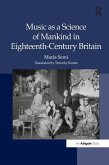


Music as a Science of Mankind offers a philosophical and historical perspective on the intellectual representation of music in British eighteenth-century culture. From the field of natural philosophy, involving the science of sounds and acoustics, to the realm of imagination, involving resounding music and art, the branches of modern culture that were involved in the intellectual tradition of the science of music proved to be variously appealing to men of letters. Among these, a particularly rich field of investigation was the British philosophy of the mind and of human understanding, developed between the seventeenth and eighteenth centuries, which looked at music and found in its realm a way of understanding human experience. Focussing on the world of sensation - trying to describe how the human mind could develop ideas and emotions by its means - philosophers and physicians often took their cases from art's products, be it music (sounds), painting (colours) or poetry (words assigns of sound conveying a meaning), thus looking at art from a particular point of view: that of the perceiving mind. The relationship between music and the philosophies of mind is presented here as a significant part of the construction of a Science of Man: a huge and impressive 'project' involving both the study of man's nature, to which - in David Hume's words - 'all sciences have a relation', and the creation of an ideal of what Man should be. Maria Semi sheds light on how these reflections moved towards a Science of Music: a complex and articulated vision of the discipline that was later to be known as 'musicology'; or Musikwissenschaft.
'I recommend this book to a wide audience... absolutely engrossing and satisfying.' Early Music America 'Two significant questions posed by Semi's new book are, to what extent does speculation on music enter into this scientific discourse, and in what way does the art of music itself participate in and contribute to the overall project? These are important but underexplored issues, one reason being that, for the most part, historians of eighteenth-century British science and philosophy have not considered music as part of their intellectual remit. In my view, this book certainly shows that they should.' British Journal for the History of Science '... an interesting and welcome synthesis of British eighteenth century theories of music.' Journal for Eighteenth-Century Studies