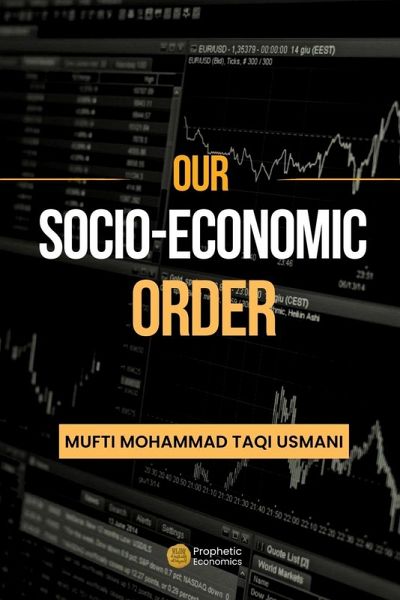
In "Our Socio-Economic Order," renowned Islamic scholar Justice Mufti Mohammad Taqi Usmani offers a comprehensive exploration of the economic challenges facing the Muslim world and presents an Islamic framework for addressing these issues. Drawing on his extensive scholarship and practical insights, Usmani delves into the principles of Islamic economics, critiques contemporary socio-economic systems, and proposes practical solutions rooted in Islamic teachings. This book is an essential read for anyone interested in understanding how Islamic principles can be applied to modern economic…mehr
In "Our Socio-Economic Order," renowned Islamic scholar Justice Mufti Mohammad Taqi Usmani offers a comprehensive exploration of the economic challenges facing the Muslim world and presents an Islamic framework for addressing these issues. Drawing on his extensive scholarship and practical insights, Usmani delves into the principles of Islamic economics, critiques contemporary socio-economic systems, and proposes practical solutions rooted in Islamic teachings. This book is an essential read for anyone interested in understanding how Islamic principles can be applied to modern economic problems to achieve justice, equity, and prosperity.For the past twenty-three years, I have been writing on the new problems that keep coming up in our present age and their solution. Most of these thoughts have been published in the monthly Al Balagh. Fifteen years back a collection of these articles running over 750 pages was published under the title, *Asr e Hazir Mein Islam Kaise Nafiz Ho* (How May Islam Be Implemented in the Present Times).Later, I had occasion to write on other aspects of the same topic and my friends desired that these should also be included in the same book but as this would make it too cumbersome to benefit by, I decided to publish them in a separate volume. Besides, as the articles dealt with different subjects, such as politics, law, education, personal reconstruction, etc., a reader interested only in one of them would have to purchase the larger edition.Accordingly, I have prepared separate volumes for different subjects. They are: Implementation of Shariah and Connected Problems; Islam and Present Day Politics; Islam and Modernism; Our Educational System; The Individual's Reconstruction; A Life of the Holy Prophet ¿; Social Reconstruction; Our Socio-Economic Order; Muslims and Qadianiet.Of these nine collections, the present one is *Our Socio-Economic Order*. I pray Allah that it may prove useful for Muslims everywhere, and for this humble servant a source of salvation in the Hereafter! Aameen!!This book introduces the need for economic improvements within an Islamic framework and outlines the Ulema's plan for addressing contemporary economic problems. It discusses socialism in relation to poverty, democracy, and economic equality, while also addressing socialist objections from an Islamic perspective. Furthermore, it proposes practical agricultural reforms and explores the intricacies of interest and banking, including interest-free banking solutions, interest-free counters, and new schemes for Musharika (Co-Sharing).With its rich insights and practical recommendations, "Our Socio-Economic Order" is a vital resource for those looking to understand and implement Islamic economic principles in today's world. Justice Mufti Mohammad Taqi Usmani's scholarly approach and clear articulation make this book a compelling read for scholars, students, and anyone interested in the intersection of Islam and modern economic challenges.
Mufti Mohammad Taqi Usmani stands as one of the most authoritative and influential Islamic scholars of the modern era, combining deep traditional learning with sophisticated engagement with contemporary challenges. Born on October 5, 1943, in Deoband, India, he received rigorous training in classical Islamic sciences and modern disciplines, uniquely positioning him to address the intersection of Shariʿah principles with complex modern systems.
After completing his studies at Dar al-ʿUlum Karachi under his father, the renowned Grand Mufti Muhammad Shafi, he pursued advanced studies in Arabic literature and earned a law degree, subsequently practicing as an advocate before Pakistan's High Court. His legal career culminated in appointment to the Shariʿah Appellate Bench of the Supreme Court of Pakistan (19822002), where he adjudicated cases involving the compatibility of Pakistani laws with Islamic principles.
Mufti Usmani's scholarly contributions span over 150 books in Urdu, Arabic, and English, covering jurisprudence (fiqh), Qurʾanic exegesis (tafsir), hadith sciences, Islamic spirituality (ta?awwuf), and contemporary issues. His works on Islamic economics and finance have provided core intellectual foundations for the global Islamic finance industry. He has chaired the Shariʿah boards of numerous Islamic financial institutions worldwide and served as chairman of the International Islamic Fiqh Academy of the Organization of Islamic Cooperation.
Beyond academic contributions, Mufti Usmani founded several educational institutions and regularly teaches advanced jurisprudence at Dar al-ʿUlum Karachi. His classes attract students from across the Muslim world seeking traditional Islamic learning integrated with contemporary relevance. He has lectured extensively on five continents, addressing both Muslim and Western audiences on Islam's perspective regarding contemporary economic, social, and ethical questions.
His approach balances adherence to classical Islamic legal methodology with recognition of contemporary realities, neither compromising fundamental principles nor ignoring practical necessities. This methodology appears prominently in Our Socio-Economic Order, where he critiques both capitalism and socialism while presenting Islamic alternatives grounded in Qurʾan, Sunnah, and centuries of jurisprudential development. His work demonstrates that authentic Islam offers practical solutions to economic injustice without importing alien ideologies.
Mufti Usmani's influence extends beyond scholarship to policy impact. His recommendations have shaped Islamic banking regulations in multiple countries, and his Shariʿah opinions are sought by governments, central banks, and international financial institutions. His combination of traditional ʿulamaʾ credentials, modern legal expertise, and practical wisdom makes him an unparalleled voice on how Islamic teachings address humanity's struggles with economic justice, social welfare, and ethical governance.
Es gelten unsere Allgemeinen Geschäftsbedingungen: www.buecher.de/agb
Impressum
www.buecher.de ist ein Internetauftritt der buecher.de internetstores GmbH
Geschäftsführung: Monica Sawhney | Roland Kölbl | Günter Hilger
Sitz der Gesellschaft: Batheyer Straße 115 - 117, 58099 Hagen
Postanschrift: Bürgermeister-Wegele-Str. 12, 86167 Augsburg
Amtsgericht Hagen HRB 13257
Steuernummer: 321/5800/1497
USt-IdNr: DE450055826