

Andere Kunden interessierten sich auch für
 The Coronavirus Pandemic of 202033,99 €
 Sociology of Religion171,99 €
 Consumerism and the Movement of Housewives into Wage Work47,99 €
 The Pandemic in Central Europe56,99 €
 Pandemic of Perspectives57,99 €
 Trends and Issues in Housing in Asia55,99 €
 Essays on Covid-1919,99 €







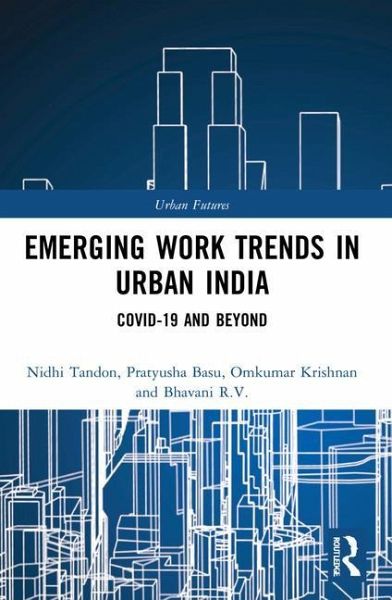
This book offers an overview of India's emerging digital economy and the resulting challenges and opportunities for urban workplaces. It examines contemporary economic and social transformations in India by focusing on how new technologies and policies are shaping urban work practices and patterns. The book emphasizes inclusive and equitable practices that consider the needs of the formal and informal sector workforce as essential to India's urban development. Drawing on cross-disciplinary frameworks, it examines key issues related to work trends in the Indian urban economy and its digital landscapes, including Industry 4.0 and technology-labour nexus, smart cities and innovation, urbanism and consumerism, workplace transitions such as service industry and remote work, digital divide, skill development initiatives, and the impact of socio-economic inequalities and disruptions. The authors provide perspectives on the digital future of urban work in India and other emerging economies in the post-COVID-19 phase, and underscore the importance of enacting balanced policies, remodelling institutions, and equipping the labour force for adapting to new demands related to future employability and investments. This book will interest students, teachers, and researchers of urban studies, urban sociology, sociology of work, labour studies, human and urban geography, economic geography, urban economics, development studies, urban development and planning, public policy, regional planning, politics of urban development, social and cultural change, urban sustainability, environmental studies, management studies, South Asian Studies, and Global South studies. It will also be useful to policymakers, non-governmental organizations, activists, and those interested in India and the future of the global economy.
"Emerging Work Trends in India: COVID-19 and Beyond is a brilliantly written book capturing the changing dynamics of the workspace in India. It critically and objectively describes the challenges during and after this public health crisis and how it is going to change the landscape in time to come in one of the world's most culturally diverse and vibrant countries. It is a very insightful groundwork that explains the complex interplay of the social, political, and economic factors and their impact on society at large in the given situation."
Ranjeet S Ajmani, Chief Executive Officer, PlasmaGen BioSciences, Bangalore, India
"A much-needed recipe to learn the changing trends of work towards automation. It spans the entire gamut of manufacturing to services and the need for digitalisation while addressing the socio-political and cultural barriers."
Bhavik Kumar, Founder & CEO, Medibox, India
"The Covid-19 pandemic has intersected with ongoing digital technology led economic transformations to bring about serious disruptions to work, livelihoods, incomes, and inequalities across rural and urban India. This book offers a comprehensive and inter-disciplinary overview of the precarity, fissures, and exclusions brought about by these ongoing changes. Focusing on the formal and informal sectors, on issues related to skills, gender nature of impacts, and rural-urban divides, and the "the digitalisation of the urban", the volume thoroughly analyses impacts of technology on work and work force to yield significant policy recommendations that address the future of work, and the way forward for reducing inequalities."
D. Parthasarathy, Professor, Department of Humanities and Social Sciences, Indian Institute of Technology Bombay, Mumbai, India
Ranjeet S Ajmani, Chief Executive Officer, PlasmaGen BioSciences, Bangalore, India
"A much-needed recipe to learn the changing trends of work towards automation. It spans the entire gamut of manufacturing to services and the need for digitalisation while addressing the socio-political and cultural barriers."
Bhavik Kumar, Founder & CEO, Medibox, India
"The Covid-19 pandemic has intersected with ongoing digital technology led economic transformations to bring about serious disruptions to work, livelihoods, incomes, and inequalities across rural and urban India. This book offers a comprehensive and inter-disciplinary overview of the precarity, fissures, and exclusions brought about by these ongoing changes. Focusing on the formal and informal sectors, on issues related to skills, gender nature of impacts, and rural-urban divides, and the "the digitalisation of the urban", the volume thoroughly analyses impacts of technology on work and work force to yield significant policy recommendations that address the future of work, and the way forward for reducing inequalities."
D. Parthasarathy, Professor, Department of Humanities and Social Sciences, Indian Institute of Technology Bombay, Mumbai, India