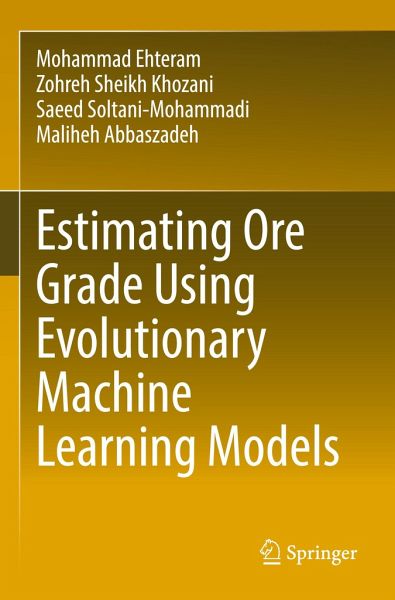
This book examines the abilities of new machine learning models for predicting ore grade in mining engineering. A variety of case studies are examined in this book. A motivation for preparing this book was the absence of robust models for estimating ore grade. Models of current books can also be used for the different sciences because they have high capabilities for estimating different variables. Mining engineers can use the book to determine the ore grade accurately. This book helps identify mineral-rich regions for exploration and exploitation. Exploration costs can be decreased by using…mehr
This book examines the abilities of new machine learning models for predicting ore grade in mining engineering. A variety of case studies are examined in this book. A motivation for preparing this book was the absence of robust models for estimating ore grade. Models of current books can also be used for the different sciences because they have high capabilities for estimating different variables. Mining engineers can use the book to determine the ore grade accurately. This book helps identify mineral-rich regions for exploration and exploitation. Exploration costs can be decreased by using the models in the current book. In this book, the author discusses the new concepts in mining engineering, such as uncertainty in ore grade modeling. Ensemble models are presented in this book to estimate ore grade. In the book, readers learn how to construct advanced machine learning models for estimating ore grade. The authors of this book present advanced and hybrid models used to estimate oregrade instead of the classic methods such as kriging. The current book can be used as a comprehensive handbook for estimating ore grades. Industrial managers and modelers can use the models of the current books. Each level of ore grade modeling is explained in the book. In this book, advanced optimizers are presented to train machine learning models. Therefore, the book can also be used by modelers in other fields. The main motivation of this book is to address previous shortcomings in the modeling process of ore grades. The scope of this book includes mining engineering, soft computing models, and artificial intelligence.
Mohammad Ehtearm is a researcher in artificial intelligence. He has a Ph.D. in Computer Science and a Ph.D. in Civil Engineering. His previous positions include a visiting and post-doctoral researcher at university of different universities of Canada, USA, and Poland, a manager of dam and irrigation project, manager of rehabilitation of dam and expert of stability, monitoring, and operation of dams in Isfahan Regional Water (2014-2016), a lecturer in Islamic Azad University, Kashan, Iran (2016-2018), and a manager of different projects of artificial intelligence of Iran including finding optimal location of mines and grade estimation of raw materials. His research interests generally lie in the areas application of remote sensing in water resources, water, energy, and food nexus, sustainable water resources development, extreme hydrological events, river engineering, remote sensing in water resources, dam and hydropower operation, geotechnical engineering, mining engineering, and artificial intelligence, and remote sensing in mining engineering. Akram Seifi is an associate professor at Water and Science Engineering Department of Vali-e-Asr University of Rafsanjan, Iran, with broad research interests in environmental science, water quality, and drip irrigation management, with a particular focus on artificial intelligence modeling. She holds a Ph.D. and M.Sc. degrees on Irrigation and Drainage Engineering from the Tarbiat Modares University, Tehran. Fatemeh Barzegari Banadkooki is an assistant professor at Agricultural Department, Payame Noor University, Tehran, Iran, with broad research interests in environmental science, water quality, and water resource management, with a particular focus on artificial intelligence modeling. She holds a Ph.D. on Watershed Management Science from the Yazd University, Yazd.
Inhaltsangabe
Explains the importance of ore grade estimation.- Reviews machine learning models for ore grade estimation.- Explains the structure of different kinds of machine learning models.- Explains different training algorithms and optimization algorithms. This chapter also explains the structure of evolutionary machine learning models.- Explains the Bayesian model averaging and multilayer perceptron networks for estimating AL2O3 grade in a mine.- Explains the structure of inclusive multiple models and optimized radial basis function neural networks for estimating Sio2 grade in a mine.- Explains the application of hybrid kriging and extreme learning machine models for estimating copper ore grade in a mine.- Explains the application of optimized group machine data handling, support vector machines, and Adaptive neuro-fuzzy interface systems for estimating iron ore grade in mines.- Presents the conclusion, general comments, and suggestions for the next books.
Explains the importance of ore grade estimation.- Reviews machine learning models for ore grade estimation.- Explains the structure of different kinds of machine learning models.- Explains different training algorithms and optimization algorithms. This chapter also explains the structure of evolutionary machine learning models.- Explains the Bayesian model averaging and multilayer perceptron networks for estimating AL2O3 grade in a mine.- Explains the structure of inclusive multiple models and optimized radial basis function neural networks for estimating Sio2 grade in a mine.- Explains the application of hybrid kriging and extreme learning machine models for estimating copper ore grade in a mine.- Explains the application of optimized group machine data handling, support vector machines, and Adaptive neuro-fuzzy interface systems for estimating iron ore grade in mines.- Presents the conclusion, general comments, and suggestions for the next books.
Es gelten unsere Allgemeinen Geschäftsbedingungen: www.buecher.de/agb
Impressum
www.buecher.de ist ein Internetauftritt der buecher.de internetstores GmbH
Geschäftsführung: Monica Sawhney | Roland Kölbl | Günter Hilger
Sitz der Gesellschaft: Batheyer Straße 115 - 117, 58099 Hagen
Postanschrift: Bürgermeister-Wegele-Str. 12, 86167 Augsburg
Amtsgericht Hagen HRB 13257
Steuernummer: 321/5800/1497
USt-IdNr: DE450055826