C. Anandharamakrishnan, Jeyan A. Moses, P. Santhoshkumar
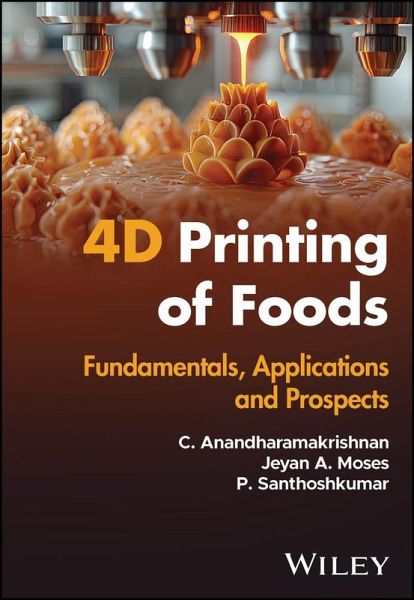
4D Printing of Foods (eBook, ePUB)
Fundamentals, Applications and Prospects
157,99 €
157,99 €
inkl. MwSt.
Sofort per Download lieferbar
0 °P sammeln
157,99 €
Als Download kaufen
157,99 €
inkl. MwSt.
Sofort per Download lieferbar
0 °P sammeln
Jetzt verschenken
Alle Infos zum eBook verschenken
157,99 €
inkl. MwSt.
Sofort per Download lieferbar
Alle Infos zum eBook verschenken
0 °P sammeln
C. Anandharamakrishnan, Jeyan A. Moses, P. Santhoshkumar
4D Printing of Foods (eBook, ePUB)
Fundamentals, Applications and Prospects
- Format: ePub
- Merkliste
- Auf die Merkliste
- Bewerten Bewerten
- Teilen
- Produkt teilen
- Produkterinnerung
- Produkterinnerung

Bitte loggen Sie sich zunächst in Ihr Kundenkonto ein oder registrieren Sie sich bei
bücher.de, um das eBook-Abo tolino select nutzen zu können.
Hier können Sie sich einloggen
Sie sind bereits eingeloggt. Klicken Sie auf 2. tolino select Abo, um fortzufahren.

Bitte loggen Sie sich zunächst in Ihr Kundenkonto ein oder registrieren Sie sich bei bücher.de, um das eBook-Abo tolino select nutzen zu können.
An up-to-date and authoritative discussion of 4D food printing and its applications
In 4D Printing of Foods: Fundamentals, Applications and Prospects, a team of distinguished researchers deliver a comprehensive discussion of the fundamentals of food printing approaches, introducing the concept of 4D printing. The book highlights 4D printing's application to the food industry and explains the principles and methodologies involved.
Readers will explore stimulus and material design, modeling and simulation. The authors introduce the global knowledge-base in 4D printing technology and…mehr
- Geräte: eReader
- mit Kopierschutz
- eBook Hilfe
- Größe: 15.9MB
Andere Kunden interessierten sich auch für
C. Anandharamakrishnan3D Printing of Foods (eBook, ePUB)179,99 €
Milk and Dairy Products as Functional Foods (eBook, ePUB)151,99 €
Trait-Modified Oils in Foods (eBook, ePUB)153,99 €
Microbial Functional Foods and Nutraceuticals (eBook, ePUB)139,99 €
Formulation Engineering of Foods (eBook, ePUB)152,99 €
Encapsulation and Controlled Release Technologies in Food Systems (eBook, ePUB)157,99 €
Amos NussinovitchAdhesion in Foods (eBook, ePUB)134,99 €-
-
-
An up-to-date and authoritative discussion of 4D food printing and its applications
In 4D Printing of Foods: Fundamentals, Applications and Prospects, a team of distinguished researchers deliver a comprehensive discussion of the fundamentals of food printing approaches, introducing the concept of 4D printing. The book highlights 4D printing's application to the food industry and explains the principles and methodologies involved.
Readers will explore stimulus and material design, modeling and simulation. The authors introduce the global knowledge-base in 4D printing technology and application sectors, and then elaborate on stimulus responsiveness of food, highlighting the scope and approaches to transformations in shape, color, nutritive value, texture, flavor, aroma and cell growth. Key highlights include:
Perfect for food engineers, 4D Printing of Foods will also benefit other professionals working in biomaterials, sensory science, gastronomy, and digitalized food manufacturing.
In 4D Printing of Foods: Fundamentals, Applications and Prospects, a team of distinguished researchers deliver a comprehensive discussion of the fundamentals of food printing approaches, introducing the concept of 4D printing. The book highlights 4D printing's application to the food industry and explains the principles and methodologies involved.
Readers will explore stimulus and material design, modeling and simulation. The authors introduce the global knowledge-base in 4D printing technology and application sectors, and then elaborate on stimulus responsiveness of food, highlighting the scope and approaches to transformations in shape, color, nutritive value, texture, flavor, aroma and cell growth. Key highlights include:
- A thorough introduction to physical, chemical and biological stimuli
- Practical discussions of 4D printing technology, including bibliometric analyses of the state-of-the-art
- Case studies on consumer preferences for food printing technologies
- Prospective applications in 4D, 5D, 6D and 7D printing technologies
Perfect for food engineers, 4D Printing of Foods will also benefit other professionals working in biomaterials, sensory science, gastronomy, and digitalized food manufacturing.
Dieser Download kann aus rechtlichen Gründen nur mit Rechnungsadresse in D ausgeliefert werden.
Produktdetails
- Produktdetails
- Verlag: John Wiley & Sons
- Seitenzahl: 596
- Erscheinungstermin: 12. November 2025
- Englisch
- ISBN-13: 9781394305254
- Artikelnr.: 75898550
- Verlag: John Wiley & Sons
- Seitenzahl: 596
- Erscheinungstermin: 12. November 2025
- Englisch
- ISBN-13: 9781394305254
- Artikelnr.: 75898550
- Herstellerkennzeichnung Die Herstellerinformationen sind derzeit nicht verfügbar.
C. Anandharamakrishnan, PhD, is Director, CSIR - National Institute for Interdisciplinary Science and Technology (NIIST), India.
Jeyan A. Moses, PhD, is an Assistant Professor at the National Institute of Food Technology, Entrepreneurship and Management - Thanjavur (NIFTEM -T), India.
P. Santhoshkumar is a PhD researcher at the University of Foggia, Italy.
Jeyan A. Moses, PhD, is an Assistant Professor at the National Institute of Food Technology, Entrepreneurship and Management - Thanjavur (NIFTEM -T), India.
P. Santhoshkumar is a PhD researcher at the University of Foggia, Italy.
Preface xi
1 Introduction to Food Printing Technology 1
1.1 Introduction 1
1.2 Advances in Food Customization 2
1.2.1 Customization Approaches 3
1.3 Additive Manufacturing and 3D Printing 5
1.4 Fundamental Concepts of 3D Food Printing 6
1.5 Nomenclature/Terminologies Related to Food Printing 7
1.6 Food Printability 9
1.6.1 Materials Classification 9
1.7 3D Food Printing Types 11
1.7.1 Extrusion-Based 3D Printing 11
1.7.2 Inkjet 3D Printing 14
1.7.3 Binder Jetting 16
1.7.4 Selective Sintering 16
1.7.5 Bioprinting 17
1.7.6 Others 17
1.8 Hardware Requirements and 3D Printer Configurations 18
1.9 Software Requirements 18
1.10 Conclusion 19
References 20
2 3D Food Printing and Emerging Applications 27
2.1 Introduction 27
2.2 Emerging Concepts in 3D Food Printing 28
2.2.1 Multimaterial Printing 29
2.2.1.1 Dual/Multinozzle Axial Printing 29
2.2.1.2 Coaxial Nozzle Printing 31
2.3 Application Segments -3D Food Printing 33
2.3.1 Personalizing Nutrients and Nutraceuticals 33
2.3.2 Customizing Appearance 34
2.3.3 Customizing Release of Target Molecules 35
2.3.4 Healthier Food Options 36
2.3.5 Foods for Special Needs 37
2.3.6 Consumer Requirements: Conveniences and Variety 38
2.3.7 Toward Waste Valorization and Cleaner Production 39
2.3.8 Improving Food Packaging 40
2.4 Conclusion 40
References 41
3 Postprinting and Postprocessing: Need, Methods, and Quality Assessment
49
3.1 Introduction 49
3.2 Postprinting Stability and Applicability 50
3.3 Postprocessing Methods and Impact on Quality 52
3.4 Approaches for Quality Assessment 55
3.4.1 Texture and Color Assessment 55
3.4.2 Dimensional Assessment 55
3.4.3 Sensory Evaluation 56
3.4.4 Image Analysis 57
3.4.5 Computer-Assisted Quality Evaluation 59
3.4.6 Microstructure Imaging 61
3.4.7 Structural Stability Assessment 63
3.5 Challenges and Future Needs 64
3.6 Scope for Four-Dimensional (4D) Printing 64
3.7 Conclusion 65
References 65
4 Fundamentals of 4D Printing Technology 73
4.1 Introduction 73
4.2 Fundamental Concepts and Definitions 74
4.2.1 Stimulus and Material Design 75
4.2.2 Modeling and Simulation 78
4.3 Laws of 4D Printing 78
4.4 Nature-Inspired Concepts in 4D Printing 79
4.5 Materials in 4D Printing 83
4.5.1 Single Material 4D Printing 86
4.5.1.1 Stimulus Responsiveness by Single SME 86
4.5.1.2 Stimulus Responsiveness by Multiple SME 86
4.5.2 Multimaterial 4D Printing 90
4.5.2.1 Materials Used in Multimaterial 4D Prints 93
4.6 Printers in 4D Printing 93
4.6.1 Printer Configurations 94
4.6.2 Printing Variations 94
4.7 Mathematical Modeling in 4D Printing 99
4.8 Current State of the Art 101
4.9 Conclusion 102
References 102
5 Expanding Avenues in 4D Printing Technology 109
5.1 Introduction 109
5.2 Sector-Specific Applications 110
5.2.1 Aerospace and Aeronautics 110
5.2.2 Fashion and Textiles 111
5.2.3 Defense 112
5.2.4 Ceramics and Construction 113
5.2.5 Renewable Energy 113
5.3 Applications in Life Sciences 113
5.3.1 Drug Delivery 115
5.3.2 Tissue Engineering 118
5.3.3 Bioprinting 118
5.3.4 Biomedical and Healthcare 121
5.4 Interdisciplinary Approaches 122
5.4.1 Soft Robotics 122
5.4.2 Sensors and Electronics 123
5.4.3 Microfluidics 125
5.4.4 Material Handling and Transportation 125
5.5 Challenges and Research Needs 127
5.6 Conclusion 127
References 128
6 Printing Foods in the Fourth Dimension 137
6.1 Introduction 138
6.2 From 3D to 4D Printing 139
6.3 Defining 4D Food Printing 139
6.4 Stages in 4D Printing of Foods 141
6.4.1 Preprinting 141
6.4.1.1 Software 141
6.4.1.2 Simulation and Modeling 143
6.4.1.3 Smart/Intelligent Food Materials 145
6.4.2 Printers and Printing Types 152
6.4.3 Postprinting/Processing 152
6.4.3.1 Postprinting Analysis 154
6.4.3.2 Stimulus 155
6.5 Role of Smart/Intelligent Materials in 4D Food Printing 155
6.5.1 Polysaccharides 155
6.5.2 Protein 156
6.5.3 Bioactive Components 157
6.5.4 Lipids 157
6.5.5 Essential Oils 159
6.5.6 Cells 160
6.6 Dynamic/Intelligent Structure Changes in 4D Food 162
6.6.1 Shape 162
6.6.2 Color 163
6.6.3 Nutrients 167
6.6.4 Texture 168
6.6.5 Taste 169
6.6.6 Flavor/Aroma 170
6.6.7 Live Cell Cultures 171
6.7 Application Range - Dynamic/Intelligent Structure Changes 172
6.8 Challenges and Future Aspects in 4D Food Printing 173
6.9 Conclusion 175
References 175
7 Stimuli in 4D Printing of Foods 185
7.1 Introduction 185
7.2 Engineering Structures Through Physical Stimuli 188
7.2.1 Temperature 188
7.2.2 Liquid/Water 190
7.2.3 Radiation and Sound-Assisted Stimuli 191
7.2.4 Prospective Physical Stimuli for 4D Food Printing 192
7.2.4.1 Magnetic Field 192
7.2.4.2 Electric Field 193
7.2.4.3 Optical Field 193
7.3 Engineering Structures Through Chemical Stimuli 195
7.3.1 pH 195
7.3.2 Ionic Concentration 197
7.4 Engineering Structures Through Biological Stimuli 198
7.4.1 Microbes 199
7.4.2 Enzymes 199
7.4.3 Glucose 200
7.5 Stimuli Effects on Smart/Intelligent Materials 201
7.6 Stimuli Effects on Sensory Properties of 4D-Printed Food 201
7.7 Challenges Associated with Stimuli in 4D Food Printing 202
7.8 Conclusion 203
References 204
8 5D, 6D, 7D Printing and Beyond 211
8.1 Introduction 211
8.2 Evolving from 4D Printing -Need and Approaches 214
8.2.1 Smart Materials 215
8.3 5D Printing 217
8.3.1 5D Food Printing 219
8.4 6D Printing 219
8.5 7D Printing 221
8.6 Current Research Status of 5D, 6D, and 7D Printing Technologies 221
8.7 5D and 6D Printer Configurations 222
8.8 5D and 6D Printing: Non-food Applications 222
8.9 5D and 6D Printing: Food Applications 224
8.10 Prospects and Opportunities in 5D, 6D, and 7D Printing 225
8.11 Conclusion 225
References 226
9 Consumer Perception Toward Food Printing Technologies 233
9.1 Introduction 233
9.2 Studies on Consumer Perception of Printed Foods 234
9.2.1 Case Study I: 3D-Printed Snack Bar for Soldiers 239
9.2.2 Case Study II: 3D-Printed Insect-Based Foods and 3D-Printed Meat 240
9.3 Consumer Perception: 3D vs. 4D Food Printing 244
9.4 Consumer Behavior and Food Choices Toward Food Printing 246
9.4.1 Food Neophobia 246
9.4.2 Technology Unfamiliarity 249
9.5 Changing Consumer Dynamics: Increasing Awareness and Popularity 249
9.6 Tools and Approaches for Enhancing Consumer Knowledge 249
9.7 Conclusion 250
References 250
10 Research and Commercialization Status: Food Printing Technologies 255
10.1 Introduction 255
10.2 Bibliometric Analysis -Food Printing Technologies 261
10.2.1 Scientific Publications 261
10.2.1.1 Search Criteria and Database 261
10.2.1.2 Search Approach and Results 263
10.2.2 Patents 270
10.2.2.1 Search Criteria and Database 272
10.2.2.2 Search Results 272
10.3 Research Funding for Food Printing Technologies 273
10.4 Current Commercialization Status and Globalization of Food Printing
Technologies 274
10.5 Techno-feasibility and Challenges 276
10.5.1 Scalability 277
10.5.2 Piracy and Counterfeiting 277
10.5.3 Others 278
10.6 Conclusion 279
References 279
11 Digitalization and the Future of Food Printing Technology 283
11.1 Introduction 283
11.2 Futuristic Applications -4D
Onward Technologies 285
11.2.1 Customized and Tailor-Made Foods 286
11.2.2 Delivery Systems 286
11.2.3 Vending Machines and Personalized Items 287
11.2.4 Kitchen and Restaurant Printing 287
11.2.5 Digital Gastronomy 288
11.2.6 Retail Packaging 289
11.3 Information and Communication Technology (ICT)-Assisted Concepts 289
11.3.1 For Food Preparation 289
11.3.1.1 AI 291
11.3.1.2 Robotic Printing 293
11.3.2 For Advanced Quality Assessment 294
11.3.2.1 Computer Vision 296
11.3.2.2 Sensors 296
11.3.3 For Robust Supply Chains 297
11.3.3.1 Big Data 298
11.3.3.2 Cloud Computing 298
11.3.4 For Consumer Interfacing 299
11.4 Sustainability in Food Printing Technology 300
11.5 Conclusion 301
References 302
Index 311
1 Introduction to Food Printing Technology 1
1.1 Introduction 1
1.2 Advances in Food Customization 2
1.2.1 Customization Approaches 3
1.3 Additive Manufacturing and 3D Printing 5
1.4 Fundamental Concepts of 3D Food Printing 6
1.5 Nomenclature/Terminologies Related to Food Printing 7
1.6 Food Printability 9
1.6.1 Materials Classification 9
1.7 3D Food Printing Types 11
1.7.1 Extrusion-Based 3D Printing 11
1.7.2 Inkjet 3D Printing 14
1.7.3 Binder Jetting 16
1.7.4 Selective Sintering 16
1.7.5 Bioprinting 17
1.7.6 Others 17
1.8 Hardware Requirements and 3D Printer Configurations 18
1.9 Software Requirements 18
1.10 Conclusion 19
References 20
2 3D Food Printing and Emerging Applications 27
2.1 Introduction 27
2.2 Emerging Concepts in 3D Food Printing 28
2.2.1 Multimaterial Printing 29
2.2.1.1 Dual/Multinozzle Axial Printing 29
2.2.1.2 Coaxial Nozzle Printing 31
2.3 Application Segments -3D Food Printing 33
2.3.1 Personalizing Nutrients and Nutraceuticals 33
2.3.2 Customizing Appearance 34
2.3.3 Customizing Release of Target Molecules 35
2.3.4 Healthier Food Options 36
2.3.5 Foods for Special Needs 37
2.3.6 Consumer Requirements: Conveniences and Variety 38
2.3.7 Toward Waste Valorization and Cleaner Production 39
2.3.8 Improving Food Packaging 40
2.4 Conclusion 40
References 41
3 Postprinting and Postprocessing: Need, Methods, and Quality Assessment
49
3.1 Introduction 49
3.2 Postprinting Stability and Applicability 50
3.3 Postprocessing Methods and Impact on Quality 52
3.4 Approaches for Quality Assessment 55
3.4.1 Texture and Color Assessment 55
3.4.2 Dimensional Assessment 55
3.4.3 Sensory Evaluation 56
3.4.4 Image Analysis 57
3.4.5 Computer-Assisted Quality Evaluation 59
3.4.6 Microstructure Imaging 61
3.4.7 Structural Stability Assessment 63
3.5 Challenges and Future Needs 64
3.6 Scope for Four-Dimensional (4D) Printing 64
3.7 Conclusion 65
References 65
4 Fundamentals of 4D Printing Technology 73
4.1 Introduction 73
4.2 Fundamental Concepts and Definitions 74
4.2.1 Stimulus and Material Design 75
4.2.2 Modeling and Simulation 78
4.3 Laws of 4D Printing 78
4.4 Nature-Inspired Concepts in 4D Printing 79
4.5 Materials in 4D Printing 83
4.5.1 Single Material 4D Printing 86
4.5.1.1 Stimulus Responsiveness by Single SME 86
4.5.1.2 Stimulus Responsiveness by Multiple SME 86
4.5.2 Multimaterial 4D Printing 90
4.5.2.1 Materials Used in Multimaterial 4D Prints 93
4.6 Printers in 4D Printing 93
4.6.1 Printer Configurations 94
4.6.2 Printing Variations 94
4.7 Mathematical Modeling in 4D Printing 99
4.8 Current State of the Art 101
4.9 Conclusion 102
References 102
5 Expanding Avenues in 4D Printing Technology 109
5.1 Introduction 109
5.2 Sector-Specific Applications 110
5.2.1 Aerospace and Aeronautics 110
5.2.2 Fashion and Textiles 111
5.2.3 Defense 112
5.2.4 Ceramics and Construction 113
5.2.5 Renewable Energy 113
5.3 Applications in Life Sciences 113
5.3.1 Drug Delivery 115
5.3.2 Tissue Engineering 118
5.3.3 Bioprinting 118
5.3.4 Biomedical and Healthcare 121
5.4 Interdisciplinary Approaches 122
5.4.1 Soft Robotics 122
5.4.2 Sensors and Electronics 123
5.4.3 Microfluidics 125
5.4.4 Material Handling and Transportation 125
5.5 Challenges and Research Needs 127
5.6 Conclusion 127
References 128
6 Printing Foods in the Fourth Dimension 137
6.1 Introduction 138
6.2 From 3D to 4D Printing 139
6.3 Defining 4D Food Printing 139
6.4 Stages in 4D Printing of Foods 141
6.4.1 Preprinting 141
6.4.1.1 Software 141
6.4.1.2 Simulation and Modeling 143
6.4.1.3 Smart/Intelligent Food Materials 145
6.4.2 Printers and Printing Types 152
6.4.3 Postprinting/Processing 152
6.4.3.1 Postprinting Analysis 154
6.4.3.2 Stimulus 155
6.5 Role of Smart/Intelligent Materials in 4D Food Printing 155
6.5.1 Polysaccharides 155
6.5.2 Protein 156
6.5.3 Bioactive Components 157
6.5.4 Lipids 157
6.5.5 Essential Oils 159
6.5.6 Cells 160
6.6 Dynamic/Intelligent Structure Changes in 4D Food 162
6.6.1 Shape 162
6.6.2 Color 163
6.6.3 Nutrients 167
6.6.4 Texture 168
6.6.5 Taste 169
6.6.6 Flavor/Aroma 170
6.6.7 Live Cell Cultures 171
6.7 Application Range - Dynamic/Intelligent Structure Changes 172
6.8 Challenges and Future Aspects in 4D Food Printing 173
6.9 Conclusion 175
References 175
7 Stimuli in 4D Printing of Foods 185
7.1 Introduction 185
7.2 Engineering Structures Through Physical Stimuli 188
7.2.1 Temperature 188
7.2.2 Liquid/Water 190
7.2.3 Radiation and Sound-Assisted Stimuli 191
7.2.4 Prospective Physical Stimuli for 4D Food Printing 192
7.2.4.1 Magnetic Field 192
7.2.4.2 Electric Field 193
7.2.4.3 Optical Field 193
7.3 Engineering Structures Through Chemical Stimuli 195
7.3.1 pH 195
7.3.2 Ionic Concentration 197
7.4 Engineering Structures Through Biological Stimuli 198
7.4.1 Microbes 199
7.4.2 Enzymes 199
7.4.3 Glucose 200
7.5 Stimuli Effects on Smart/Intelligent Materials 201
7.6 Stimuli Effects on Sensory Properties of 4D-Printed Food 201
7.7 Challenges Associated with Stimuli in 4D Food Printing 202
7.8 Conclusion 203
References 204
8 5D, 6D, 7D Printing and Beyond 211
8.1 Introduction 211
8.2 Evolving from 4D Printing -Need and Approaches 214
8.2.1 Smart Materials 215
8.3 5D Printing 217
8.3.1 5D Food Printing 219
8.4 6D Printing 219
8.5 7D Printing 221
8.6 Current Research Status of 5D, 6D, and 7D Printing Technologies 221
8.7 5D and 6D Printer Configurations 222
8.8 5D and 6D Printing: Non-food Applications 222
8.9 5D and 6D Printing: Food Applications 224
8.10 Prospects and Opportunities in 5D, 6D, and 7D Printing 225
8.11 Conclusion 225
References 226
9 Consumer Perception Toward Food Printing Technologies 233
9.1 Introduction 233
9.2 Studies on Consumer Perception of Printed Foods 234
9.2.1 Case Study I: 3D-Printed Snack Bar for Soldiers 239
9.2.2 Case Study II: 3D-Printed Insect-Based Foods and 3D-Printed Meat 240
9.3 Consumer Perception: 3D vs. 4D Food Printing 244
9.4 Consumer Behavior and Food Choices Toward Food Printing 246
9.4.1 Food Neophobia 246
9.4.2 Technology Unfamiliarity 249
9.5 Changing Consumer Dynamics: Increasing Awareness and Popularity 249
9.6 Tools and Approaches for Enhancing Consumer Knowledge 249
9.7 Conclusion 250
References 250
10 Research and Commercialization Status: Food Printing Technologies 255
10.1 Introduction 255
10.2 Bibliometric Analysis -Food Printing Technologies 261
10.2.1 Scientific Publications 261
10.2.1.1 Search Criteria and Database 261
10.2.1.2 Search Approach and Results 263
10.2.2 Patents 270
10.2.2.1 Search Criteria and Database 272
10.2.2.2 Search Results 272
10.3 Research Funding for Food Printing Technologies 273
10.4 Current Commercialization Status and Globalization of Food Printing
Technologies 274
10.5 Techno-feasibility and Challenges 276
10.5.1 Scalability 277
10.5.2 Piracy and Counterfeiting 277
10.5.3 Others 278
10.6 Conclusion 279
References 279
11 Digitalization and the Future of Food Printing Technology 283
11.1 Introduction 283
11.2 Futuristic Applications -4D
Onward Technologies 285
11.2.1 Customized and Tailor-Made Foods 286
11.2.2 Delivery Systems 286
11.2.3 Vending Machines and Personalized Items 287
11.2.4 Kitchen and Restaurant Printing 287
11.2.5 Digital Gastronomy 288
11.2.6 Retail Packaging 289
11.3 Information and Communication Technology (ICT)-Assisted Concepts 289
11.3.1 For Food Preparation 289
11.3.1.1 AI 291
11.3.1.2 Robotic Printing 293
11.3.2 For Advanced Quality Assessment 294
11.3.2.1 Computer Vision 296
11.3.2.2 Sensors 296
11.3.3 For Robust Supply Chains 297
11.3.3.1 Big Data 298
11.3.3.2 Cloud Computing 298
11.3.4 For Consumer Interfacing 299
11.4 Sustainability in Food Printing Technology 300
11.5 Conclusion 301
References 302
Index 311

Preface xi
1 Introduction to Food Printing Technology 1
1.1 Introduction 1
1.2 Advances in Food Customization 2
1.2.1 Customization Approaches 3
1.3 Additive Manufacturing and 3D Printing 5
1.4 Fundamental Concepts of 3D Food Printing 6
1.5 Nomenclature/Terminologies Related to Food Printing 7
1.6 Food Printability 9
1.6.1 Materials Classification 9
1.7 3D Food Printing Types 11
1.7.1 Extrusion-Based 3D Printing 11
1.7.2 Inkjet 3D Printing 14
1.7.3 Binder Jetting 16
1.7.4 Selective Sintering 16
1.7.5 Bioprinting 17
1.7.6 Others 17
1.8 Hardware Requirements and 3D Printer Configurations 18
1.9 Software Requirements 18
1.10 Conclusion 19
References 20
2 3D Food Printing and Emerging Applications 27
2.1 Introduction 27
2.2 Emerging Concepts in 3D Food Printing 28
2.2.1 Multimaterial Printing 29
2.2.1.1 Dual/Multinozzle Axial Printing 29
2.2.1.2 Coaxial Nozzle Printing 31
2.3 Application Segments -3D Food Printing 33
2.3.1 Personalizing Nutrients and Nutraceuticals 33
2.3.2 Customizing Appearance 34
2.3.3 Customizing Release of Target Molecules 35
2.3.4 Healthier Food Options 36
2.3.5 Foods for Special Needs 37
2.3.6 Consumer Requirements: Conveniences and Variety 38
2.3.7 Toward Waste Valorization and Cleaner Production 39
2.3.8 Improving Food Packaging 40
2.4 Conclusion 40
References 41
3 Postprinting and Postprocessing: Need, Methods, and Quality Assessment
49
3.1 Introduction 49
3.2 Postprinting Stability and Applicability 50
3.3 Postprocessing Methods and Impact on Quality 52
3.4 Approaches for Quality Assessment 55
3.4.1 Texture and Color Assessment 55
3.4.2 Dimensional Assessment 55
3.4.3 Sensory Evaluation 56
3.4.4 Image Analysis 57
3.4.5 Computer-Assisted Quality Evaluation 59
3.4.6 Microstructure Imaging 61
3.4.7 Structural Stability Assessment 63
3.5 Challenges and Future Needs 64
3.6 Scope for Four-Dimensional (4D) Printing 64
3.7 Conclusion 65
References 65
4 Fundamentals of 4D Printing Technology 73
4.1 Introduction 73
4.2 Fundamental Concepts and Definitions 74
4.2.1 Stimulus and Material Design 75
4.2.2 Modeling and Simulation 78
4.3 Laws of 4D Printing 78
4.4 Nature-Inspired Concepts in 4D Printing 79
4.5 Materials in 4D Printing 83
4.5.1 Single Material 4D Printing 86
4.5.1.1 Stimulus Responsiveness by Single SME 86
4.5.1.2 Stimulus Responsiveness by Multiple SME 86
4.5.2 Multimaterial 4D Printing 90
4.5.2.1 Materials Used in Multimaterial 4D Prints 93
4.6 Printers in 4D Printing 93
4.6.1 Printer Configurations 94
4.6.2 Printing Variations 94
4.7 Mathematical Modeling in 4D Printing 99
4.8 Current State of the Art 101
4.9 Conclusion 102
References 102
5 Expanding Avenues in 4D Printing Technology 109
5.1 Introduction 109
5.2 Sector-Specific Applications 110
5.2.1 Aerospace and Aeronautics 110
5.2.2 Fashion and Textiles 111
5.2.3 Defense 112
5.2.4 Ceramics and Construction 113
5.2.5 Renewable Energy 113
5.3 Applications in Life Sciences 113
5.3.1 Drug Delivery 115
5.3.2 Tissue Engineering 118
5.3.3 Bioprinting 118
5.3.4 Biomedical and Healthcare 121
5.4 Interdisciplinary Approaches 122
5.4.1 Soft Robotics 122
5.4.2 Sensors and Electronics 123
5.4.3 Microfluidics 125
5.4.4 Material Handling and Transportation 125
5.5 Challenges and Research Needs 127
5.6 Conclusion 127
References 128
6 Printing Foods in the Fourth Dimension 137
6.1 Introduction 138
6.2 From 3D to 4D Printing 139
6.3 Defining 4D Food Printing 139
6.4 Stages in 4D Printing of Foods 141
6.4.1 Preprinting 141
6.4.1.1 Software 141
6.4.1.2 Simulation and Modeling 143
6.4.1.3 Smart/Intelligent Food Materials 145
6.4.2 Printers and Printing Types 152
6.4.3 Postprinting/Processing 152
6.4.3.1 Postprinting Analysis 154
6.4.3.2 Stimulus 155
6.5 Role of Smart/Intelligent Materials in 4D Food Printing 155
6.5.1 Polysaccharides 155
6.5.2 Protein 156
6.5.3 Bioactive Components 157
6.5.4 Lipids 157
6.5.5 Essential Oils 159
6.5.6 Cells 160
6.6 Dynamic/Intelligent Structure Changes in 4D Food 162
6.6.1 Shape 162
6.6.2 Color 163
6.6.3 Nutrients 167
6.6.4 Texture 168
6.6.5 Taste 169
6.6.6 Flavor/Aroma 170
6.6.7 Live Cell Cultures 171
6.7 Application Range - Dynamic/Intelligent Structure Changes 172
6.8 Challenges and Future Aspects in 4D Food Printing 173
6.9 Conclusion 175
References 175
7 Stimuli in 4D Printing of Foods 185
7.1 Introduction 185
7.2 Engineering Structures Through Physical Stimuli 188
7.2.1 Temperature 188
7.2.2 Liquid/Water 190
7.2.3 Radiation and Sound-Assisted Stimuli 191
7.2.4 Prospective Physical Stimuli for 4D Food Printing 192
7.2.4.1 Magnetic Field 192
7.2.4.2 Electric Field 193
7.2.4.3 Optical Field 193
7.3 Engineering Structures Through Chemical Stimuli 195
7.3.1 pH 195
7.3.2 Ionic Concentration 197
7.4 Engineering Structures Through Biological Stimuli 198
7.4.1 Microbes 199
7.4.2 Enzymes 199
7.4.3 Glucose 200
7.5 Stimuli Effects on Smart/Intelligent Materials 201
7.6 Stimuli Effects on Sensory Properties of 4D-Printed Food 201
7.7 Challenges Associated with Stimuli in 4D Food Printing 202
7.8 Conclusion 203
References 204
8 5D, 6D, 7D Printing and Beyond 211
8.1 Introduction 211
8.2 Evolving from 4D Printing -Need and Approaches 214
8.2.1 Smart Materials 215
8.3 5D Printing 217
8.3.1 5D Food Printing 219
8.4 6D Printing 219
8.5 7D Printing 221
8.6 Current Research Status of 5D, 6D, and 7D Printing Technologies 221
8.7 5D and 6D Printer Configurations 222
8.8 5D and 6D Printing: Non-food Applications 222
8.9 5D and 6D Printing: Food Applications 224
8.10 Prospects and Opportunities in 5D, 6D, and 7D Printing 225
8.11 Conclusion 225
References 226
9 Consumer Perception Toward Food Printing Technologies 233
9.1 Introduction 233
9.2 Studies on Consumer Perception of Printed Foods 234
9.2.1 Case Study I: 3D-Printed Snack Bar for Soldiers 239
9.2.2 Case Study II: 3D-Printed Insect-Based Foods and 3D-Printed Meat 240
9.3 Consumer Perception: 3D vs. 4D Food Printing 244
9.4 Consumer Behavior and Food Choices Toward Food Printing 246
9.4.1 Food Neophobia 246
9.4.2 Technology Unfamiliarity 249
9.5 Changing Consumer Dynamics: Increasing Awareness and Popularity 249
9.6 Tools and Approaches for Enhancing Consumer Knowledge 249
9.7 Conclusion 250
References 250
10 Research and Commercialization Status: Food Printing Technologies 255
10.1 Introduction 255
10.2 Bibliometric Analysis -Food Printing Technologies 261
10.2.1 Scientific Publications 261
10.2.1.1 Search Criteria and Database 261
10.2.1.2 Search Approach and Results 263
10.2.2 Patents 270
10.2.2.1 Search Criteria and Database 272
10.2.2.2 Search Results 272
10.3 Research Funding for Food Printing Technologies 273
10.4 Current Commercialization Status and Globalization of Food Printing
Technologies 274
10.5 Techno-feasibility and Challenges 276
10.5.1 Scalability 277
10.5.2 Piracy and Counterfeiting 277
10.5.3 Others 278
10.6 Conclusion 279
References 279
11 Digitalization and the Future of Food Printing Technology 283
11.1 Introduction 283
11.2 Futuristic Applications -4D
Onward Technologies 285
11.2.1 Customized and Tailor-Made Foods 286
11.2.2 Delivery Systems 286
11.2.3 Vending Machines and Personalized Items 287
11.2.4 Kitchen and Restaurant Printing 287
11.2.5 Digital Gastronomy 288
11.2.6 Retail Packaging 289
11.3 Information and Communication Technology (ICT)-Assisted Concepts 289
11.3.1 For Food Preparation 289
11.3.1.1 AI 291
11.3.1.2 Robotic Printing 293
11.3.2 For Advanced Quality Assessment 294
11.3.2.1 Computer Vision 296
11.3.2.2 Sensors 296
11.3.3 For Robust Supply Chains 297
11.3.3.1 Big Data 298
11.3.3.2 Cloud Computing 298
11.3.4 For Consumer Interfacing 299
11.4 Sustainability in Food Printing Technology 300
11.5 Conclusion 301
References 302
Index 311

1 Introduction to Food Printing Technology 1
1.1 Introduction 1
1.2 Advances in Food Customization 2
1.2.1 Customization Approaches 3
1.3 Additive Manufacturing and 3D Printing 5
1.4 Fundamental Concepts of 3D Food Printing 6
1.5 Nomenclature/Terminologies Related to Food Printing 7
1.6 Food Printability 9
1.6.1 Materials Classification 9
1.7 3D Food Printing Types 11
1.7.1 Extrusion-Based 3D Printing 11
1.7.2 Inkjet 3D Printing 14
1.7.3 Binder Jetting 16
1.7.4 Selective Sintering 16
1.7.5 Bioprinting 17
1.7.6 Others 17
1.8 Hardware Requirements and 3D Printer Configurations 18
1.9 Software Requirements 18
1.10 Conclusion 19
References 20
2 3D Food Printing and Emerging Applications 27
2.1 Introduction 27
2.2 Emerging Concepts in 3D Food Printing 28
2.2.1 Multimaterial Printing 29
2.2.1.1 Dual/Multinozzle Axial Printing 29
2.2.1.2 Coaxial Nozzle Printing 31
2.3 Application Segments -3D Food Printing 33
2.3.1 Personalizing Nutrients and Nutraceuticals 33
2.3.2 Customizing Appearance 34
2.3.3 Customizing Release of Target Molecules 35
2.3.4 Healthier Food Options 36
2.3.5 Foods for Special Needs 37
2.3.6 Consumer Requirements: Conveniences and Variety 38
2.3.7 Toward Waste Valorization and Cleaner Production 39
2.3.8 Improving Food Packaging 40
2.4 Conclusion 40
References 41
3 Postprinting and Postprocessing: Need, Methods, and Quality Assessment
49
3.1 Introduction 49
3.2 Postprinting Stability and Applicability 50
3.3 Postprocessing Methods and Impact on Quality 52
3.4 Approaches for Quality Assessment 55
3.4.1 Texture and Color Assessment 55
3.4.2 Dimensional Assessment 55
3.4.3 Sensory Evaluation 56
3.4.4 Image Analysis 57
3.4.5 Computer-Assisted Quality Evaluation 59
3.4.6 Microstructure Imaging 61
3.4.7 Structural Stability Assessment 63
3.5 Challenges and Future Needs 64
3.6 Scope for Four-Dimensional (4D) Printing 64
3.7 Conclusion 65
References 65
4 Fundamentals of 4D Printing Technology 73
4.1 Introduction 73
4.2 Fundamental Concepts and Definitions 74
4.2.1 Stimulus and Material Design 75
4.2.2 Modeling and Simulation 78
4.3 Laws of 4D Printing 78
4.4 Nature-Inspired Concepts in 4D Printing 79
4.5 Materials in 4D Printing 83
4.5.1 Single Material 4D Printing 86
4.5.1.1 Stimulus Responsiveness by Single SME 86
4.5.1.2 Stimulus Responsiveness by Multiple SME 86
4.5.2 Multimaterial 4D Printing 90
4.5.2.1 Materials Used in Multimaterial 4D Prints 93
4.6 Printers in 4D Printing 93
4.6.1 Printer Configurations 94
4.6.2 Printing Variations 94
4.7 Mathematical Modeling in 4D Printing 99
4.8 Current State of the Art 101
4.9 Conclusion 102
References 102
5 Expanding Avenues in 4D Printing Technology 109
5.1 Introduction 109
5.2 Sector-Specific Applications 110
5.2.1 Aerospace and Aeronautics 110
5.2.2 Fashion and Textiles 111
5.2.3 Defense 112
5.2.4 Ceramics and Construction 113
5.2.5 Renewable Energy 113
5.3 Applications in Life Sciences 113
5.3.1 Drug Delivery 115
5.3.2 Tissue Engineering 118
5.3.3 Bioprinting 118
5.3.4 Biomedical and Healthcare 121
5.4 Interdisciplinary Approaches 122
5.4.1 Soft Robotics 122
5.4.2 Sensors and Electronics 123
5.4.3 Microfluidics 125
5.4.4 Material Handling and Transportation 125
5.5 Challenges and Research Needs 127
5.6 Conclusion 127
References 128
6 Printing Foods in the Fourth Dimension 137
6.1 Introduction 138
6.2 From 3D to 4D Printing 139
6.3 Defining 4D Food Printing 139
6.4 Stages in 4D Printing of Foods 141
6.4.1 Preprinting 141
6.4.1.1 Software 141
6.4.1.2 Simulation and Modeling 143
6.4.1.3 Smart/Intelligent Food Materials 145
6.4.2 Printers and Printing Types 152
6.4.3 Postprinting/Processing 152
6.4.3.1 Postprinting Analysis 154
6.4.3.2 Stimulus 155
6.5 Role of Smart/Intelligent Materials in 4D Food Printing 155
6.5.1 Polysaccharides 155
6.5.2 Protein 156
6.5.3 Bioactive Components 157
6.5.4 Lipids 157
6.5.5 Essential Oils 159
6.5.6 Cells 160
6.6 Dynamic/Intelligent Structure Changes in 4D Food 162
6.6.1 Shape 162
6.6.2 Color 163
6.6.3 Nutrients 167
6.6.4 Texture 168
6.6.5 Taste 169
6.6.6 Flavor/Aroma 170
6.6.7 Live Cell Cultures 171
6.7 Application Range - Dynamic/Intelligent Structure Changes 172
6.8 Challenges and Future Aspects in 4D Food Printing 173
6.9 Conclusion 175
References 175
7 Stimuli in 4D Printing of Foods 185
7.1 Introduction 185
7.2 Engineering Structures Through Physical Stimuli 188
7.2.1 Temperature 188
7.2.2 Liquid/Water 190
7.2.3 Radiation and Sound-Assisted Stimuli 191
7.2.4 Prospective Physical Stimuli for 4D Food Printing 192
7.2.4.1 Magnetic Field 192
7.2.4.2 Electric Field 193
7.2.4.3 Optical Field 193
7.3 Engineering Structures Through Chemical Stimuli 195
7.3.1 pH 195
7.3.2 Ionic Concentration 197
7.4 Engineering Structures Through Biological Stimuli 198
7.4.1 Microbes 199
7.4.2 Enzymes 199
7.4.3 Glucose 200
7.5 Stimuli Effects on Smart/Intelligent Materials 201
7.6 Stimuli Effects on Sensory Properties of 4D-Printed Food 201
7.7 Challenges Associated with Stimuli in 4D Food Printing 202
7.8 Conclusion 203
References 204
8 5D, 6D, 7D Printing and Beyond 211
8.1 Introduction 211
8.2 Evolving from 4D Printing -Need and Approaches 214
8.2.1 Smart Materials 215
8.3 5D Printing 217
8.3.1 5D Food Printing 219
8.4 6D Printing 219
8.5 7D Printing 221
8.6 Current Research Status of 5D, 6D, and 7D Printing Technologies 221
8.7 5D and 6D Printer Configurations 222
8.8 5D and 6D Printing: Non-food Applications 222
8.9 5D and 6D Printing: Food Applications 224
8.10 Prospects and Opportunities in 5D, 6D, and 7D Printing 225
8.11 Conclusion 225
References 226
9 Consumer Perception Toward Food Printing Technologies 233
9.1 Introduction 233
9.2 Studies on Consumer Perception of Printed Foods 234
9.2.1 Case Study I: 3D-Printed Snack Bar for Soldiers 239
9.2.2 Case Study II: 3D-Printed Insect-Based Foods and 3D-Printed Meat 240
9.3 Consumer Perception: 3D vs. 4D Food Printing 244
9.4 Consumer Behavior and Food Choices Toward Food Printing 246
9.4.1 Food Neophobia 246
9.4.2 Technology Unfamiliarity 249
9.5 Changing Consumer Dynamics: Increasing Awareness and Popularity 249
9.6 Tools and Approaches for Enhancing Consumer Knowledge 249
9.7 Conclusion 250
References 250
10 Research and Commercialization Status: Food Printing Technologies 255
10.1 Introduction 255
10.2 Bibliometric Analysis -Food Printing Technologies 261
10.2.1 Scientific Publications 261
10.2.1.1 Search Criteria and Database 261
10.2.1.2 Search Approach and Results 263
10.2.2 Patents 270
10.2.2.1 Search Criteria and Database 272
10.2.2.2 Search Results 272
10.3 Research Funding for Food Printing Technologies 273
10.4 Current Commercialization Status and Globalization of Food Printing
Technologies 274
10.5 Techno-feasibility and Challenges 276
10.5.1 Scalability 277
10.5.2 Piracy and Counterfeiting 277
10.5.3 Others 278
10.6 Conclusion 279
References 279
11 Digitalization and the Future of Food Printing Technology 283
11.1 Introduction 283
11.2 Futuristic Applications -4D
Onward Technologies 285
11.2.1 Customized and Tailor-Made Foods 286
11.2.2 Delivery Systems 286
11.2.3 Vending Machines and Personalized Items 287
11.2.4 Kitchen and Restaurant Printing 287
11.2.5 Digital Gastronomy 288
11.2.6 Retail Packaging 289
11.3 Information and Communication Technology (ICT)-Assisted Concepts 289
11.3.1 For Food Preparation 289
11.3.1.1 AI 291
11.3.1.2 Robotic Printing 293
11.3.2 For Advanced Quality Assessment 294
11.3.2.1 Computer Vision 296
11.3.2.2 Sensors 296
11.3.3 For Robust Supply Chains 297
11.3.3.1 Big Data 298
11.3.3.2 Cloud Computing 298
11.3.4 For Consumer Interfacing 299
11.4 Sustainability in Food Printing Technology 300
11.5 Conclusion 301
References 302
Index 311