
Andere Kunden interessierten sich auch für
![De Amsterdamsche Courant, Door W.p. Santijn [sic] Kluit...]( "De Amsterdamsche Courant, Door W.p. Santijn [sic] Kluit...") De Amsterdamsche Courant, Door W.p. Santijn [sic] Kluit...28,99 €
De Amsterdamsche Courant, Door W.p. Santijn [sic] Kluit...28,99 € The County Court Note-book, Volumes 1-529,99 €
 Asking Angela MacNamara73,99 €
 Cox's Fragmenta15,99 €
 Ireland in the Newsreels73,99 €
sus en France; histoire d'un siècle, 1814-1914") La Compagnie de JÃ(c)sus en France; histoire d'un siècle, 1814-191439,99 €
La Compagnie de JÃ(c)sus en France; histoire d'un siècle, 1814-191439,99 €ge Et La Commune") Les Publications De La Rue Pendant Le SiÃ(c)ge Et La Commune30,99 €
Les Publications De La Rue Pendant Le SiÃ(c)ge Et La Commune30,99 €
![De Amsterdamsche Courant, Door W.p. Santijn [sic] Kluit...](https://bilder.buecher.de/produkte/74/74653/74653532m.jpg "De Amsterdamsche Courant, Door W.p. Santijn [sic] Kluit...")





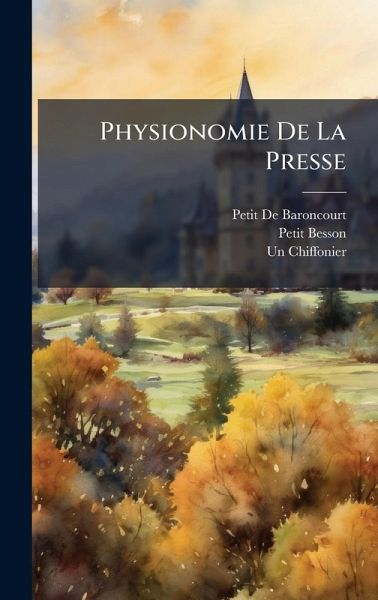
Physionomie De La Presse, Ou, Catalogue Complet Des Nouveaux Journaux Qui Ont Paru Depuis Le 24 Février, Jusqu'au 20 AoÃ't, Avec Le Nom Des Rédacteurs offers a detailed snapshot of the burgeoning press in France following the February Revolution of 1848. Compiled by Petit De Baroncourt, Petit Besson, and Un Chiffonier, this volume serves as a comprehensive catalogue of the new journals that emerged during this period of political and social upheaval. Providing the names of the editors and likely a brief overview of each publication, this book offers valuable insights into the diverse voices and perspectives that shaped public discourse in post-revolutionary France. It is an essential resource for historians and scholars interested in the history of journalism, the French Revolution of 1848, and the social and political dynamics of 19th-century France. This work has been selected by scholars as being culturally important, and is part of the knowledge base of civilization as we know it. This work was reproduced from the original artifact, and remains as true to the original work as possible. Therefore, you will see the original copyright references, library stamps (as most of these works have been housed in our most important libraries around the world), and other notations in the work. This work is in the public domain in the United States of America, and possibly other nations. Within the United States, you may freely copy and distribute this work, as no entity (individual or corporate) has a copyright on the body of the work. As a reproduction of a historical artifact, this work may contain missing or blurred pages, poor pictures, errant marks, etc. Scholars believe, and we concur, that this work is important enough to be preserved, reproduced, and made generally available to the public. We appreciate your support of the preservation process, and thank you for being an important part of keeping this knowledge alive and relevant.