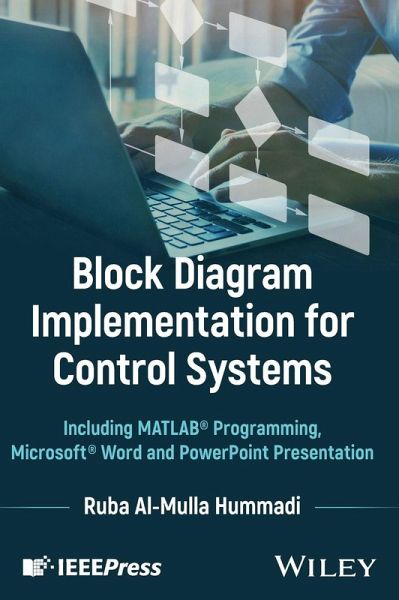
An essential review of techniques for creating block diagrams, intended to complement standard control systems engineering texts on block diagram reduction stages. Written as a two-semester course accompaniment for intermediate learners in Control System Engineering, Block Diagram Implementation for Control Systems combines the frequently used technologies of MATLAB, Word, and PowerPoint for the creation of block diagrams to deliver guidance on the widest set of programming options. Each chapter features learning objectives, and examples are followed by activities to help readers enhance their…mehr
An essential review of techniques for creating block diagrams, intended to complement standard control systems engineering texts on block diagram reduction stages. Written as a two-semester course accompaniment for intermediate learners in Control System Engineering, Block Diagram Implementation for Control Systems combines the frequently used technologies of MATLAB, Word, and PowerPoint for the creation of block diagrams to deliver guidance on the widest set of programming options. Each chapter features learning objectives, and examples are followed by activities to help readers enhance their understanding of concepts. The book contains illustrated tables, annotated figures, and MATLAB script files with executions after each step. The book also features display screens (what you get on your screen), shown in chapters four and five as print screen photos with annotations, and includes review questions after selected chapters. Written by a highly qualified author, Block Diagram Implementation for Control Systems discusses topics including: * Creating a new M-file, writing a script, saving, executing, or running a file, detecting errors, and writing pseudocode in MATLAB * Creating a block diagram using the canvas or blank page methods and following either the manual or the options alignment methods in MS Word * Organizing slides and creating expressions to turn to another slide in MS PowerPoint * Understanding signal flow graphs, covering terminology, algebra, Mason's gain formula, and examples Block Diagram Implementation for Control Systems is an essential learning resource for undergraduate courses on Control Systems and System Modeling and Simulation.
Ruba Al-Mulla Hummadi is an Assistant Professor from Sacramento, CA, USA. She obtained her MSc from Baghdad University, Iraq, in 2001 and worked at the same institution until 2018 in various roles teaching Electrical and Mechanical Engineering students Electrical Circuit Fundamentals, Electrical Machines, and Logic Circuits. From 2020, she worked as a tutor at American River College, Sacramento, USA.
Inhaltsangabe
About the Author ix Preface xi Acknowledgment xiii 1 Block Diagram Introduction and Reduction Rules 1 1.1 Introduction 1 1.2 Definition of Block Diagram 1 1.3 Transfer Function 2 1.4 Rules of Block Diagram Reduction 3 2 MATLAB 7 2.1 Introduction 7 2.2 To Start with MATLAB 7 2.3 M-File Definition 9 2.4 Create a New M-File (New Script) 9 2.5 Write a MATLAB Script 10 2.6 Matrix 13 2.7 Saving an M-File 14 2.8 Executing or Running an M-File 14 2.9 How Can MATLAB Detect Errors and How It Can't 15 2.10 Pseudocode Definition 22 2.11 Write a Pseudocode 22 2.12 Converting a Pseudocode into MATLAB Code 22 3 Examples of Block Diagram Reduction 25 3.1 Introduction 25 3.2 Examples of Block Diagram Reduction 25 4 Creating a Block Diagram in Microsoft Word 117 4.1 Introduction 117 4.2 Block Diagram Construction 117 4.3 Methods of Creation a Block Diagram 118 4.4 Alignment Methods 119 4.5 Examples of Drawing a Block Diagram in Microsoft Word 121 5 Block Diagram Presentation in Microsoft PowerPoint 135 5.1 Introduction 135 5.2 Organizing a Slide 135 5.3 Importing a MATLAB Script into a Presentation File 139 5.4 Expressions Used to Turn to Another Slide 141 5.5 Examples of Presentation 142 6 Signal Flow Graph 159 6.1 Introduction 159 6.2 Signal Flow Graph (SFG) 159 6.3 Terminology in SFG 160 6.4 SFG Algebra 160 6.5 Mason's Gain Formula 161 6.6 Examples of SFG 162 6.7 Converting A Block Diagram Into A Signal Flow Graph 176 6.8 Examples of Converting a Block Diagram Into Its Equivalent SFG 177 Review Questions 186 Appendix 189 References 191 Additional References 191 Index 193
About the Author ix Preface xi Acknowledgment xiii 1 Block Diagram Introduction and Reduction Rules 1 1.1 Introduction 1 1.2 Definition of Block Diagram 1 1.3 Transfer Function 2 1.4 Rules of Block Diagram Reduction 3 2 MATLAB 7 2.1 Introduction 7 2.2 To Start with MATLAB 7 2.3 M-File Definition 9 2.4 Create a New M-File (New Script) 9 2.5 Write a MATLAB Script 10 2.6 Matrix 13 2.7 Saving an M-File 14 2.8 Executing or Running an M-File 14 2.9 How Can MATLAB Detect Errors and How It Can't 15 2.10 Pseudocode Definition 22 2.11 Write a Pseudocode 22 2.12 Converting a Pseudocode into MATLAB Code 22 3 Examples of Block Diagram Reduction 25 3.1 Introduction 25 3.2 Examples of Block Diagram Reduction 25 4 Creating a Block Diagram in Microsoft Word 117 4.1 Introduction 117 4.2 Block Diagram Construction 117 4.3 Methods of Creation a Block Diagram 118 4.4 Alignment Methods 119 4.5 Examples of Drawing a Block Diagram in Microsoft Word 121 5 Block Diagram Presentation in Microsoft PowerPoint 135 5.1 Introduction 135 5.2 Organizing a Slide 135 5.3 Importing a MATLAB Script into a Presentation File 139 5.4 Expressions Used to Turn to Another Slide 141 5.5 Examples of Presentation 142 6 Signal Flow Graph 159 6.1 Introduction 159 6.2 Signal Flow Graph (SFG) 159 6.3 Terminology in SFG 160 6.4 SFG Algebra 160 6.5 Mason's Gain Formula 161 6.6 Examples of SFG 162 6.7 Converting A Block Diagram Into A Signal Flow Graph 176 6.8 Examples of Converting a Block Diagram Into Its Equivalent SFG 177 Review Questions 186 Appendix 189 References 191 Additional References 191 Index 193
Es gelten unsere Allgemeinen Geschäftsbedingungen: www.buecher.de/agb
Impressum
www.buecher.de ist ein Internetauftritt der buecher.de internetstores GmbH
Geschäftsführung: Monica Sawhney | Roland Kölbl | Günter Hilger
Sitz der Gesellschaft: Batheyer Straße 115 - 117, 58099 Hagen
Postanschrift: Bürgermeister-Wegele-Str. 12, 86167 Augsburg
Amtsgericht Hagen HRB 13257
Steuernummer: 321/5800/1497
USt-IdNr: DE450055826