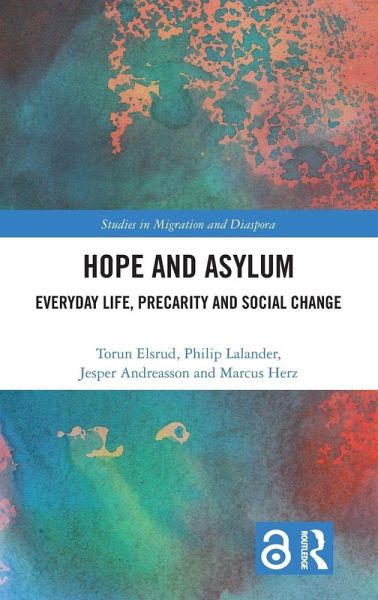
Torun Elsrud, PhD and associate professor in sociology, is a senior lecturer in social work at Linnaeus University in Sweden. Employing longitudinal ethnographic methods, her research focuses on critical social work, migration, asylum, informal solidarity networks, bureaucratic violence, racism and gender. Philip Lalander, PhD in sociology, is a professor in social work at Linnaeus University in Sweden. His main research interests concern critical social work, youth culture, longitudinal ethnographic methods, phenomenology/symbolic interactionism, migration, racism, and everyday life. He has also engaged in studies about the use of drugs and criminality. Jesper Andreasson, PhD in sociology, is a professor in sport science at Linnaeus University, Sweden. His research is mainly positioned within gender studies and cultural sociology and focuses on the areas of doping, body and identity, and gender. He has also engaged in studies of fatherhood and family life. Marcus Herz, PhD in social work, is a professor in social work at the University of Gothenburg. His main research interest is inspired by critical and radical social work and how social work can develop theoretically and practically. Other research interests concern migration, racism, gender, masculinity and youth culture.
Inhaltsangabe
1. The ambiguities of hope in the asylum context; 2. Sweden's post-2015 decline in asylum and human rights: escalation of deportability in a European migration context; 3. The fragile character of asylum hope - participants' perspectives in an uncertain world of abstract power structures; 4. Governing through hope in the asylum context; 5. Weakening of asylum hope through acts of bureaucratic cruelty and racism; 6. Managing asylum hope to deal with uncertainty and despair;7. Embodied damage - consequences of living in prolonged insecurity and controlled by border regimes; 8. Refusing to play the 'asylum game' through radical hope; 9. Unveiling scars made in Sweden - towards a collective hope for social change
1. The ambiguities of hope in the asylum context; 2. Sweden's post-2015 decline in asylum and human rights: escalation of deportability in a European migration context; 3. The fragile character of asylum hope - participants' perspectives in an uncertain world of abstract power structures; 4. Governing through hope in the asylum context; 5. Weakening of asylum hope through acts of bureaucratic cruelty and racism; 6. Managing asylum hope to deal with uncertainty and despair;7. Embodied damage - consequences of living in prolonged insecurity and controlled by border regimes; 8. Refusing to play the 'asylum game' through radical hope; 9. Unveiling scars made in Sweden - towards a collective hope for social change
Es gelten unsere Allgemeinen Geschäftsbedingungen: www.buecher.de/agb
Impressum
www.buecher.de ist ein Internetauftritt der buecher.de internetstores GmbH
Geschäftsführung: Monica Sawhney | Roland Kölbl | Günter Hilger
Sitz der Gesellschaft: Batheyer Straße 115 - 117, 58099 Hagen
Postanschrift: Bürgermeister-Wegele-Str. 12, 86167 Augsburg
Amtsgericht Hagen HRB 13257
Steuernummer: 321/5800/1497
USt-IdNr: DE450055826