
Andere Kunden interessierten sich auch für
 Gold Mining and Milling in Western Australia, With Notes Upon Telluride Treatment, Costs, and Mining Practice in Other Fields40,99 €
 Design of Offshore Oil/Gas Platforms against Ship Impacts52,99 €
 Mixed or free convective flow of non-Newtonian fluids over a surface45,99 €
 Prehistoric Gold in Europe229,99 €
 Low velocity impacts and damage identification with Lamb waves22,99 €
 Renewable Energy Sources and their Environmental Impacts31,99 €
 Dental Gold Alloys and Gold Nanoparticles for Biomedical Applications83,99 €
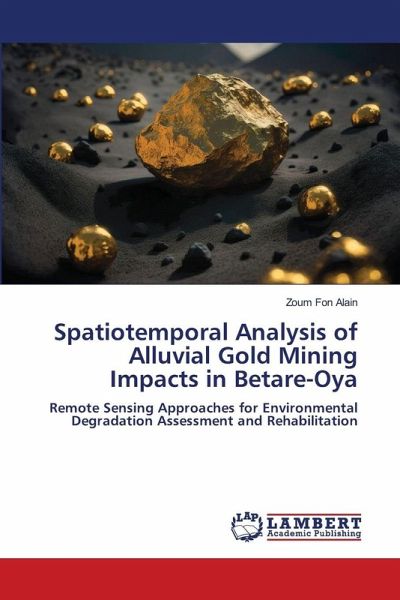
This study assesses the spatiotemporal impacts of alluvial gold mining in Betaré-Oya, East Cameroon (2021-2025) using remote sensing, field surveys, and community interviews. Sentinel-2 imagery was analyzed for land degradation (BSI), vegetation health (NDVI), water quality (NDWI, TI, SSC), and land use/land cover (LULC) changes. Field observations (Jan-Mar 2025) and Google Earth Pro confirmed deforestation, soil erosion, and water pollution. BSI showed bare soil increasing from 19.20% (2021) to 38.23% (2024). NDMI revealed moisture-deficient areas rising from 16.54% (2021) to 24.68% (2024). LULC analysis indicated declining dense vegetation and expansion of bare land and mine sites. The study proposes rehabilitation through soil stabilization, reforestation, water treatment, mine pit closure, community engagement, and monitoring. Policy actions include stricter regulation, sustainable mining promotion, and dedicated mine closure funds. The findings emphasize urgent, sustainable strategies to mitigate mining impacts and safeguard ecosystems and local livelihoods.