
Andere Kunden interessierten sich auch für
 The Making of a Scribe98,99 €
 From Summetria to Symmetry: The Making of a Revolutionary Scientific Concept289,99 €
 From Summetria to Symmetry: The Making of a Revolutionary Scientific Concept211,99 €
 Pluses and Minuses8,49 €
 Mathematical Practitioners and the Transformation of Natural Knowledge in Early Modern Europe83,99 €
 Newton's Principia, the Central Argument35,99 €
 Distributivity-like Results in the Medieval Traditions of Euclid's Elements46,99 €


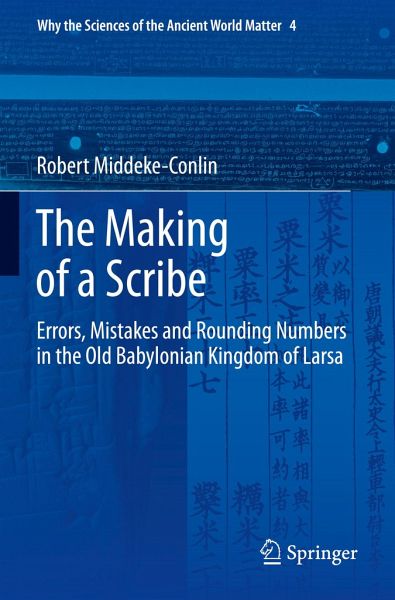
This book presents a novel methodology to study economic texts. The author investigates discrepancies in these writings by focusing on errors, mistakes, and rounding numbers. In particular, he looks at the acquisition, use, and development of practical mathematics in an ancient society: The Old Babylonian kingdom of Larsa (beginning of the second millennium BCE Southern Iraq). In so doing, coverage bridges a gap between the sciences and humanities.
Through this work, the reader will gain insight into discrepancies encountered in economic texts in general and rounding numbers in particular. They will learn a new framework to explain error as a form of economic practice. Researchers and students will also become aware of the numerical and metrological basis for calculation in these writings and how the scribes themselves conceptualized value.
This work fills a void in Assyriological studies. It provides a methodology to explore, understand, and exploit statistical data.The anlaysis also fills a void in the history of mathematics by presenting historians of mathematics a method to study practical texts. In addition, the author shows the importance mathematics has as a tool for ancient practitioners to cope with complex economic processes. This serves as a useful case study for modern policy makers into the importance of education in any economy.
Through this work, the reader will gain insight into discrepancies encountered in economic texts in general and rounding numbers in particular. They will learn a new framework to explain error as a form of economic practice. Researchers and students will also become aware of the numerical and metrological basis for calculation in these writings and how the scribes themselves conceptualized value.
This work fills a void in Assyriological studies. It provides a methodology to explore, understand, and exploit statistical data.The anlaysis also fills a void in the history of mathematics by presenting historians of mathematics a method to study practical texts. In addition, the author shows the importance mathematics has as a tool for ancient practitioners to cope with complex economic processes. This serves as a useful case study for modern policy makers into the importance of education in any economy.
"Middeke-Conlin's study greatly expands our understanding of the interplay between theoretical `school' mathematics and the actual practices of numerate scribes going about their daily business, at least in Old Babylonian Larsa. It is to be hoped that future scholars will take this careful and detailed methodology as a model for probing practices in other times and places." (Duncan J. Melville, Mathematical Reviews, Issue (6), March, 2024)