
Nicht lieferbar
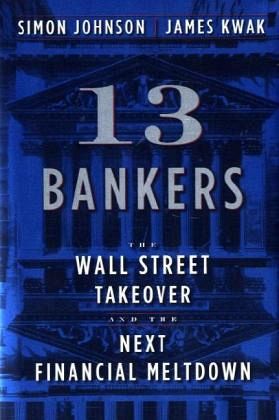
Even after the ruinous financial crisis of 2008, America is still beset by the depredations of an oligarchy that is now bigger, more profitable, and more resistant to regulation than ever. Anchored by six megabanks-Bank of America, JPMorgan Chase, Citigroup, Wells Fargo, Goldman Sachs, and Morgan Stanley-which together control assets amounting, astonishingly, to more than 60 percent of the country's gross domestic product, these financial institutions (now more emphatically "too big to fail") continue to hold the global economy hostage, threatening yet another financial meltdown with their excessive risk-taking and toxic "business as usual" practices. How did this come to be-and what is to be done? These are the central concerns of 13 Bankers, a brilliant, historically informed account of our troubled political economy. In 13 Bankers, Simon Johnson-one of the most prominent and frequently cited economists in America (former chief economist of the International Monetary Fund, Professor of Entrepreneurship at MIT, and author of the controversial "The Quiet Coup" in The Atlantic )-and James Kwak give a wide-ranging, meticulous, and bracing account of recent U.S. financial history within the context of previous showdowns between American democracy and Big Finance: from Thomas Jefferson to Andrew Jackson, from Theodore Roosevelt to Franklin Delano Roosevelt. They convincingly show why our future is imperiled by the ideology of finance (finance is good, unregulated finance is better, unfettered finance run amok is best) and by Wall Street's political control of government policy pertaining to it. As the authors insist, the choice that America faces is stark: whether Washington will accede to the vested interests of an unbridled financial sector that runs up profits in good years and dumps its losses on taxpayers in lean years, or reform through stringent regulation the banking system as first and foremost an engine of economic growth. To restore health and balance to our economy, Johnson and Kwak make a radical yet feasible and focused proposal: reconfigure the megabanks to be "small enough to fail." Lucid, authoritative, crucial for its timeliness, 13 Bankers is certain to be one of the most discussed and debated books of 2010.
"How Modern Wall Street-the most powerful and concentrated financial sector in the country's history-both created the financial crisis and ensured a bail-out for its own benefit." - The Economist "Mr. Johnson offers an enticing vision of a Wall Street confined, its potency limited to put-downs and head-shaking: a Wall Street where right-sized banking is a do-gooder word for a safer, saner system that has learned from its mistakes." -David Weidner, Wall Street Journal "The best explanation yet for how the smart guys on Wall Street led us to the brink of collapse. In the process, Johnson and Kwak demystify our financial system, stripping it down to expose the ruthless power grab that lies at its center." - Elizabeth Warren, Leo Gottlieb Professor of Law, Harvard Law School; and Chair, TARP Congressional Oversight Panel "Too many discussions of the Great Recession present it as a purely economic phenomenon - the result of excessive leverage or errors of monetary policy or algorithms run mad. Simon Johnson was the first to point out that this was and is a crisis of political economy. His and James Kwak's analysis of the unholy inter-twining of Washington and Wall Street - a cross between the gilded age and a banana republic - is essential reading." - Niall Ferguson, Professor of History, Harvard University; Professor, Harvard Business School; and author of The Ascent of Money "If the wads of money you're stuffed into your mattress for safekeeping don't keep you up at night, 13 Bankers will. A disturbing and painstakingly researched account of how the banks wrenched control of government and society out of our hands - and what we can do to seize it back." - Bill Moyers "Essential reading for anyone who wants to understand what comes next for the world economy. Dangerous and reckless elements of our financial sector have become too powerful and must be reined in. If this problem is not addressed there is serious trouble in all our futures." - Nouriel Roubini , Professor of Economics, Leonard N. Stern School of Business, New York University; and Chairman of Roubini Global Economics "Beautifully written and powerful. Ties the current financial crisis to a cycle of politics as old as the Republic, and to a pathology in our politics that is as profound as any that our Republic has faced. Required reading for the president, and for anyone else who cares for this Republic." - Lawrence Lessig, Director of the Edmond J. Safra Foundation for Ethics, Harvard University "Simon Johnson makes it clear that our financial system is broken, and that Wall Street and Washington broke it. Sadly, he also makes it clear that they want to keep it that way. His gripping book explains how the economic crisis developed and what must be done to create a fair system, one that will benefit all Americans rather than just those who are the members of the club." - Herbert A. Allen III, President and Chief Executive Officer, Allen & Company "The U.S. financial sector is incredibly bloated and a drain on the productive economy. It uses its enormous economic power to buy politicians and policies that favor its interests and perpetuates its power. This is the main argument of Simon Johnson's new book. The views expressed are especially striking because Johnson is the former chief economist at the IMF. He has had decades of experience dealing with financial crises. This often required working with corrupt governments dominated by powerful financial interests. It is striking to see Johnson putting the U.S. government in this category." - Dean Baker, Co-Founder and Co-Director of the Center for Economic and Policy Research "Johnson and Kwak embed the financial crisis in a sophisticated analysis of US economic history, explain its evolution with unusual clarity and propose policy reforms to prevent its ever happening again that are both straight forward and compelling." - C. Fred Bergsten, Director, Peterson Institute for Internationa