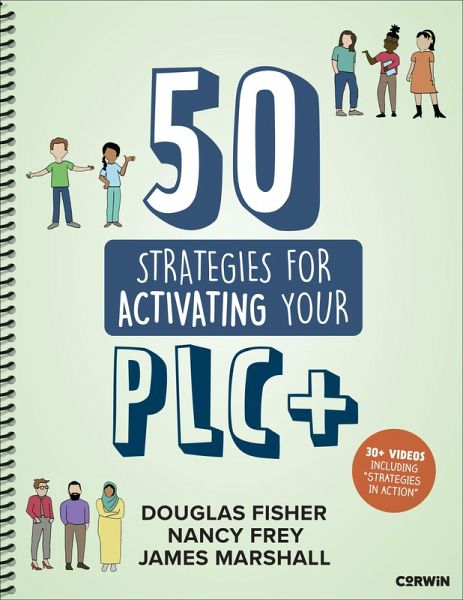
50 Strategies for Activating the Full Potential of Your PLC+ Team Are you maximizing the impact of your professional learning communities? 50 Strategies for Activating Your PLC+ equips educators with the tools and actions needed to foster highly effective PLC+ teams. Successful PLCs are built on a foundation of strong collaboration, unified purpose, trust, and effective communication. The 50+ strategies in this essential guide address the challenges and possibilities within teacher teams by focusing on the role of activators, group members who work to ensure that all members of the PLC+…mehr
50 Strategies for Activating the Full Potential of Your PLC+ Team Are you maximizing the impact of your professional learning communities? 50 Strategies for Activating Your PLC+ equips educators with the tools and actions needed to foster highly effective PLC+ teams. Successful PLCs are built on a foundation of strong collaboration, unified purpose, trust, and effective communication. The 50+ strategies in this essential guide address the challenges and possibilities within teacher teams by focusing on the role of activators, group members who work to ensure that all members of the PLC+ contribute to meaningful, solution-driven progress. Grounded in experience and practical guidance, this resource is designed to make every step of your PLC+ experience impactful. With strategies organized into eight comprehensive sections, the authors provide the frameworks necessary to create an engaged, productive learning culture with: * Eight categories of strategies aligned with the five guiding PLC+ questions to support targeted and actionable leadership * A practical cross-reference table connecting the strategies to content with additional context and insights to deepen understanding * Tools for developing activator skills that enhance facilitation, decision-making, and solution-oriented collaboration within your PLC+ teams * Concrete protocols and frameworks for addressing team dynamics, meeting structures, and continuous improvement From establishing goals to reviewing results, yoüll find purposeful actions that drive positive outcomes for educators and students alike. Take the next step in your PLC+ leadership to shape the future of learning in your school.
Douglas Fisher is professor and chair of educational leadership at San Diego State University and a teacher leader at Health Sciences High and Middle College. Previously, Doug was an early intervention teacher and elementary school educator. He is a credentialed English teacher and administrator in California. In 2022, he was inducted into the Reading Hall of Fame by the Literacy Research Association. He has published numerous articles on reading and literacy, leadership, and curriculum design, as well as books such as The Teacher Clarity Playbook (2nd ed.), Your Introduction to PLC+, The Illustrated Guide to Teacher Credibility, Instructional Strategies to Move Learning Forward: 50+ Tools That Support Gradual Release of Responsibility, and Welcome to Teaching!
Inhaltsangabe
Strategy and Usage Overview Introduction The Development of Professional Learning Communities Stepping Into the Activator Role Activators Make Things Happen An Overview of This Guide Your Activation Goal Your Introduction to PLC+ Content Cross-Reference Table 50 Strategies for Activating Your PLC+ Activating Questions 1-5 1. Activating Question 1: Where are we going? 2. Activating Question 2: Where are we now? 3. Activating Question 3: How do we move learning forward? 4. Activating Question 4: What did we learn today? 5. Activating Question 5: Who benefited and who did not benefit? Activator Skills and Abilities 6. Activator Skills and Abilities: Activating to Achieve a True Impact on Learning 7. Activator Skills and Abilities: Assessing Your Activator Fitness Level 8. Activator Skills and Abilities: Defining Your Activator Role 9. Activator Skills and Abilities: Developing Successful PLC+ Activators 10. Activator Skills and Abilities: Facilitation Self-Assessment 11. Activator Skills and Abilities: Facilitating With Grace 12. Activator Skills and Abilities: Finding the Key Activator Continuous Improvement 13. Continuous Improvement: Discussions and Actions 14. Continuous Improvement: Making Course Corrections 15. Continuous Improvement: Taking Priority Practices to Scale 16. Continuous Improvement: Strong Team Structures to Achieve High Function Function and Impact 17. Function and Impact: Activating Others by Sharing Your PLC+ Success 18. Function and Impact: Applying Evaluative Thinking 19. Function and Impact: Assessing PLC+ Readiness 20. Function and Impact: Assessing Your Current PLC+ Performance 21. Function and Impact: Building Momentum With Early Wins 22. Function and Impact: Evaluating Your PLC+ Progress and Impact 23. Function and Impact: Increasing Impact in PLC+ Teams 24. Function and Impact: Realizing the Optimal Combination of Function and Impact Meeting Moves 25. Meeting Moves: Coming to Agreement About Professional Learning 26. Meeting Moves: Documentation and Note-Taking 27. Meeting Moves: Effectively Activating When Meetings Become Challenging 28. Meeting Moves: Establishing Norms 29. Meeting Moves: Establishing PLC+ Roles 30. Meeting Moves: Finding Solid Ground in Assessments and Data 31. Meeting Moves: Social Emotional Check-Ins 32. Meeting Moves: Utilizing Authentic Instructional Protocols Norms of Collaborative Work 33. Norms of Collaborative Work 1: Pausing 34. Norms of Collaborative Work 2: Paraphrasing 35. Norms of Collaborative Work 3: Posing Questions 36. Norms of Collaborative Work 4: Providing Data 37. Norms of Collaborative Work 5: Putting Ideas on the Table 38. Norms of Collaborative Work 6: Paying Attention to Self and Others 39. Norms of Collaborative Work 7: Presuming Positive Intentions Team Dynamics 40. Team Dynamics: Achieving Team Psychological Safety 41. Team Dynamics: Activating Dialogue When Topics Become Sensitive 42. Team Dynamics: Activating When Team Members Do Not Want to Change 43. Team Dynamics: Analyzing and Describing Team Strengths 44. Team Dynamics: Breaking Barriers, Bringing Team Members Together 45. Team Dynamics: Countering Resistance With Will, Skill, Knowledge, Capacity, and Emotional Support 46. Team Dynamics: From Independent to an Interdependent PLC+ Time Matters 47. Time Matters: Developing an Assessment Calendar 48. Time Matters: Scheduling PLC+ Meetings 49. Time Matters: Setting Aside Time for the PLC+ Reflecting on Your Activation of the PLC+ Journey 50. Metareflection and Intention Setting With the 5Ds References Index
Strategy and Usage Overview Introduction The Development of Professional Learning Communities Stepping Into the Activator Role Activators Make Things Happen An Overview of This Guide Your Activation Goal Your Introduction to PLC+ Content Cross-Reference Table 50 Strategies for Activating Your PLC+ Activating Questions 1-5 1. Activating Question 1: Where are we going? 2. Activating Question 2: Where are we now? 3. Activating Question 3: How do we move learning forward? 4. Activating Question 4: What did we learn today? 5. Activating Question 5: Who benefited and who did not benefit? Activator Skills and Abilities 6. Activator Skills and Abilities: Activating to Achieve a True Impact on Learning 7. Activator Skills and Abilities: Assessing Your Activator Fitness Level 8. Activator Skills and Abilities: Defining Your Activator Role 9. Activator Skills and Abilities: Developing Successful PLC+ Activators 10. Activator Skills and Abilities: Facilitation Self-Assessment 11. Activator Skills and Abilities: Facilitating With Grace 12. Activator Skills and Abilities: Finding the Key Activator Continuous Improvement 13. Continuous Improvement: Discussions and Actions 14. Continuous Improvement: Making Course Corrections 15. Continuous Improvement: Taking Priority Practices to Scale 16. Continuous Improvement: Strong Team Structures to Achieve High Function Function and Impact 17. Function and Impact: Activating Others by Sharing Your PLC+ Success 18. Function and Impact: Applying Evaluative Thinking 19. Function and Impact: Assessing PLC+ Readiness 20. Function and Impact: Assessing Your Current PLC+ Performance 21. Function and Impact: Building Momentum With Early Wins 22. Function and Impact: Evaluating Your PLC+ Progress and Impact 23. Function and Impact: Increasing Impact in PLC+ Teams 24. Function and Impact: Realizing the Optimal Combination of Function and Impact Meeting Moves 25. Meeting Moves: Coming to Agreement About Professional Learning 26. Meeting Moves: Documentation and Note-Taking 27. Meeting Moves: Effectively Activating When Meetings Become Challenging 28. Meeting Moves: Establishing Norms 29. Meeting Moves: Establishing PLC+ Roles 30. Meeting Moves: Finding Solid Ground in Assessments and Data 31. Meeting Moves: Social Emotional Check-Ins 32. Meeting Moves: Utilizing Authentic Instructional Protocols Norms of Collaborative Work 33. Norms of Collaborative Work 1: Pausing 34. Norms of Collaborative Work 2: Paraphrasing 35. Norms of Collaborative Work 3: Posing Questions 36. Norms of Collaborative Work 4: Providing Data 37. Norms of Collaborative Work 5: Putting Ideas on the Table 38. Norms of Collaborative Work 6: Paying Attention to Self and Others 39. Norms of Collaborative Work 7: Presuming Positive Intentions Team Dynamics 40. Team Dynamics: Achieving Team Psychological Safety 41. Team Dynamics: Activating Dialogue When Topics Become Sensitive 42. Team Dynamics: Activating When Team Members Do Not Want to Change 43. Team Dynamics: Analyzing and Describing Team Strengths 44. Team Dynamics: Breaking Barriers, Bringing Team Members Together 45. Team Dynamics: Countering Resistance With Will, Skill, Knowledge, Capacity, and Emotional Support 46. Team Dynamics: From Independent to an Interdependent PLC+ Time Matters 47. Time Matters: Developing an Assessment Calendar 48. Time Matters: Scheduling PLC+ Meetings 49. Time Matters: Setting Aside Time for the PLC+ Reflecting on Your Activation of the PLC+ Journey 50. Metareflection and Intention Setting With the 5Ds References Index
Es gelten unsere Allgemeinen Geschäftsbedingungen: www.buecher.de/agb
Impressum
www.buecher.de ist ein Internetauftritt der buecher.de internetstores GmbH
Geschäftsführung: Monica Sawhney | Roland Kölbl | Günter Hilger
Sitz der Gesellschaft: Batheyer Straße 115 - 117, 58099 Hagen
Postanschrift: Bürgermeister-Wegele-Str. 12, 86167 Augsburg
Amtsgericht Hagen HRB 13257
Steuernummer: 321/5800/1497
USt-IdNr: DE450055826