
Andere Kunden interessierten sich auch für
 Contents of Testimony Taken Before the Committee on Privileges and Elections of the United States Senate: In the Matter of the Protests Against the Ri30,99 €
 A Complete Collection of the Protests of the Lords: 1826-187439,99 €
 A Complete Collection of the Protests of the Lords36,90 €
 A Complete Collection of the Protests of the Lords, With Historical Introductions; Volume 238,99 €
 Protests during the EU summit in Gothenburg 200123,99 €
 Mrs. Maxon Protests34,99 €
 A Complete Collection of the Protests of the Lords39,99 €






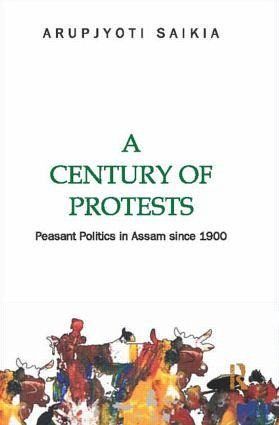
This book traces the transformations in the agrarian landscape of Assam in the twentieth century. Drawing upon a wealth of hitherto unused archival material and delving into a relatively unexplored aspect of Assamese political history, it examines the complex socio-economic processes instrumental in the making of modern Assamese peasantry and rural politics.
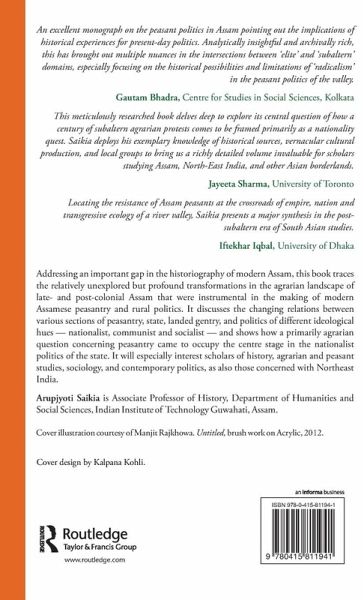
'An excellent monograph on the peasant politics in Assam pointing out the implications of historical experiences for present-day politics. Analytically insightful and archivally rich, this has brought out multiple nuances in the intersections between "elite" and "subaltern" domains, especially focusing on the historical possibilities and limitations of 'radicalism' in the peasant politics of the valley.' - Gautam Bhadra, Centre for Studies in Social Sciences, Kolkata
'This meticulously researched book delves deep to explore its central question of how a century of subaltern agrarian protests comes to be framed primarily as a nationality quest. Saikia deploys his exemplary knowledge of historical sources, vernacular cultural production, and local groups to bring us a richly detailed volume invaluable for scholars studying Assam, North-East India, and other Asian borderlands.' - Jayeeta Sharma, University of Toronto
'Locating the resistance of Assam peasants at the crossroads of empire, nation and transgressive ecology of a river valley, Saikia presents a major synthesis in the post-subaltern era of South Asian studies.' - Iftekhar Iqbal, University of Dhaka
'This meticulously researched book delves deep to explore its central question of how a century of subaltern agrarian protests comes to be framed primarily as a nationality quest. Saikia deploys his exemplary knowledge of historical sources, vernacular cultural production, and local groups to bring us a richly detailed volume invaluable for scholars studying Assam, North-East India, and other Asian borderlands.' - Jayeeta Sharma, University of Toronto
'Locating the resistance of Assam peasants at the crossroads of empire, nation and transgressive ecology of a river valley, Saikia presents a major synthesis in the post-subaltern era of South Asian studies.' - Iftekhar Iqbal, University of Dhaka