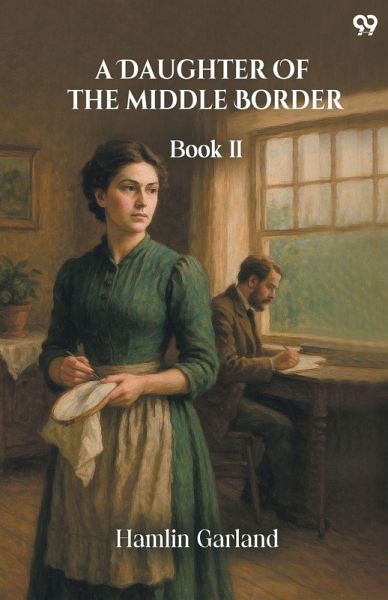
A daughter of the middle border Book II reflects on generational bonds, the fading pioneer spirit, and the evolving landscape of American life through a deeply personal lens. As the narrator returns to his family's Midwestern homestead after achieving recognition in the East, he confronts the changes that time and success have brought to both his inner world and the rural community he left behind. His parents' modest life becomes a focal point for his renewed sense of duty and affection, particularly his father's stoic endurance and his mother's unfulfilled yearning for a daughter. These…mehr
A daughter of the middle border Book II reflects on generational bonds, the fading pioneer spirit, and the evolving landscape of American life through a deeply personal lens. As the narrator returns to his family's Midwestern homestead after achieving recognition in the East, he confronts the changes that time and success have brought to both his inner world and the rural community he left behind. His parents' modest life becomes a focal point for his renewed sense of duty and affection, particularly his father's stoic endurance and his mother's unfulfilled yearning for a daughter. These emotional undercurrents frame his journey not as a retreat but as an attempt to reconcile ambition with belonging. The homestead serves as both sanctuary and symbol of vanishing values, and the narrative lingers on everyday scenes filled with quiet significance. The act of returning becomes a meditation on memory, aging, and the sacrifices that shaped his path. In its intimate observations and reverence for domestic detail, the book balances personal history with a broader commentary on shifting American ideals and the enduring pull of familial love.
Hannibal Hamlin Garland was an American novelist, poet, essayist, short story author, Georgist, and psychical researcher. He is best known for his fiction about hardworking Midwestern farmers. Hannibal Hamlin Garland was born on a farm near West Salem, Wisconsin, on September 14, 1860, as the second of four children of Richard Garland of Maine and Charlotte Isabelle McClintock. The boy was named after Abraham Lincoln's vice president, Hannibal Hamlin. He grew up on numerous Midwestern farms before relocating to Boston, Massachusetts, in 1884 to pursue a writing career. He read diligently at the Boston Public Library. There he grew infatuated with Henry George's views and the Single Tax Movement. George's beliefs influenced several of his writings, including Main-Travelled Roads (1891), Prairie Folks (1892), and his novel Jason Edwards (1892). Main-Travelled Roads was his first big hit. It was a compilation of short stories inspired by his time on the farm. He serialized a biography of Ulysses S. Grant in McClure's Magazine before turning it into a book in 1898. The same year, Garland visited the Yukon to observe the Klondike Gold Rush, which inspired The Trail of the Gold Seekers (1899).
Es gelten unsere Allgemeinen Geschäftsbedingungen: www.buecher.de/agb
Impressum
www.buecher.de ist ein Internetauftritt der buecher.de internetstores GmbH
Geschäftsführung: Monica Sawhney | Roland Kölbl | Günter Hilger
Sitz der Gesellschaft: Batheyer Straße 115 - 117, 58099 Hagen
Postanschrift: Bürgermeister-Wegele-Str. 12, 86167 Augsburg
Amtsgericht Hagen HRB 13257
Steuernummer: 321/5800/1497
USt-IdNr: DE450055826