
Andere Kunden interessierten sich auch für
 Data Analytics in Digital Humanities68,99 €
 Data Analytics in Digital Humanities98,99 €
 Computers and Creativity83,99 €
 Artificial Intelligence and the Arts136,99 €
 Guide to Programming for the Digital Humanities53,99 €
 Artificial Intelligence and Games27,99 €
 Artificial Intelligence and Games45,99 €
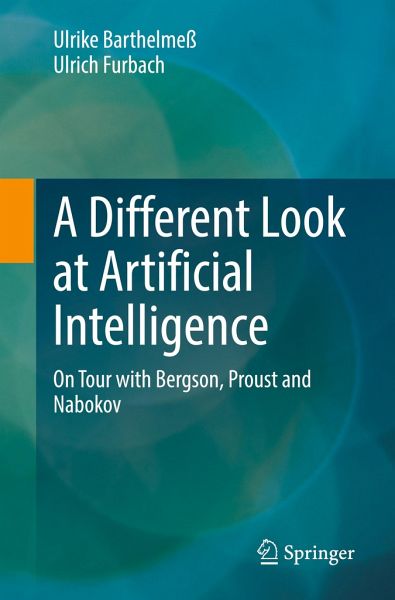
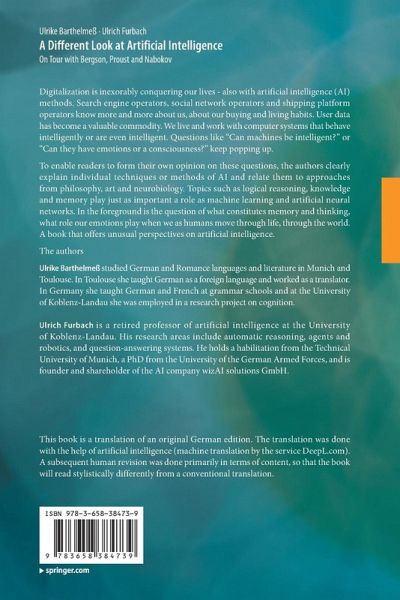
Digitalization is inexorably conquering our lives - also with artificial intelligence (AI) methods. Search engine operators, social network operators and shipping platform operators know more and more about us, about our buying and living habits. User data has become a valuable commodity. We live and work with computer systems that behave intelligently or are even intelligent. Questions like "Can machines be intelligent?" or "Can they have emotions or a consciousness?" keep popping up.
To enable readers to form their own opinion on these questions, the authors clearly explain individual techniques or methods of AI and relate them to approaches from philosophy, art and neurobiology. Topics such as logical reasoning, knowledge and memory play just as important a role as machine learning and artificial neural networks. In the foreground is the question of what constitutes memory and thinking, what role our emotions play when we as humans move through life, through the world.A book that offers unusual perspectives on artificial intelligence.
To enable readers to form their own opinion on these questions, the authors clearly explain individual techniques or methods of AI and relate them to approaches from philosophy, art and neurobiology. Topics such as logical reasoning, knowledge and memory play just as important a role as machine learning and artificial neural networks. In the foreground is the question of what constitutes memory and thinking, what role our emotions play when we as humans move through life, through the world.A book that offers unusual perspectives on artificial intelligence.