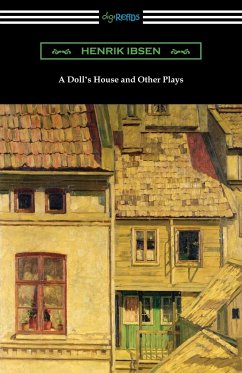
A Doll's House (Norwegian: Et dukkehjem; also translated as A Doll House) is a three-act play in prose by Henrik Ibsen. It premiered at the Royal Theatre in Copenhagen, Denmark, on 21 December 1879, having been published earlier that month. The play is significant for its critical attitude toward 19th century marriage norms. It aroused great controversy at the time, as it concludes with the protagonist, Nora, leaving her husband and children because she wants to discover herself. Ibsen was inspired by the belief that "a woman cannot be herself in modern society," since it is "an exclusively…mehr
A Doll's House (Norwegian: Et dukkehjem; also translated as A Doll House) is a three-act play in prose by Henrik Ibsen. It premiered at the Royal Theatre in Copenhagen, Denmark, on 21 December 1879, having been published earlier that month. The play is significant for its critical attitude toward 19th century marriage norms. It aroused great controversy at the time, as it concludes with the protagonist, Nora, leaving her husband and children because she wants to discover herself. Ibsen was inspired by the belief that "a woman cannot be herself in modern society," since it is "an exclusively male society, with laws made by men and with prosecutors and judges who assess feminine conduct from a masculine standpoint." Its ideas can also be seen as having a wider application: Michael Meyer argued that the play's theme is not women's rights, but rather "the need of every individual to find out the kind of person he or she really is and to strive to become that person." In a speech given to the Norwegian Association for Women's Rights in 1898, Ibsen insisted that he "must disclaim the honor of having consciously worked for the women's rights movement," since he wrote "without any conscious thought of making propaganda," his task having been "the description of humanity."
Henrik Johan Ibsen was a prominent Norwegian playwright and theatre director born on March 20, 1828, in Skien, Norway. Widely regarded as one of the most influential dramatists in history, Ibsen is often referred to as the "father of modern drama" due to his pioneering work in introducing theatrical realism to the stage. His plays challenged societal norms and examined deep psychological and social issues, often with controversial themes that sparked public debate. His work influenced not only theatre but also broader discussions about the role of individuals within society, particularly regarding gender roles and the power structures of the time. Ibsen's most famous works include A Doll s House, Hedda Gabler, Ghosts, and The Master Builder. Throughout his career, Ibsen's plays were often criticized for their radical ideas, but they are now regarded as central to the development of modern theatre. Ibsen died on May 23, 1906, in Oslo, Norway, leaving behind a legacy that has shaped contemporary theatre worldwide. His works continue to be performed and studied for their insight into the complexities of human nature and society.
Es gelten unsere Allgemeinen Geschäftsbedingungen: www.buecher.de/agb
Impressum
www.buecher.de ist ein Internetauftritt der buecher.de internetstores GmbH
Geschäftsführung: Monica Sawhney | Roland Kölbl | Günter Hilger
Sitz der Gesellschaft: Batheyer Straße 115 - 117, 58099 Hagen
Postanschrift: Bürgermeister-Wegele-Str. 12, 86167 Augsburg
Amtsgericht Hagen HRB 13257
Steuernummer: 321/5800/1497
USt-IdNr: DE450055826