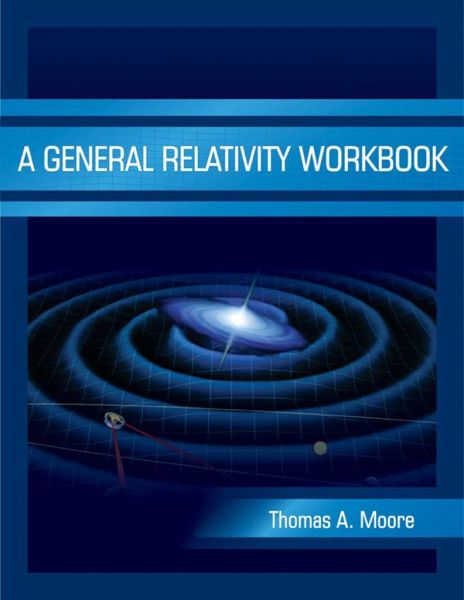
A General Relativity Workbook is atextbook intended to support a one-semester upper division undergraduatecourse on general relativity. General relativity, which lies at the heart of contemporary physics, has recently become the focus of a number of lively theoretical, experimental, and computational research programs. As a result, undergraduates have become increasingly excited to learn about the subject.A General Relativity Workbook is a textbook intended to support a one-semester upper division undergraduate course on general relativity. Through its unique workbook-based design, it enables…mehr
A General Relativity Workbook is atextbook intended to support a one-semester upper division undergraduatecourse on general relativity. General relativity, which lies at the heart of contemporary physics, has recently become the focus of a number of lively theoretical, experimental, and computational research programs. As a result, undergraduates have become increasingly excited to learn about the subject.A General Relativity Workbook is a textbook intended to support a one-semester upper division undergraduate course on general relativity. Through its unique workbook-based design, it enables students to develop a solid mastery of both the physics and the supporting tensor calculus by pushing (and guiding) them to work through the implications. Each chapter, which is designed to correspond to one class session, involves a short overview of the concepts without obscuring derivations or details, followed by a series of boxes that guide students through the process of working things out for themselves.This active-learning approach enables students to develop a more secure mastery of the material than more traditional approaches. More than 350 homework problems support further learning. This book more strongly emphasizes the physics than many of its competitors, and while it provides students a full grounding in the supporting mathematics (unlike certain other competitors), it introduces the mathematics gradually and in a completely physical context.Hinweis: Dieser Artikel kann nur an eine deutsche Lieferadresse ausgeliefert werden.
Thomas A. Moore is a professor in the physics department of Pomona College. He graduated from Carleton College in 1976, and earned an M. Phil. in 1978 and a Ph. D. in 1981 from Yale University. He then taught at Carleton College and Luther College before taking his current position at Pomona College in 1987, where he won a Wig Award for Distinguished Teaching in 1991. He served as an active member of the national Introductory University Physics Project (IUPP), and has published a number of articles about astrophysical sources of gravitational waves, detection of gravitational waves, and new approaches to teaching physics. His previous books include A Traveler's Guide to Spacetime (McGraw-Hill, 1995) on special relativity, and a six-volume introductory calculus-based physics text called Six Ideas That Shaped Physics (McGraw-Hill, 2003).
Inhaltsangabe
1. Introduction 2. Review of Special Relativity 3. Four-Vectors 4. Index Notation 5. Arbitrary Coordinates 6. Tensor Equations 7. Maxwell’s Equations 8. Geodesics 9. The Schwarzschild Metric 10. Particle Orbits 11. Precession of the Perihelion 12. Photon Orbits 13. Deflection of Light 14. Event Horizon 15. Alternative Coordinates 16. Black Hole Thermodynamics 17. The Absolute Gradient 18. Geodesic Deviation 19. The Riemann Tensor 20. The Stress-Energy Tensor 21. The Einstein Equation 22. Interpreting the Equation 23. The Schwarzschild Solution 24. The Universe Observed 25. A Metric for the Cosmos 26. Evolution of the Universe 27. Cosmic Implications 28. The Early Universe 29. CMB Fluctuations and Inflation 30. Gauge Freedom 31. Detecting Gravitational Waves 32. Gravitational Wave Energy 33. Generating Gravitational Waves 34. Gravitational Wave Astronomy 35. Gravitomagnetism 36. The Kerr Metric 37. Particle Orbits in Kerr Spacetime 38. Ergoregion and Horizon 39. Negative-Energy Orbits Index
1. Introduction 2. Review of Special Relativity 3. Four-Vectors 4. Index Notation 5. Arbitrary Coordinates 6. Tensor Equations 7. Maxwell’s Equations 8. Geodesics 9. The Schwarzschild Metric 10. Particle Orbits 11. Precession of the Perihelion 12. Photon Orbits 13. Deflection of Light 14. Event Horizon 15. Alternative Coordinates 16. Black Hole Thermodynamics 17. The Absolute Gradient 18. Geodesic Deviation 19. The Riemann Tensor 20. The Stress-Energy Tensor 21. The Einstein Equation 22. Interpreting the Equation 23. The Schwarzschild Solution 24. The Universe Observed 25. A Metric for the Cosmos 26. Evolution of the Universe 27. Cosmic Implications 28. The Early Universe 29. CMB Fluctuations and Inflation 30. Gauge Freedom 31. Detecting Gravitational Waves 32. Gravitational Wave Energy 33. Generating Gravitational Waves 34. Gravitational Wave Astronomy 35. Gravitomagnetism 36. The Kerr Metric 37. Particle Orbits in Kerr Spacetime 38. Ergoregion and Horizon 39. Negative-Energy Orbits Index
Es gelten unsere Allgemeinen Geschäftsbedingungen: www.buecher.de/agb
Impressum
www.buecher.de ist ein Internetauftritt der buecher.de internetstores GmbH
Geschäftsführung: Monica Sawhney | Roland Kölbl | Günter Hilger
Sitz der Gesellschaft: Batheyer Straße 115 - 117, 58099 Hagen
Postanschrift: Bürgermeister-Wegele-Str. 12, 86167 Augsburg
Amtsgericht Hagen HRB 13257
Steuernummer: 321/5800/1497
USt-IdNr: DE450055826