
70,99 €
inkl. MwSt.
Versandkostenfrei*
Versandfertig in 1-2 Wochen
payback
35 °P sammeln
  • Broschiertes Buch

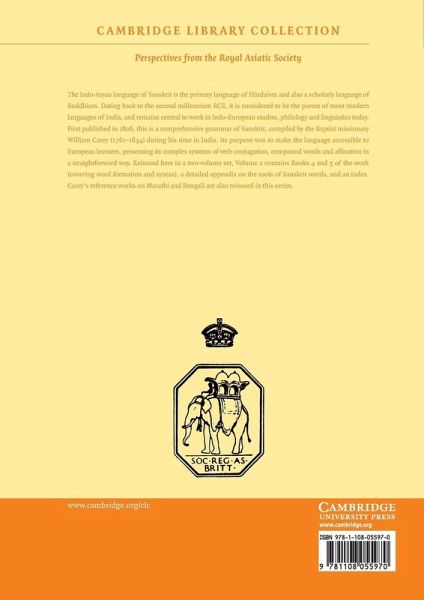
The Indo-Aryan language of Sanskrit is the primary language of Hinduism and also a scholarly language of Buddhism. Dating back to the second millennium BCE, it is considered to be the parent of most modern languages of India, and remains central to work in Indo-European studies, philology and linguistics today. First published in 1806, this is a comprehensive grammar of Sanskrit, compiled by the Baptist missionary William Carey (1761-1834) during his time in India. Its purpose was to make the language accessible to European learners, presenting its complex systems of verb conjugation, compound…mehr

Produktbeschreibung
The Indo-Aryan language of Sanskrit is the primary language of Hinduism and also a scholarly language of Buddhism. Dating back to the second millennium BCE, it is considered to be the parent of most modern languages of India, and remains central to work in Indo-European studies, philology and linguistics today. First published in 1806, this is a comprehensive grammar of Sanskrit, compiled by the Baptist missionary William Carey (1761-1834) during his time in India. Its purpose was to make the language accessible to European learners, presenting its complex systems of verb conjugation, compound words and affixation in a straightforward way. Reissued here in a two-volume set, Volume 2 contains Books 4 and 5 of the work (covering word formation and syntax), a detailed appendix on the roots of Sanskrit words, and an index. Carey's reference works on Marathi and Bengali are also reissued in this series.
Autorenporträt
William Carey (1761-1834) was born in Northampton, England and raised in the Church of England. He adopted Baptist views early in life eventually becoming a Baptist pastor. Sailing from England in 1793 as the first commissioned missionary by London's Baptist Missionary Society (the society he inspired and helped create), his long missions tenure in India included itinerant evangelism, church planting, social reform, Bible translation and printing, and the founding of the Serampore University, the first university in India to award degrees.