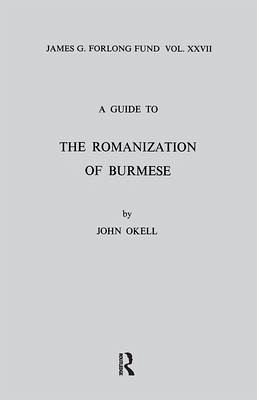
This work covers the three methods of Romanization: transliteration (Duroiselle's system); transcription (early, conventional, IPA and typewritten types); and the combined method (Minn Latt's system).
This work covers the three methods of Romanization: transliteration (Duroiselle's system); transcription (early, conventional, IPA and typewritten types); and the combined method (Minn Latt's system).
1 PRELIMINARY 1.1 Introduction: scope of booklet. 1.2 Abbreviations. 2 THE PROBLEM. 2.1 Sound and symbol: transliteration transcription and combined systems 2.2 Burmese and the roman alphabet: ways of filling the gaps 3 SURVEY OF THE THREE METHODS OF ROMANIZATION 3.1Transliteration method. 3.2 Transcription method. 3.3 Combined method 3.4 Summary 4 THE THREE METHODS IN DETAIL 4.1 Transliteration 4.1.1 Table 1: Duroiselle' s system 4.1.2 Notes and variants: fi ai o2 ui special vowels medials finals tone marks punctuation abbreviations spacing Sanskrit letters. 4.1.3 Summary 4.2 Transcription 4.2.1 Table 2: early conventional IPA and typewritten types 4.2.2 Notes and variants: aspirate plosives palatal affricates voiced consonants voiced dental fricative hush sibilant nasal consonants glottal onset vowels finals tones voicing spacing. 4.2.3 Summary. 4.3 Combined method. 4.3.1 Table 3: Minn Latt's system 4.3.2 Notes and variants : velar and palatal initials aspirate plosives voiced plosives nj/nj j/y/r etc glottal onset vowels ut un etc finals tones voicing and spacing. 4.3.3 Summary. 5 CONCLUSION: CHOICE OF SYSTEM. 6 BIBLIOGRAPHY. 7 REFERENCE TABLES. 7.1 Recommended systems. 7.1.1 Transliteration: Table 4: standard transliteration and variation: sim plified transliteration. 7.1.2 Transcription: Table 5: standard phonetic transcription with standard conventional transcription and variations: phonetic transcription witn voicing marked conventional transcription with accented tones conventional transcription with raised comma tones. 7.2 Major transcriptions in current use: Table 6: 1957 Sprigg 1955 Stewart 1944 Cornyn 1958 Cornyn 1969 Okell 1961 Ballard 1966 Library of Congress 1930 Government 1966 Minn Latt.
1 PRELIMINARY 1.1 Introduction: scope of booklet. 1.2 Abbreviations. 2 THE PROBLEM. 2.1 Sound and symbol: transliteration transcription and combined systems 2.2 Burmese and the roman alphabet: ways of filling the gaps 3 SURVEY OF THE THREE METHODS OF ROMANIZATION 3.1Transliteration method. 3.2 Transcription method. 3.3 Combined method 3.4 Summary 4 THE THREE METHODS IN DETAIL 4.1 Transliteration 4.1.1 Table 1: Duroiselle' s system 4.1.2 Notes and variants: fi ai o2 ui special vowels medials finals tone marks punctuation abbreviations spacing Sanskrit letters. 4.1.3 Summary 4.2 Transcription 4.2.1 Table 2: early conventional IPA and typewritten types 4.2.2 Notes and variants: aspirate plosives palatal affricates voiced consonants voiced dental fricative hush sibilant nasal consonants glottal onset vowels finals tones voicing spacing. 4.2.3 Summary. 4.3 Combined method. 4.3.1 Table 3: Minn Latt's system 4.3.2 Notes and variants : velar and palatal initials aspirate plosives voiced plosives nj/nj j/y/r etc glottal onset vowels ut un etc finals tones voicing and spacing. 4.3.3 Summary. 5 CONCLUSION: CHOICE OF SYSTEM. 6 BIBLIOGRAPHY. 7 REFERENCE TABLES. 7.1 Recommended systems. 7.1.1 Transliteration: Table 4: standard transliteration and variation: sim plified transliteration. 7.1.2 Transcription: Table 5: standard phonetic transcription with standard conventional transcription and variations: phonetic transcription witn voicing marked conventional transcription with accented tones conventional transcription with raised comma tones. 7.2 Major transcriptions in current use: Table 6: 1957 Sprigg 1955 Stewart 1944 Cornyn 1958 Cornyn 1969 Okell 1961 Ballard 1966 Library of Congress 1930 Government 1966 Minn Latt.
Es gelten unsere Allgemeinen Geschäftsbedingungen: www.buecher.de/agb
Impressum
www.buecher.de ist ein Internetauftritt der buecher.de internetstores GmbH
Geschäftsführung: Monica Sawhney | Roland Kölbl | Günter Hilger
Sitz der Gesellschaft: Batheyer Straße 115 - 117, 58099 Hagen
Postanschrift: Bürgermeister-Wegele-Str. 12, 86167 Augsburg
Amtsgericht Hagen HRB 13257
Steuernummer: 321/5800/1497
USt-IdNr: DE450055826