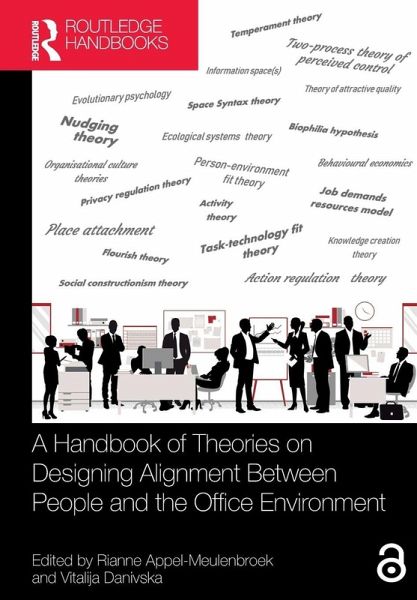
This first book in the series focuses on the employee as a user of the work environment. The 21 theories, that are discussed and applied to workplace design in this book, address people's ability to do their job and thrive in relation to the office workplace.
This first book in the series focuses on the employee as a user of the work environment. The 21 theories, that are discussed and applied to workplace design in this book, address people's ability to do their job and thrive in relation to the office workplace.
Dr Ir Rianne Appel-Meulenbroek is an associate professor in corporate real estate (CRE) and workplace at the Department of the Built Environment at Eindhoven University of Technology. She is Chair of the Transdisciplinary Workplace Research (TWR) network, co-editor of the Journal of CRE, and a regular speaker at international events. In her research, she approaches workplaces as an important strategic resource for knowledge organizations, studying how they should be managed strategically and how workplace design and use aspects impact employee and organizational outcomes. Dr Vitalija Danivska is a postdoctoral researcher in the Department of Built Environment at Aalto University, Finland. With a background in real estate economics, she is particularly interested in the real estate business and corporate, facilities management areas. In 2018, she obtained her doctoral degree with her thesis studying the 'Workplace-as-a-Service' concept. She received the EuroFM 2020 Best Paper award, was the runner-up for the 2018 EuroFM Researcher of the Year award, and organized the first TWR conference in 2018 in Tampere, Finland.
Inhaltsangabe
1. Gathering theories to explain employee-workplace alignment from an interdisciplinary viewpoint 2. Person-environment fit theory: application to the design of work environments 3. Job demands-resources model: its applicability to the workplace environment and human flourishing 4. Task-technology fit theory: an approach for mitigating technostress 5. Action regulation theory 6. Privacy regulation theory: redevelopment and application to work privacy 7. Information space(s) 8. Social constructionism theory: constructing the user experience of workplace 9. Ecological systems theory 10. Temperament theory: understanding people in a workplace context 11. Two-process theory of perceived control: changing the workspace and changing the self 12. Organisational culture theories: dimensions of organisational culture and office layouts 13. Theory of attractive quality: occupant satisfaction with indoor environmental quality at workplaces 14. Flourish theory: a model for multisensory human-centric design 15. Biophilia hypothesis: the benefits of nature in the workplace 16. Place attachment theory 17. Evolutionary psychology theory: can I ever let go of my past? 18. Behavioural economics theory: masters of deviations, irrationalities, and biases 19. Nudging in the workplace: facilitating desirable behaviour by changing the environment 20. Activity theory: a framework for understanding the interrelations between users and workplace design 21. Space syntax theory: understanding human movement, co-presence and encounters in relation to the spatial structure of workplaces 22. Organisational knowledge creation theory and knowledge workplaces 23. Towards an interdisciplinary employee-workplace alignment theory
1. Gathering theories to explain employee-workplace alignment from an interdisciplinary viewpoint 2. Person-environment fit theory: application to the design of work environments 3. Job demands-resources model: its applicability to the workplace environment and human flourishing 4. Task-technology fit theory: an approach for mitigating technostress 5. Action regulation theory 6. Privacy regulation theory: redevelopment and application to work privacy 7. Information space(s) 8. Social constructionism theory: constructing the user experience of workplace 9. Ecological systems theory 10. Temperament theory: understanding people in a workplace context 11. Two-process theory of perceived control: changing the workspace and changing the self 12. Organisational culture theories: dimensions of organisational culture and office layouts 13. Theory of attractive quality: occupant satisfaction with indoor environmental quality at workplaces 14. Flourish theory: a model for multisensory human-centric design 15. Biophilia hypothesis: the benefits of nature in the workplace 16. Place attachment theory 17. Evolutionary psychology theory: can I ever let go of my past? 18. Behavioural economics theory: masters of deviations, irrationalities, and biases 19. Nudging in the workplace: facilitating desirable behaviour by changing the environment 20. Activity theory: a framework for understanding the interrelations between users and workplace design 21. Space syntax theory: understanding human movement, co-presence and encounters in relation to the spatial structure of workplaces 22. Organisational knowledge creation theory and knowledge workplaces 23. Towards an interdisciplinary employee-workplace alignment theory
Es gelten unsere Allgemeinen Geschäftsbedingungen: www.buecher.de/agb
Impressum
www.buecher.de ist ein Internetauftritt der buecher.de internetstores GmbH
Geschäftsführung: Monica Sawhney | Roland Kölbl | Günter Hilger
Sitz der Gesellschaft: Batheyer Straße 115 - 117, 58099 Hagen
Postanschrift: Bürgermeister-Wegele-Str. 12, 86167 Augsburg
Amtsgericht Hagen HRB 13257
Steuernummer: 321/5800/1497
USt-IdNr: DE450055826