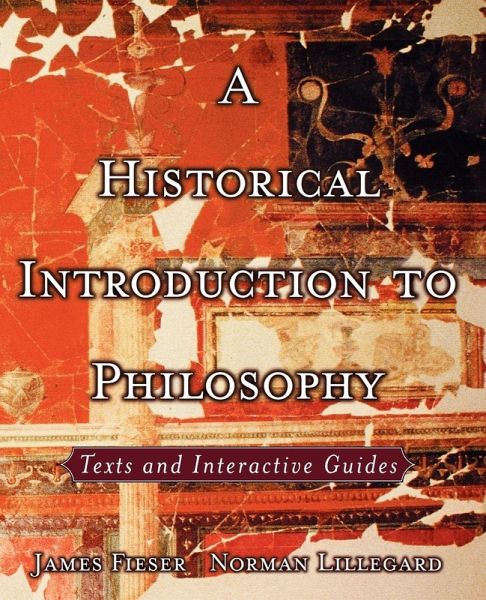
Featuring a unique pedagogical apparatus, A Historical Introduction to Philosophy: Texts and Interactive Guides provides selections from the most influential primary works in philosophy from the Presocratics through the twentieth century, integrating them with substantial commentary and study questions. It offers extensive treatment of the Hellenistic and Renaissance periods--which are typically given only minimal coverage in other anthologies--and devotes substantial chapters to nineteenth- and twentieth-century philosophy. The selections are organized historically and are presented in short…mehr
Featuring a unique pedagogical apparatus, A Historical Introduction to Philosophy: Texts and Interactive Guides provides selections from the most influential primary works in philosophy from the Presocratics through the twentieth century, integrating them with substantial commentary and study questions. It offers extensive treatment of the Hellenistic and Renaissance periods--which are typically given only minimal coverage in other anthologies--and devotes substantial chapters to nineteenth- and twentieth-century philosophy. The selections are organized historically and are presented in short and manageable sections with organizational headings and subheadings; archaic and difficult material has been adapted for clarity. Accompanying commentaries simplify difficult passages, explain technical terminology, and expand upon allusions to unfamiliar literature and arguments. Study questions are interspersed throughout the chapters in "Ask Yourself" boxes and vary with respect to format and level of difficulty. They require students to reconstruct arguments, summarize passages, complete blanks in statements and arguments, evaluate the success or viability of a philosophical point, or draw contemporary parallels and applications. The questions are carefully framed so as to avoid commitment to any particular side in controversies. Instructors can assign those questions that will best suit the aims of their courses and aid their students' comprehension of the primary source material. A Historical Introduction to Philosophy is enhanced by a comprehensive time line, a glossary, and lists of suggested further readings for both primary and secondary sources. This rich and flexible anthology and interactive textbook is ideal for introduction to philosophy and history of philosophy courses.
* * * 1. EARLY GREEK PHILOSOPHY * Introduction * Homer and Hesiod * Principal concerns of the Presocratics * Milesians * Thales * Anaximander * Anaximenes * Other Ionians * Xenophanes * Pythagoras and the Pythagoreans * Heraclitus * The Eleatics * Parmenides * Zeno * Pluralist Alternatives to Parmenides * Empedocles * Anaxagoras * The Atomists: Parmenides as Pluralist * The Sophists: Rhetoric and Virtue for a Price * Protagoras and Gorgias * 2. SOCRATES AND PLATO * Introduction * Socrates * The Euthyphro * Meno * The Apology * Plato * Introduction to the Theory of Forms * Phaedo * The Republic * Phaedrus * 3. ARISTOTLE * Introduction * Logical Works * Categories * Nature and the Soul * Physics * On the Soul * Ethics * Book 1 * Book 2 * Book 3 * 4. HELLENISTIC PHILOSOPHY * Epicureanism * Atoms and Free Will * Fearing the Gods * Fear of Death * Pleasure and Pain * Prudence and Freedom * Stoicism * Zeno of Citium: Logic, Physics, and Ethics * Epictetus * Cynicism * Antisthenes and Diogenes * Skepticism * Academics and Pyrrhonians * The Goal and Criterion of Skepticism * The Ten Modes of Skepticism * 5. MEDIEVAL PHILOSOPHY * Augustine * Book 1. Good and Evil * Book 2. * Book 3. * The Confessions: Augustine on Time * Anselm * Proslogion 1 * Averroes (from The Decisive Treatise Determining the Nature of the Connection Between Religion and Philosophy) * Chapter 2: Philosophy and Religion Belong Together * Chapter 3: The Elite and Ordinary Believers * Moses Maimonides (from The Guide for the Perplexed) * God and Biblical Language * Thomas Aquinas (from Summa Theologica) * The Existence of God * Natural Law * 6. RENAISSANCE AND EARLY MODERN PHILOSOPHY * Humanism * Pico's Oration * More's Utopia * The Reformation * Luther's Appeal * Calvin's Institutes * Fideism and Skepticism * Montaigne's Apology (from "Apology for Raymond Sebond") * Bayle's Dictionary (from "Psyrrho" in Historical and Critical Dictionary) * Pascal's Wager (from Thoughts) * Astronomy * The Earth-Centered System of the Universe * Copernicus ("Dedication" to On the Revolutions of * the Heavenly Spheres) * Galileo (from "letter to Giacomo Muti," and Dialogues on the Two Chief Systems of the World) * Newton (from "Preface" to Principia Mathematica) * Implications of Modern Astronomy * Scientific Method * Bacon and Induction * Descartes's Method * Newton's Method of Investigation (from Principia Mathematica and Optics) * Mathematics and Scientific Method * 7. RATIONALISM * René Descartes * Meditation 1: Concerning Those Things That Can Be Called Into Doubt * Meditation 2: Concerning the Nature of the Human Mind: That the Mind Is More Known Than the Body * Meditation 3: Of God: That He Exists * Meditation 6: Of the Existence of Material Things, and of the Real Distinction between the Soul and Body of Man * Supplementary Selections * Benedict Spinoza (from The Ethics) * God Does Not Willfully Direct the Course of Nature * Nicholas Malebranche (from The Search after Truth) * Chapter 1, Section 1: What Is Meant by Ideas; That They Truly Exist, and That They Are Necessary to Perceive All Material Objects * Chapter 6: That We See All Things Through God * Occasionalism * Gottfried Wilhelm Leibniz * Monads * Human Perception * Good * Body and Soul * The Human Spirit * Against Atoms and a Vacuum * Anne Conway * All Creatures Are Changeable * Against Descartes, Hobbes, and Spinoza * 8. BRITISH EMPIRICISM * John Locke (from Essay Concerning Human Understanding) * 1:2: No Speculative Innate Principles in the Mind * 2:1: Of Ideas in General and Their Origin * 2:2: Of Simple Ideas * 2:3: Of Simple Ideas of Sense * 2:5: Of Simple Ideas of Diverse Senses * 2:6: Of Simple Ideas of Reflection * 2:7: Of Simple Ideas of Both Sensation and Reflection * 2:8: Some Farther Considerations Concerning Our Simple Ideas * 2:12: Of Complex Ideas * 4:3: Of the Extent of Human Knowledge * 4:9: Of Our Threefold Knowledge of Existence * 4.11: Of Our Knowledge of the Existence of Other Things * George Berkeley * Dialogue One * Dialogue Two * Dialogue Three * David Hume (from Enquiries and Treatise of Human Nature * Section 2: Of the Origin of Ideas * Section 3: Of the Association of Ideas * Section 7: Of the Idea of Necessary Connection * Section 10: Of Miracles * Section 12: Of The Academical or Skeptical Philosophy * Personal Identity * Moral Theory * 9. LATE MODERN AND NINETEETH-CENTURY PHILOSOPHY * Thomas Reid (from Inquiry into the Human Mind) * Introduction * Chapter II. Of Smelling * Immanuel Kant (from Prolegomena to Any Future Metaphysics and Groundwork of the Metaphysics of Morals) * Introduction * Preamble on the Peculiarities of All Metaphysical Knowledge * How Is Pure Mathematics Possible? * How Is the Science of Nature Possible? * How Is Metaphysics in General Possible? * Kant's Ethical Theory * Georg Wilhelm Friedrich Hegel (from Preface to Phenomenology of Mind ) * Introduction * Philosophy and History * The Unity of Subject and Object * History as Rational * Soren Kierkegaard (from Either/Or vol. I and II) * Introduction: Kierkegaard's "Existentialism" * The Life of Enjoyment * The Ethical Life * Mary Wollstonecraft (from Vindication of the Rights of Women) * The Rights of Women; True Virtue and True Social Flourishing * Eduation, Virtue, and the Need for a Revolution in Manners * John Stuart Mill (from Utilitarianism) * 1: General Remarks * 2: What Utilitarianism Is * Friedrich Nietzsche (from The Birth of Tragedy, The Genealogy of Morals, The Joyful Science, and Thus Spake Zarathustra) * Art, Morality, and Religion * The Critique of Morality * The Death of God * TWENTIETH-CENTURY AND CONTEMPORARY PHILOSOPHY * Bertrand Russell * Knowledge by Acquaintance and Knowledge by * Description * Ludwig Wittgenstein * Introduction * Language and Use * Willard Van Orman Quine * The Nature of Modern Empiricism * Background for Analyticity * Definition * Interchangeability * The Verification Theory and Reductionism * Empiricism without the Dogmas * Jean-Paul Sartre * Freedom in a Godless World * G.E.M. Anscombe * Modern Moral Philosophy * *
* * * 1. EARLY GREEK PHILOSOPHY * Introduction * Homer and Hesiod * Principal concerns of the Presocratics * Milesians * Thales * Anaximander * Anaximenes * Other Ionians * Xenophanes * Pythagoras and the Pythagoreans * Heraclitus * The Eleatics * Parmenides * Zeno * Pluralist Alternatives to Parmenides * Empedocles * Anaxagoras * The Atomists: Parmenides as Pluralist * The Sophists: Rhetoric and Virtue for a Price * Protagoras and Gorgias * 2. SOCRATES AND PLATO * Introduction * Socrates * The Euthyphro * Meno * The Apology * Plato * Introduction to the Theory of Forms * Phaedo * The Republic * Phaedrus * 3. ARISTOTLE * Introduction * Logical Works * Categories * Nature and the Soul * Physics * On the Soul * Ethics * Book 1 * Book 2 * Book 3 * 4. HELLENISTIC PHILOSOPHY * Epicureanism * Atoms and Free Will * Fearing the Gods * Fear of Death * Pleasure and Pain * Prudence and Freedom * Stoicism * Zeno of Citium: Logic, Physics, and Ethics * Epictetus * Cynicism * Antisthenes and Diogenes * Skepticism * Academics and Pyrrhonians * The Goal and Criterion of Skepticism * The Ten Modes of Skepticism * 5. MEDIEVAL PHILOSOPHY * Augustine * Book 1. Good and Evil * Book 2. * Book 3. * The Confessions: Augustine on Time * Anselm * Proslogion 1 * Averroes (from The Decisive Treatise Determining the Nature of the Connection Between Religion and Philosophy) * Chapter 2: Philosophy and Religion Belong Together * Chapter 3: The Elite and Ordinary Believers * Moses Maimonides (from The Guide for the Perplexed) * God and Biblical Language * Thomas Aquinas (from Summa Theologica) * The Existence of God * Natural Law * 6. RENAISSANCE AND EARLY MODERN PHILOSOPHY * Humanism * Pico's Oration * More's Utopia * The Reformation * Luther's Appeal * Calvin's Institutes * Fideism and Skepticism * Montaigne's Apology (from "Apology for Raymond Sebond") * Bayle's Dictionary (from "Psyrrho" in Historical and Critical Dictionary) * Pascal's Wager (from Thoughts) * Astronomy * The Earth-Centered System of the Universe * Copernicus ("Dedication" to On the Revolutions of * the Heavenly Spheres) * Galileo (from "letter to Giacomo Muti," and Dialogues on the Two Chief Systems of the World) * Newton (from "Preface" to Principia Mathematica) * Implications of Modern Astronomy * Scientific Method * Bacon and Induction * Descartes's Method * Newton's Method of Investigation (from Principia Mathematica and Optics) * Mathematics and Scientific Method * 7. RATIONALISM * René Descartes * Meditation 1: Concerning Those Things That Can Be Called Into Doubt * Meditation 2: Concerning the Nature of the Human Mind: That the Mind Is More Known Than the Body * Meditation 3: Of God: That He Exists * Meditation 6: Of the Existence of Material Things, and of the Real Distinction between the Soul and Body of Man * Supplementary Selections * Benedict Spinoza (from The Ethics) * God Does Not Willfully Direct the Course of Nature * Nicholas Malebranche (from The Search after Truth) * Chapter 1, Section 1: What Is Meant by Ideas; That They Truly Exist, and That They Are Necessary to Perceive All Material Objects * Chapter 6: That We See All Things Through God * Occasionalism * Gottfried Wilhelm Leibniz * Monads * Human Perception * Good * Body and Soul * The Human Spirit * Against Atoms and a Vacuum * Anne Conway * All Creatures Are Changeable * Against Descartes, Hobbes, and Spinoza * 8. BRITISH EMPIRICISM * John Locke (from Essay Concerning Human Understanding) * 1:2: No Speculative Innate Principles in the Mind * 2:1: Of Ideas in General and Their Origin * 2:2: Of Simple Ideas * 2:3: Of Simple Ideas of Sense * 2:5: Of Simple Ideas of Diverse Senses * 2:6: Of Simple Ideas of Reflection * 2:7: Of Simple Ideas of Both Sensation and Reflection * 2:8: Some Farther Considerations Concerning Our Simple Ideas * 2:12: Of Complex Ideas * 4:3: Of the Extent of Human Knowledge * 4:9: Of Our Threefold Knowledge of Existence * 4.11: Of Our Knowledge of the Existence of Other Things * George Berkeley * Dialogue One * Dialogue Two * Dialogue Three * David Hume (from Enquiries and Treatise of Human Nature * Section 2: Of the Origin of Ideas * Section 3: Of the Association of Ideas * Section 7: Of the Idea of Necessary Connection * Section 10: Of Miracles * Section 12: Of The Academical or Skeptical Philosophy * Personal Identity * Moral Theory * 9. LATE MODERN AND NINETEETH-CENTURY PHILOSOPHY * Thomas Reid (from Inquiry into the Human Mind) * Introduction * Chapter II. Of Smelling * Immanuel Kant (from Prolegomena to Any Future Metaphysics and Groundwork of the Metaphysics of Morals) * Introduction * Preamble on the Peculiarities of All Metaphysical Knowledge * How Is Pure Mathematics Possible? * How Is the Science of Nature Possible? * How Is Metaphysics in General Possible? * Kant's Ethical Theory * Georg Wilhelm Friedrich Hegel (from Preface to Phenomenology of Mind ) * Introduction * Philosophy and History * The Unity of Subject and Object * History as Rational * Soren Kierkegaard (from Either/Or vol. I and II) * Introduction: Kierkegaard's "Existentialism" * The Life of Enjoyment * The Ethical Life * Mary Wollstonecraft (from Vindication of the Rights of Women) * The Rights of Women; True Virtue and True Social Flourishing * Eduation, Virtue, and the Need for a Revolution in Manners * John Stuart Mill (from Utilitarianism) * 1: General Remarks * 2: What Utilitarianism Is * Friedrich Nietzsche (from The Birth of Tragedy, The Genealogy of Morals, The Joyful Science, and Thus Spake Zarathustra) * Art, Morality, and Religion * The Critique of Morality * The Death of God * TWENTIETH-CENTURY AND CONTEMPORARY PHILOSOPHY * Bertrand Russell * Knowledge by Acquaintance and Knowledge by * Description * Ludwig Wittgenstein * Introduction * Language and Use * Willard Van Orman Quine * The Nature of Modern Empiricism * Background for Analyticity * Definition * Interchangeability * The Verification Theory and Reductionism * Empiricism without the Dogmas * Jean-Paul Sartre * Freedom in a Godless World * G.E.M. Anscombe * Modern Moral Philosophy * *
Es gelten unsere Allgemeinen Geschäftsbedingungen: www.buecher.de/agb
Impressum
www.buecher.de ist ein Internetauftritt der buecher.de internetstores GmbH
Geschäftsführung: Monica Sawhney | Roland Kölbl | Günter Hilger
Sitz der Gesellschaft: Batheyer Straße 115 - 117, 58099 Hagen
Postanschrift: Bürgermeister-Wegele-Str. 12, 86167 Augsburg
Amtsgericht Hagen HRB 13257
Steuernummer: 321/5800/1497
USt-IdNr: DE450055826





![The Philosophy of Beards [electronic Resource]: a Lecture: Physiological, Artistic & Historical](https://bilder.buecher.de/produkte/65/65630/65630995m.jpg "The Philosophy of Beards [electronic Resource]: a Lecture: Physiological, Artistic & Historical")