
Andere Kunden interessierten sich auch für
 A History of British Eugenics since 1865106,99 €
 Race, Ethnicity and the Women's Movement in England, 1968-199361,99 €
 John Venn: Unpublished Writings and Selected Correspondence98,99 €
 John Venn: Unpublished Writings and Selected Correspondence98,99 €
 Pharmacy and Professionalization in the British Empire, 1780-197098,99 €
 Pharmacy and Professionalization in the British Empire, 1780-197098,99 €
 Why Trust Science?18,99 €


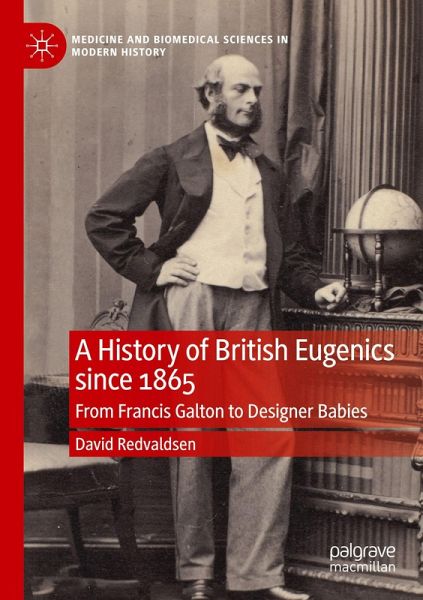
This book examines British eugenics from its origins in 1865 to the early 1990s. It considers the two institutions promoting the doctrine: the Galton Laboratory attached to the University of London; and the Eugenics Society. It charts internal and ideological changes across more than a century, seeing eugenics as primarily a political movement. The doctrine had influence on British society and guided adherents ranging from scientists to charitable ladies. The Galton Laboratory published detailed studies of heredity. It transformed itself into a centre for medical genetics after the Second World War. As early as the 1920s, the Eugenics Society was the mainspring of the doctrine, formulating what became the British version of an international ideology. It began as applied social Darwinism, later incorporating a greater degree of meritocracy and amelioration. Its support for sterilization in the 1930s eroded the kudos it had gained in policy-making circles. From the 1960s, organized eugenics was especially a forum for learned and popular discussion of biology and sociology. Medical advances after 1970 aided its continuation, notably the growth of assisted reproductive technologies. The book presents British eugenics as mostly shaped by domestic concerns, offering new revelations and interpretations with the capacity to readjust historical thinking. It also covers contemporary bioethical and political issues aligned to eugenics.
One of the book s positive qualities is its outstanding synthesis. Redvaldsen s ability to conduct such thorough research and compose a volume meticulously portraying the British history of eugenics is impressive. The bibliography is massive and thoughtfully used throughout the book . Redvaldsen s successful survey and reassessment of the history of British eugenics from its beginning to the present day fills a gap in the eugenics bibliography. It should be studied by scholars, students and even non-academic readers . (Alexandra Barmpouti, European History Quarterly, Vol. 55 (4), 2025)
The book is well researched and accessible. ... this is a must-read for anyone interested in the history of eugenics. (Kostas Kampourakis, The Quarterly Review of Biology, Vol. 100 (2), 2025)
The book is well researched and accessible. ... this is a must-read for anyone interested in the history of eugenics. (Kostas Kampourakis, The Quarterly Review of Biology, Vol. 100 (2), 2025)
The book is well researched and accessible. ... this is a must-read for anyone interested in the history of eugenics. (Kostas Kampourakis, The Quarterly Review of Biology, Vol. 100 (2), 2025)