
Andere Kunden interessierten sich auch für
 A History of Modern Culture78,99 €
 Gender in Early Modern German History47,99 €
 A History of Modern Europe43,99 €
 Print Culture in Early Modern France108,99 €
 The New Cambridge Modern History133,99 €
 The Cambridge Economic History of Modern Europe, Volume 2143,99 €
 The Cambridge Economic History of Modern Europe, Volume 1147,99 €




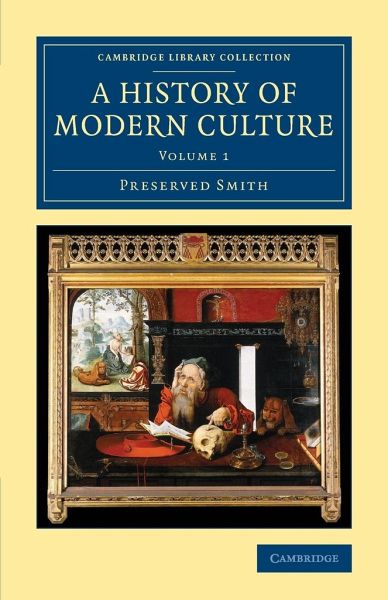
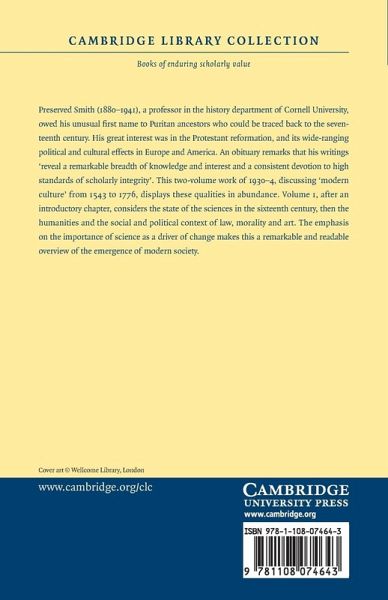
Preserved Smith (1880-1941), a professor in the history department of Cornell University, owed his unusual first name to Puritan ancestors who could be traced back to the seventeenth century. His great interest was in the Protestant reformation, and its wide-ranging political and cultural effects in Europe and America. An obituary remarks that his writings 'reveal a remarkable breadth of knowledge and interest and a consistent devotion to high standards of scholarly integrity'. This two-volume work of 1930-4, discussing 'modern culture' from 1543 to 1776, displays these qualities in abundance. Volume 1, after an introductory chapter, considers the state of the sciences in the sixteenth century, then the humanities and the social and political context of law, morality and art. The emphasis on the importance of science as a driver of change makes this a remarkable and readable overview of the emergence of modern society.