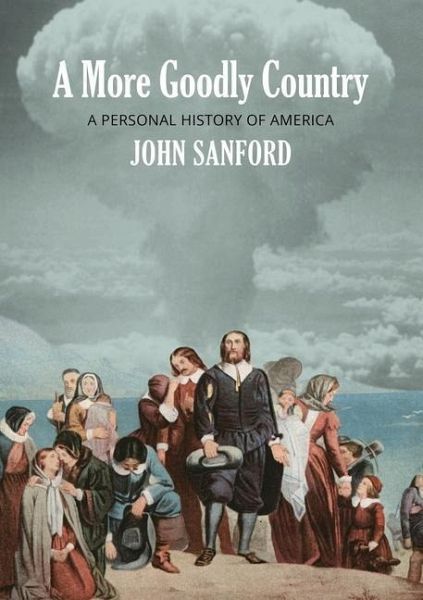
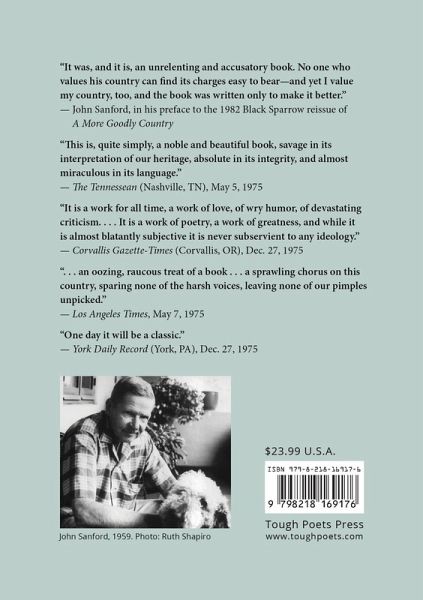
Beginning in A.D. 1000 with Leif Ericson and ending with the dropping of the atomic bomb on Hiroshima in 1945, John Sanford (1904-2003), recipient of the PEN Award and the Los Angeles Times Lifetime Achievement Award, presents in poetic prose a searing personal history of the United States. "It was, and it is, an unrelenting and accusatory book. No one who values his country can find its charges easy to bear-and yet I value my country, too, and the book was written only to make it better." - John Sanford, in his preface to the 1982 Black Sparrow reissue of A More Goodly Country
Beginning in A.D. 1000 with Leif Ericson and ending with the dropping of the atomic bomb on Hiroshima in 1945, John Sanford (1904-2003), recipient of the PEN Award and the Los Angeles Times Lifetime Achievement Award, presents in poetic prose a searing personal history of the United States. "It was, and it is, an unrelenting and accusatory book. No one who values his country can find its charges easy to bear-and yet I value my country, too, and the book was written only to make it better." - John Sanford, in his preface to the 1982 Black Sparrow reissue of A More Goodly Country
John Sanford was born Julian L. Shapiro on May 31, 1904, and died on March 5, 2003. He was the author of 24 books, including novels, creative interpretations of history, and several volumes of memoir and autobiography.While studying law at Fordham University, Sanford had a chance encounter with his childhood acquaintance Nathan Weinstein, who was then going by the name of Nathanael West (later known for such works as Miss Lonelyhearts and The Day of the Locust) and working on his first novel. Inspired by West, he ultimately decided to devote all his time to writing. William Carlos Williams, Ernest Hemingway, and James Joyce were also important early influences on Sanford's themes and style.In 1935, Shapiro adopted as his pen name John Sanford, the protagonist in his first novel, The Water Wheel (1933), in hopes that, in a time of rising antisemitism in the U.S., a gentile name would aid book sales.Sanford was married for over 50 years to screenwriter Marguerite Roberts, who is best known for scripting John Wayne's 1969 Oscar-winner, True Grit. Both Sanford and Roberts were blacklisted during the McCarthy era of the 1950s.Sanford wrote half of his books after he was 80. He published a five-volume autobiography. He received a PEN Award and the Los Angeles Times Lifetime Achievement Award. He left three unpublished books and was writing up until a month before his death at the age of 98. During his later years, Sanford was variously described as the "most unjustly neglected major writer in America" and "America's greatest unread writer." Just before his death, the Los Angeles Times hailed Sanford as "an authentic hero of American letters."
Es gelten unsere Allgemeinen Geschäftsbedingungen: www.buecher.de/agb
Impressum
www.buecher.de ist ein Internetauftritt der buecher.de internetstores GmbH
Geschäftsführung: Monica Sawhney | Roland Kölbl | Günter Hilger
Sitz der Gesellschaft: Batheyer Straße 115 - 117, 58099 Hagen
Postanschrift: Bürgermeister-Wegele-Str. 12, 86167 Augsburg
Amtsgericht Hagen HRB 13257
Steuernummer: 321/5800/1497
USt-IdNr: DE450055826

![The Northern Pacific Railroad [microform]: Its Land Grant, Resources, Traffic and Tributary Country: Valley Route to the Pacific](https://bilder.buecher.de/produkte/65/65598/65598021m.jpg "The Northern Pacific Railroad [microform]: Its Land Grant, Resources, Traffic and Tributary Country: Valley Route to the Pacific")