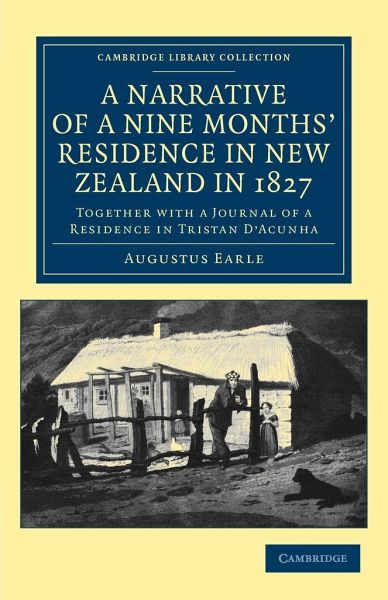
Augustus Earle (1793-1838) was a professional watercolour artist specialising in colonial themes. He exhibited at the Royal Academy from the age of thirteen and in 1815 travelled to the Mediterranean. He spent the next fifteen years touring the world and in 1832, when this book was published, was briefly employed by Darwin on H.M.S. Beagle, though he left that expedition in Montevideo owing to ill health. The first part of the book describes Earle's experiences in New Zealand, where he observed in detail the lifestyle of the pre-colonial Maori and the early European settlers. The second part…mehr
Augustus Earle (1793-1838) was a professional watercolour artist specialising in colonial themes. He exhibited at the Royal Academy from the age of thirteen and in 1815 travelled to the Mediterranean. He spent the next fifteen years touring the world and in 1832, when this book was published, was briefly employed by Darwin on H.M.S. Beagle, though he left that expedition in Montevideo owing to ill health. The first part of the book describes Earle's experiences in New Zealand, where he observed in detail the lifestyle of the pre-colonial Maori and the early European settlers. The second part tells how in 1824 Earle, travelling from Rio to Cape Town, found himself left behind on the Atlantic island of Tristan da Cunha and spent eight months sharing the simple life of the tiny British community there and tutoring their children until finally a rare passing ship took him on board.
Augustus Earle was a British painter born on June 1, 1793, in London, United Kingdom. He was the son of James Earl and Georgina Caroline Pitt Pilkington. Earle's career as an artist was distinct for his independence, unlike many earlier artists who were often employed by wealthy patrons or explorers. He had a strong desire for travel and adventure, which he combined with his artistic abilities to support himself. This allowed him to work freely, traveling to various parts of the world and documenting his experiences through his art. His works provide a visual record of many places he visited, including New Zealand, where he captured the landscapes and people of the region. Despite his relatively short life, as he passed away on December 10, 1838, at the age of 45, Earle's paintings and sketches remain significant for their detailed and vivid depictions of the early 19th century world. His work can be found on display at the National Gallery of Australia.
Es gelten unsere Allgemeinen Geschäftsbedingungen: www.buecher.de/agb
Impressum
www.buecher.de ist ein Internetauftritt der buecher.de internetstores GmbH
Geschäftsführung: Monica Sawhney | Roland Kölbl | Günter Hilger
Sitz der Gesellschaft: Batheyer Straße 115 - 117, 58099 Hagen
Postanschrift: Bürgermeister-Wegele-Str. 12, 86167 Augsburg
Amtsgericht Hagen HRB 13257
Steuernummer: 321/5800/1497
USt-IdNr: DE450055826