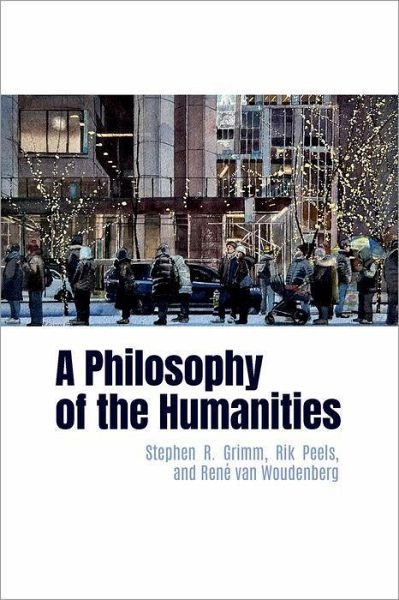
Co-authored by three philosophers, this ground-breaking book explores a range of new and classic questions concerning the humanities. For example, do the humanities (like the sciences) really make progress? Is there anything that unifies scholarship in the humanities, across fields as diverse as history, literary studies, philosophy, and musicology? And what should we make of the political aims of the humanities--for example, the desire by many scholars in the humanities to uncover systems of oppression and domination?
Co-authored by three philosophers, this ground-breaking book explores a range of new and classic questions concerning the humanities. For example, do the humanities (like the sciences) really make progress? Is there anything that unifies scholarship in the humanities, across fields as diverse as history, literary studies, philosophy, and musicology? And what should we make of the political aims of the humanities--for example, the desire by many scholars in the humanities to uncover systems of oppression and domination?
Stephen R. Grimm is Professor of Philosophy and Chair of the Philosophy Department at Fordham University in New York. He is Series Editor for the Oxford University Press series "Guides to the Good Life," and author of Varieties of Understanding (2019) and Making Sense of the World (2017). He is a Lifetime Member of Clare Hall, Cambridge University. Rik Peels is University Research Chair in Analytic and Interdisciplinary Philosophy of Religion at the Department of Beliefs and Practices and the Philosophy Department at the Vrije Universiteit Amsterdam in the Netherlands. He is also a Senior Research Associate at the African Centre for Epistemology and Philosophy of Science at the University of Johannesburg in South-Africa. He is the author of numerous books, including Ignorance (2023), and Responsible Belief (2016). He currently leads an ERC-funded project on Extreme Beliefs: The Epistemology and Ethics of Fundamentalism. René van Woudenberg is Dean of the Faculty of Humanities and Professor at CLUE+, the Interfaculty Research Institute for Culture, Cognition, History, and Hertiage at the Vrije Universiteit Amsterdam. He is the co-editor of The Cambridge Companion to Common-Sense Philosophy (2020), and Scientism: Prospects and Problems (2018).
Inhaltsangabe
Preface Chapter 1: Philosophy of the Humanities: What and Why? Chapter 2: The Objects of the Humanities Chapter 3: The Epistemic Goals of the Humanities Chapter 4: Authority and Deference in the Humanities Chapter 5: Methods and Interpretation in the Humanities Chapter 6: Perspectives, Social Constructions, Standpoints, and Truth in the Humanities Chapter 7: The Humanities and Political Aims Chapter 8: Progress in the Humanities Chapter 9: Replication in the Humanities Chapter 10: The Future of the Philosophy of the Humanities Bibliography Index
Preface Chapter 1: Philosophy of the Humanities: What and Why? Chapter 2: The Objects of the Humanities Chapter 3: The Epistemic Goals of the Humanities Chapter 4: Authority and Deference in the Humanities Chapter 5: Methods and Interpretation in the Humanities Chapter 6: Perspectives, Social Constructions, Standpoints, and Truth in the Humanities Chapter 7: The Humanities and Political Aims Chapter 8: Progress in the Humanities Chapter 9: Replication in the Humanities Chapter 10: The Future of the Philosophy of the Humanities Bibliography Index
Es gelten unsere Allgemeinen Geschäftsbedingungen: www.buecher.de/agb
Impressum
www.buecher.de ist ein Internetauftritt der buecher.de internetstores GmbH
Geschäftsführung: Monica Sawhney | Roland Kölbl | Günter Hilger
Sitz der Gesellschaft: Batheyer Straße 115 - 117, 58099 Hagen
Postanschrift: Bürgermeister-Wegele-Str. 12, 86167 Augsburg
Amtsgericht Hagen HRB 13257
Steuernummer: 321/5800/1497
USt-IdNr: DE450055826