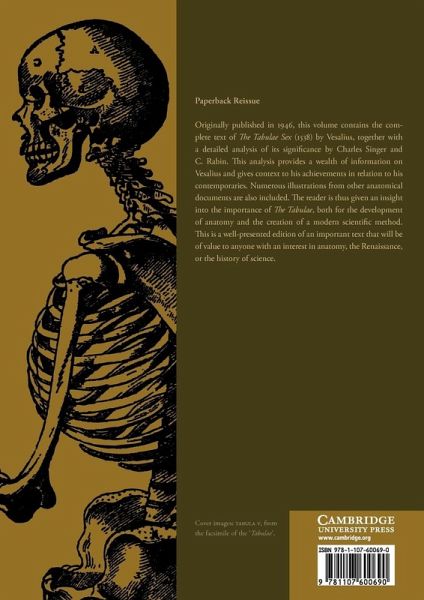
Originally published in 1946, this volume contains the complete text of the Tabulae anatomicae sex (1538) by Vesalius, together with a detailed analysis of its significance by Charles Singer and C. Rabin. This analysis provides a wealth of information on Vesalius and contextualizes his achievements in terms of the contemporary context, numerous illustrations from other anatomical documents are also included. The reader is thus given an insight into the importance of the Tabulae, both for the development of anatomy and the creation of a modern scientific method. This is a well-presented edition…mehr
Originally published in 1946, this volume contains the complete text of the Tabulae anatomicae sex (1538) by Vesalius, together with a detailed analysis of its significance by Charles Singer and C. Rabin. This analysis provides a wealth of information on Vesalius and contextualizes his achievements in terms of the contemporary context, numerous illustrations from other anatomical documents are also included. The reader is thus given an insight into the importance of the Tabulae, both for the development of anatomy and the creation of a modern scientific method. This is a well-presented edition of an important text that will be of value to anyone with an interest in anatomy, the Renaissance, or the history of science.
Part I. Character and Purpose of the Tabulae: 1. The Vesalian problem 2. Advent of the graphic method 3. The art of the Tabulae Part II. Vesalius and the schools of Louvain and Paris: 1. Early years of Vesalius 2. Anatomy at Paris 3. Charles Estienne 4. Vesalius at Paris 5. Vesalius returns to Louvain 6. Anatomical equipment of Vesalius in 1537 Part III. Italian Predecessors of Vesalius: 1. Early Italian Humanist anatomists 2. Early Italian illustrated anatomies 3. Massa (c.1480-1569) Part IV. Galenic Physiology and its Latin Presentation: 1. Basic principle of Galenic physiology 2. The Galenic physiological scheme Part V. Certain Anatomica Elements in the Tabulae: 1. Reliance of Vesalius on animal anatomy 2. Rete mitabile 3. Position and form of the heart 4. Branches of aortic arch 5. Superior vena cava 6. Caval system 7. Posterior intercostal vessels 8. Relative levels of kidneys and of renal vessels 9. Five equal lobes of liver 10. Homologies of generative organs of the two sexes 11. Prostate gland 12. Asymmetry of spermatic veins 13. Seven segments of sternum Part VI. Renaissance Anatomical Vocabulary: 1. General sources of the vocabulary 2. Direct sources of the 'modern' vocabulary 3. Anatomical incunabula 4. Contributions to the vocabulary from Renaissance antomies Part VII. Semitic elements in the Tabulae: 1. Introduction 2. History of Arabic anatomical nomenclature 3. Passage of Arabic anatomical nomenclature to Latin West 4. The Hebrew elements in the Renaissance anatomical vocabulary 5. Did Vesalius know Arabic and Hebrew? 6. General character of Medieval Hebrew 9. Hebraic corruptions in the Tabulae 10. General character of the Arabic vocabulary in the Tabulae 11. Hebraized Romace terms in the Tabulae Part VIII. Translation and Commentary Part IX. General Index Part X. Greek Index Part XI. Arabic Index Part XXII. Hebrew index Plates.
Part I. Character and Purpose of the Tabulae: 1. The Vesalian problem 2. Advent of the graphic method 3. The art of the Tabulae Part II. Vesalius and the schools of Louvain and Paris: 1. Early years of Vesalius 2. Anatomy at Paris 3. Charles Estienne 4. Vesalius at Paris 5. Vesalius returns to Louvain 6. Anatomical equipment of Vesalius in 1537 Part III. Italian Predecessors of Vesalius: 1. Early Italian Humanist anatomists 2. Early Italian illustrated anatomies 3. Massa (c.1480-1569) Part IV. Galenic Physiology and its Latin Presentation: 1. Basic principle of Galenic physiology 2. The Galenic physiological scheme Part V. Certain Anatomica Elements in the Tabulae: 1. Reliance of Vesalius on animal anatomy 2. Rete mitabile 3. Position and form of the heart 4. Branches of aortic arch 5. Superior vena cava 6. Caval system 7. Posterior intercostal vessels 8. Relative levels of kidneys and of renal vessels 9. Five equal lobes of liver 10. Homologies of generative organs of the two sexes 11. Prostate gland 12. Asymmetry of spermatic veins 13. Seven segments of sternum Part VI. Renaissance Anatomical Vocabulary: 1. General sources of the vocabulary 2. Direct sources of the 'modern' vocabulary 3. Anatomical incunabula 4. Contributions to the vocabulary from Renaissance antomies Part VII. Semitic elements in the Tabulae: 1. Introduction 2. History of Arabic anatomical nomenclature 3. Passage of Arabic anatomical nomenclature to Latin West 4. The Hebrew elements in the Renaissance anatomical vocabulary 5. Did Vesalius know Arabic and Hebrew? 6. General character of Medieval Hebrew 9. Hebraic corruptions in the Tabulae 10. General character of the Arabic vocabulary in the Tabulae 11. Hebraized Romace terms in the Tabulae Part VIII. Translation and Commentary Part IX. General Index Part X. Greek Index Part XI. Arabic Index Part XXII. Hebrew index Plates.
Es gelten unsere Allgemeinen Geschäftsbedingungen: www.buecher.de/agb
Impressum
www.buecher.de ist ein Internetauftritt der buecher.de internetstores GmbH
Geschäftsführung: Monica Sawhney | Roland Kölbl | Günter Hilger
Sitz der Gesellschaft: Batheyer Straße 115 - 117, 58099 Hagen
Postanschrift: Bürgermeister-Wegele-Str. 12, 86167 Augsburg
Amtsgericht Hagen HRB 13257
Steuernummer: 321/5800/1497
USt-IdNr: DE450055826