
Andere Kunden interessierten sich auch für
 A Primer of Permutation Statistical Methods68,99 €
 The Measurement of Association115,99 €
 Permutation Statistical Methods76,99 €
 A Medical Educator's Guide to Thinking Critically about Randomised Controlled Trials: Deconstructing the "Gold Standard"100,99 €
 Statistical Methods: Connections, Equivalencies, and Relationships130,99 €
 Statistical Methods: Connections, Equivalencies, and Relationships129,99 €
 Mindful Topics on Risk Analysis and Design of Experiments151,99 €
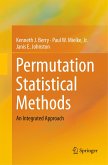
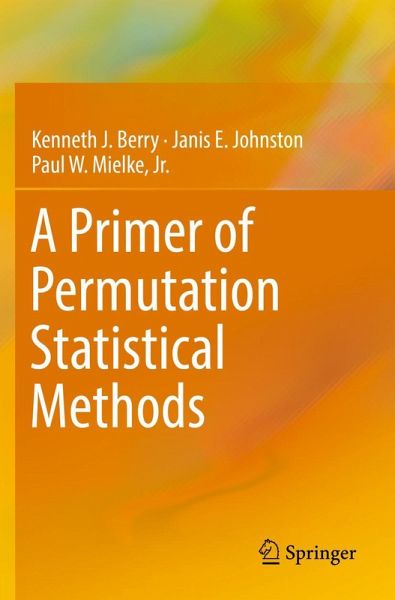
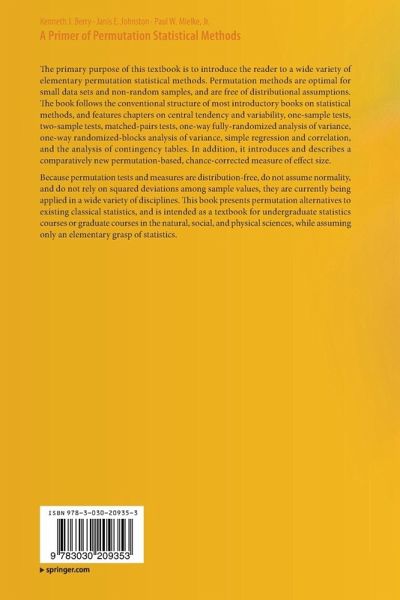
The primary purpose of this textbook is to introduce the reader to a wide variety of elementary permutation statistical methods. Permutation methods are optimal for small data sets and non-random samples, and are free of distributional assumptions. The book follows the conventional structure of most introductory books on statistical methods, and features chapters on central tendency and variability, one-sample tests, two-sample tests, matched-pairs tests, one-way fully-randomized analysis of variance, one-way randomized-blocks analysis of variance, simple regression and correlation, and the analysis of contingency tables. In addition, it introduces and describes a comparatively new permutation-based, chance-corrected measure of effect size.
Because permutation tests and measures are distribution-free, do not assume normality, and do not rely on squared deviations among sample values, they are currently being applied in a wide variety of disciplines. This book presents permutation alternatives to existing classical statistics, and is intended as a textbook for undergraduate statistics courses or graduate courses in the natural, social, and physical sciences, while assuming only an elementary grasp of statistics.
Because permutation tests and measures are distribution-free, do not assume normality, and do not rely on squared deviations among sample values, they are currently being applied in a wide variety of disciplines. This book presents permutation alternatives to existing classical statistics, and is intended as a textbook for undergraduate statistics courses or graduate courses in the natural, social, and physical sciences, while assuming only an elementary grasp of statistics.