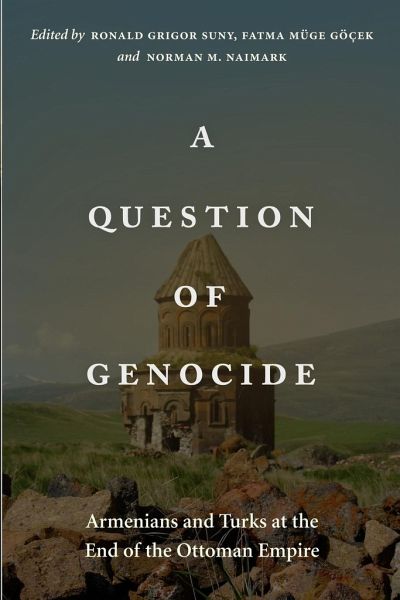
One hundred years after the deportations and mass murder of Armenians, Greeks, Assyrians, and other peoples in the final years of the Ottoman Empire, the history of the Armenian genocide is a victim of historical distortion, state-sponsored falsification, and deep divisions between Armenians and Turks. Working together for the first time, Turkish, Armenian, and other scholars present here a compelling reconstruction of what happened and why. This volume gathers the most up-to-date scholarship on Armenian genocide, looking at how the event has been written about in Western and Turkish…mehr
One hundred years after the deportations and mass murder of Armenians, Greeks, Assyrians, and other peoples in the final years of the Ottoman Empire, the history of the Armenian genocide is a victim of historical distortion, state-sponsored falsification, and deep divisions between Armenians and Turks. Working together for the first time, Turkish, Armenian, and other scholars present here a compelling reconstruction of what happened and why. This volume gathers the most up-to-date scholarship on Armenian genocide, looking at how the event has been written about in Western and Turkish historiographies; what was happening on the eve of the catastrophe; portraits of the perpetrators; detailed accounts of the massacres; how the event has been perceived in both local and international contexts, including World War I; and reflections on the broader implications of what happened then. The result is a comprehensive work that moves beyond nationalist master narratives and offers a more complete understanding of this tragic event.
Ronald Grigor Suny is the Charles Tilly Collegiate Professor of Social and Political History at the University of Michigan. Fatma Müge Göçek is Associate Professor of Sociology and Women's Studies at the University of Michigan. Norman M. Naimark is the Robert and Florence McDonnell Professor of East European Studies and Senior Fellow of the Hoover Institution at Stanford University.
Inhaltsangabe
* Preface- Norman M. Naimark * Introduction: Leaving It to the Historians-Ronald Grigor Suny and Fatma Mà ge Göçek * Part I Historiographies of the Genocide * Ch 1. Writing Genocide: The Fate of the Ottoman Armenians in Western Historiographies- Ronald Grigor Suny * Ch 2. Reading Genocide: Turkish Historiography on the Armenian Ethnic Cleansing- Fatma Mà ge Göçek * Part II On the Eve of Catastrophe * Ch3. The Silence of the Land: Agrarian Relations, Ethnicity, and Power- Stephan H. Astourian * Ch 4. What was Revolutionary about Armenian Political Parties in the Ottoman Empire?- Gerald J. Libaridian * Ch 5. Non-Muslims in the Ottoman Army and the Ottoman Defeat in the Balkan War of 1912-1913- Fikret Adanir * Ch 6. From Patriotism to Mass Murder: Dr. Mehmed Reshid (1873-1919)- Hans-Lukas Kieser * Part III Genocide in International Context * Ch 7. The Politics and Practice of the Russian Occupation of Armenia, 1915-February 1917- Peter Holquist * Ch 8. Germany and the Young Turks: Revolutionaries into Statesmen- Eric D. Weitz * Ch 9. Who Still Talked about the Extermination of the Armenians? German Talk and German Silences- Margaret Lavinia Anderson * Part IV Genocide in Local Context * Ch 10. Zeytun and the Commencement of the Armenian Genocide- Aram Arkun * Ch 11. The Ottoman Treatment of the Assyrians- David Gaunt * Ch 12. The First World War and the Development of the Armenian Genocide- Donald Bloxham * Ch 13. Pouring a People into the Desert: The "Definitive Solution" of the Unionists to the Armenian Question- Fuat Dà ndar * Part V Continuties * Ch 14. "Turkey for the Turks": Demographic Engineering in Eastern Anatolia, 1914-1945- Ugur Umit Ungör * Ch 15. Renewal and Silence: Unionist Policies After World War I- Erik Jan Zà rcher
* Preface- Norman M. Naimark * Introduction: Leaving It to the Historians-Ronald Grigor Suny and Fatma Mà ge Göçek * Part I Historiographies of the Genocide * Ch 1. Writing Genocide: The Fate of the Ottoman Armenians in Western Historiographies- Ronald Grigor Suny * Ch 2. Reading Genocide: Turkish Historiography on the Armenian Ethnic Cleansing- Fatma Mà ge Göçek * Part II On the Eve of Catastrophe * Ch3. The Silence of the Land: Agrarian Relations, Ethnicity, and Power- Stephan H. Astourian * Ch 4. What was Revolutionary about Armenian Political Parties in the Ottoman Empire?- Gerald J. Libaridian * Ch 5. Non-Muslims in the Ottoman Army and the Ottoman Defeat in the Balkan War of 1912-1913- Fikret Adanir * Ch 6. From Patriotism to Mass Murder: Dr. Mehmed Reshid (1873-1919)- Hans-Lukas Kieser * Part III Genocide in International Context * Ch 7. The Politics and Practice of the Russian Occupation of Armenia, 1915-February 1917- Peter Holquist * Ch 8. Germany and the Young Turks: Revolutionaries into Statesmen- Eric D. Weitz * Ch 9. Who Still Talked about the Extermination of the Armenians? German Talk and German Silences- Margaret Lavinia Anderson * Part IV Genocide in Local Context * Ch 10. Zeytun and the Commencement of the Armenian Genocide- Aram Arkun * Ch 11. The Ottoman Treatment of the Assyrians- David Gaunt * Ch 12. The First World War and the Development of the Armenian Genocide- Donald Bloxham * Ch 13. Pouring a People into the Desert: The "Definitive Solution" of the Unionists to the Armenian Question- Fuat Dà ndar * Part V Continuties * Ch 14. "Turkey for the Turks": Demographic Engineering in Eastern Anatolia, 1914-1945- Ugur Umit Ungör * Ch 15. Renewal and Silence: Unionist Policies After World War I- Erik Jan Zà rcher
Es gelten unsere Allgemeinen Geschäftsbedingungen: www.buecher.de/agb
Impressum
www.buecher.de ist ein Internetauftritt der buecher.de internetstores GmbH
Geschäftsführung: Monica Sawhney | Roland Kölbl | Günter Hilger
Sitz der Gesellschaft: Batheyer Straße 115 - 117, 58099 Hagen
Postanschrift: Bürgermeister-Wegele-Str. 12, 86167 Augsburg
Amtsgericht Hagen HRB 13257
Steuernummer: 321/5800/1497
USt-IdNr: DE450055826