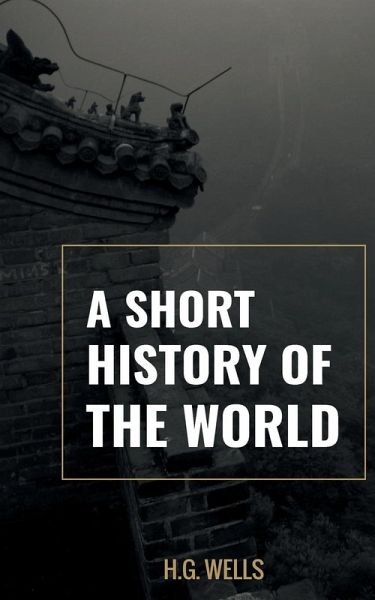
This Short History of The World is meant to be read straightforwardly almost as a novel is read. It gives in the most general way an account of our present knowledge of history, shorn of elaborations and complications. It has been amply illustrated and everything has been done to make it vivid and clear. From it the reader should be able to get that general view of history which is so necessary a framework for the study of a particular period or the history of a particular country. It may be found useful as a preparatory excursion before the reading of the author's much fuller and more…mehr
This Short History of The World is meant to be read straightforwardly almost as a novel is read. It gives in the most general way an account of our present knowledge of history, shorn of elaborations and complications. It has been amply illustrated and everything has been done to make it vivid and clear. From it the reader should be able to get that general view of history which is so necessary a framework for the study of a particular period or the history of a particular country. It may be found useful as a preparatory excursion before the reading of the author's much fuller and more explicit Outline of History is undertaken. But its especial end is to meet the needs of the busy general reader, too driven to study the maps and time charts of the Outline in detail; Who wishes to refresh and repair his faded or fragmentary conceptions of the great adventure of mankind. It is not an abstract or condensation of that former work. Within its aim the Outline admits of no further condensation. This is a much more generalized History, planned and written afresh.
Herbert George Wells was an influential English writer, best known for his works in science fiction, though his prolific output spanned various genres, including history, social commentary, politics, and autobiography. Born on September 21, 1866, in Bromley, London, Wells attended the Normal School of Science in London, where he studied biology under Thomas Henry Huxley. Wells initially worked as a teacher and journalist before turning to writing full time. Over his career, he penned more than fifty novels, along with numerous short stories and non-fiction works. His early works, such as "The Time Machine,The War of the Worlds," and "The Invisible Man," helped establish him as one of the pioneers of modern science fiction. He also explored themes of social justice, the possibilities of science and technology, and the complexities of human nature in works like "The History of Mr. Polly" and "The Shape of Things to Come." Throughout his life, Wells engaged in political and philosophical discourse, influenced by thinkers like Mark Twain and Plato. He died on August 13, 1946, in London, leaving behind a legacy that shaped the development of speculative fiction and continued to inspire future generations of writers and thinkers.
Es gelten unsere Allgemeinen Geschäftsbedingungen: www.buecher.de/agb
Impressum
www.buecher.de ist ein Internetauftritt der buecher.de internetstores GmbH
Geschäftsführung: Monica Sawhney | Roland Kölbl | Günter Hilger
Sitz der Gesellschaft: Batheyer Straße 115 - 117, 58099 Hagen
Postanschrift: Bürgermeister-Wegele-Str. 12, 86167 Augsburg
Amtsgericht Hagen HRB 13257
Steuernummer: 321/5800/1497
USt-IdNr: DE450055826