In A Ticket to Work, Bettina Kohlrausch examines the differing approaches taken by Britain and Germany to assisting young people with the often difficult transition from school to full-time work. Detailing the workings of such programs as skills training and job-placement assistance, the volume places those vocational training methods in the context of the general political and economic climate of the two nations, drawing a contrast between Britain’s more liberal market economy and Germany’s more structured and coordinated regime. Immer mehr Jugendliche verlassen die Schule ohne…mehr
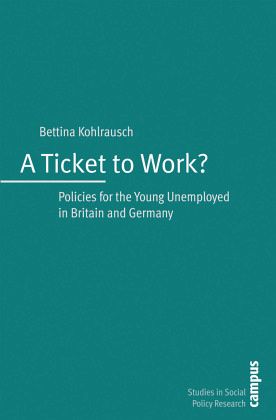
In A Ticket to Work, Bettina Kohlrausch examines the differing approaches taken by Britain and Germany to assisting young people with the often difficult transition from school to full-time work. Detailing the workings of such programs as skills training and job-placement assistance, the volume places those vocational training methods in the context of the general political and economic climate of the two nations, drawing a contrast between Britain’s more liberal market economy and Germany’s more structured and coordinated regime.
Immer mehr Jugendliche verlassen die Schule ohne qualifizierten Abschluss. Um ihnen dennoch den Zugang zum Arbeitsmarkt zu ermöglichen, gibt es jenseits des traditionellen Ausbildungssystems eine Vielzahl staatlicher Maßnahmen. Bettina Kohlrausch vergleicht diese sogenannten Übergangssysteme in Deutschland und Großbritannien und zeigt, dass in beiden Ländern die staatlichen Modelle mittlerweile ein bedeutendes Segment des Ausbildungssystems sind.Hinweis: Dieser Artikel kann nur an eine deutsche Lieferadresse ausgeliefert werden.
Produktdetails
Produktdetails
Schriften des Zentrums für Sozialpolitik, Bremen 18
Die Herstellerinformationen sind derzeit nicht verfügbar.
Autorenporträt
Dr. Bettina Kohlrausch ist wissenschaftliche Mitarbeiterin am Soziologischen Forschungsinstitut an der Universität Göttingen (SOFI).
Inhaltsangabe
Contents Acknowledgement 1 Introduction 2 Bridging Institutions and Life Courses: Why Skills Matter for the Analytical Frame of the reference 2.1 Skill Regimes in Comparative Perspective: The New Institutional Approach.19 2.2 The Life-Course Approach 2.2.1 Structuring the Life Course 2.3 The Meaning of Skills for School-to-Work Transitions 2.3.1 Varieties of the Institutional Framing of Labour Market Integration 2.3.2 Skills are the Answer: Three Dimensions of Skills 3 Training Systems in Germany and Britain 3.1 Youth Labour Markets in Germany 3.1.1 Skill Protection: Foundations of the German Vocational Training System 3.1.2 Skill Formation 3.1.3 Skill Access and Job Allocation Process 3.2 Youth Labour Markets in Britain 3.2.1 Skill Protection 3.2.2 Skill Formation 3.2.3 Skill Access 3.3 Conclusion: The British and German Training Systems as Exemplary Institutions of Liberal and Coordinated Market Economies? 4 Implementation of Jump and NDYP 4.1 The Jump-programme 4.1.1 Jump in the Context of National Labour-market and Training Policy 4.1.2 Structure of the Programme 4.1.3 Summary: Skills in Jump 4.2 Description of the New Deal for Young People 4.2.1 New Deal in the Context of National Labour-market Policy 4.2.2 Implementation of the New Deal 4.2.3 Summary: Skills in the NDYP 4.3 Conclusion: Comparing Jump and NDYP 4.3.1 Jump and New Deal against the Framework of Current Labour-Market and Training Policies 4.3.2 Skills in Jump and New Deal 4.3.3 Final Conclusion: Are the Programmes Indicators of a CME and LME? 5 Transition Patterns within Jump and NDYP 5.1 Have the Programmes Helped to Reduce Unemployment? 5.1.1 The New Deal for Young People 5.1.2 The Jump-programme 5.2 Successful Measures and Options with regard to Labour-Market Integration 5.2.1 Success of Measures of the Jump-programme 5.2.2 Labour-Market Chances after Leaving the NDYP according to Leaving Destination 5.3 Distribution of Qualifications within Jump and New Deal 5.3.1 Making Qualifications Comparable: The CASMIN Scale 5.3.2 Attendance of Certain Instruments According to Education in the Jump programme 5.4 Patterns of Participation According to Gender and Ethnic Origin 5.4.1 Education According to Nationality and Gender 5.5 Patterns of Status-Changes 5.5.1 The Status-Changes from being Unemployed to being Participant of the Programme 5.5.2 Length of Stay in the Programme 5.5.3 Summary: Institutional Framing of Jump and NDYP 5.6 Is there Workfare Recycling in both Programmes? 5.6.1 Workfare Recycling in Jump 5.6.2 Workfare Recycling in the NDYP 5.6.3 Summary: Workfare Recycling in Jump and New Deal 5.7 Summary: Transition Patterns in Jump and NDYP 6 Jump and New Deal: Old or New Path into (Un)employment? List of Tables and Figures References
Es gelten unsere Allgemeinen Geschäftsbedingungen: www.buecher.de/agb
Impressum
www.buecher.de ist ein Internetauftritt der buecher.de internetstores GmbH
Geschäftsführung: Monica Sawhney | Roland Kölbl | Günter Hilger
Sitz der Gesellschaft: Batheyer Straße 115 - 117, 58099 Hagen
Postanschrift: Bürgermeister-Wegele-Str. 12, 86167 Augsburg
Amtsgericht Hagen HRB 13257
Steuernummer: 321/5800/1497
USt-IdNr: DE450055826