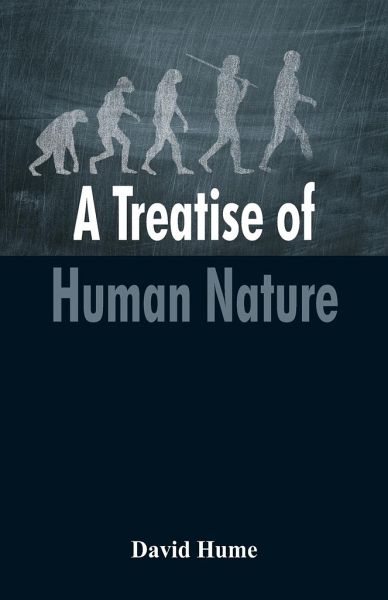
A Treatise of Human Nature (1738–40) is a book by Scottish philosopher David Hume, considered by many to be Hume's most important work and one of the most influential works in the history of philosophy. The Treatise is a classic statement of philosophical empiricism, skepticism, and naturalism. In the introduction Hume presents the idea of placing all science and philosophy on a novel foundation: namely, an empirical investigation into human nature. Impressed by Isaac Newton's achievements in the physical sciences, Hume sought to introduce the same experimental method of reasoning into the…mehr
A Treatise of Human Nature (1738–40) is a book by Scottish philosopher David Hume, considered by many to be Hume's most important work and one of the most influential works in the history of philosophy. The Treatise is a classic statement of philosophical empiricism, skepticism, and naturalism. In the introduction Hume presents the idea of placing all science and philosophy on a novel foundation: namely, an empirical investigation into human nature. Impressed by Isaac Newton's achievements in the physical sciences, Hume sought to introduce the same experimental method of reasoning into the study of human psychology, with the aim of discovering the "extent and force of human understanding". Against the philosophical rationalists, Hume argues that passion rather than reason governs human behaviour. He introduces the famous problem of induction, arguing that inductive reasoning and our beliefs regarding cause and effect cannot be justified by reason; instead, our faith in induction and causation is the result of mental habit and custom. Hume defends a sentimentalist account of morality, arguing that ethics is based on sentiment and passion rather than reason, and famously declaring that "reason is, and ought only to be the slave to the passions". Hume also offers a skeptical theory of personal identity and a compatibilist account of free will.
David Home, a Scottish Enlightenment philosopher, historian, economist, librarian, and essayist who lived from 7 May 1711 NS (26 April 1711 OS) to 25 August 1776, was most recognized today for his very important school of philosophical empiricism, skepticism, and naturalism. Hume worked to establish a naturalistic science of man that looked at the psychological underpinnings of human nature, starting with A Treatise of Human Nature (1739-1740). Hume contended that there are no inborn notions and that all human understanding comes only through experience. As an empiricist, he is so grouped with Francis Bacon, Thomas Hobbes, John Locke, and George Berkeley. Inductive reasoning and the notion of causation, according to Hume, cannot be supported by logic; rather, they are the products of mental habits and custom. Due to the induction problem, it is impossible to provide the basis for the premise that the future will resemble the past, which is required in order to draw any causal conclusions from the past. Hume also rejected the idea that people have a true sense of who they are, asserting that what we actually experience is a collection of sensations and that the self is nothing more than this collection of causally related experiences.
Es gelten unsere Allgemeinen Geschäftsbedingungen: www.buecher.de/agb
Impressum
www.buecher.de ist ein Internetauftritt der buecher.de internetstores GmbH
Geschäftsführung: Monica Sawhney | Roland Kölbl | Günter Hilger
Sitz der Gesellschaft: Batheyer Straße 115 - 117, 58099 Hagen
Postanschrift: Bürgermeister-Wegele-Str. 12, 86167 Augsburg
Amtsgericht Hagen HRB 13257
Steuernummer: 321/5800/1497
USt-IdNr: DE450055826