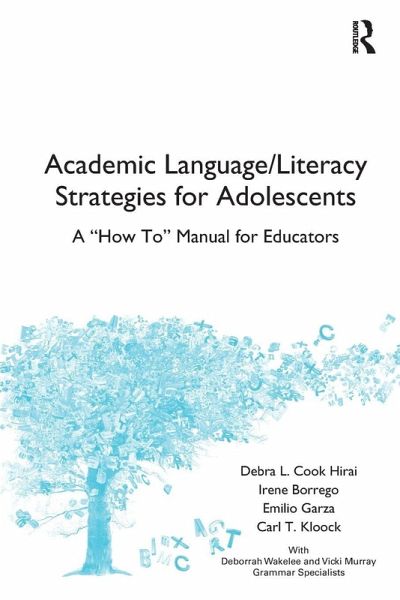
Fast-paced, practical, and innovative, this text for pre-service and in-service teachers features clear, easily accessible lessons and professional development activities to improve the delivery of academic language/literacy instruction across the content areas for junior/middle school and high school students, particularly English language learners, struggling readers, and other special populations of students.
Fast-paced, practical, and innovative, this text for pre-service and in-service teachers features clear, easily accessible lessons and professional development activities to improve the delivery of academic language/literacy instruction across the content areas for junior/middle school and high school students, particularly English language learners, struggling readers, and other special populations of students.
Debra L. Cook Hirai is Associate Professor, California State University Bakersfield, where she teaches Masters courses in the Education Bilingual Multicultural Program. Irene Borrego is Associate Professor and BCLAD Coordinator at California State University Bakersfield, and a State of California School Assistance and Intervention Team member identified by the California State Department of Education. Emilio Garza \is Assistant Professor, School of Education, California State University, Bakersfield, where he teaches in the Advanced Educational Studies Department. Carl T. Kloock is in the Department of Biology at California State University Bakersfield, where he teaches courses for biology majors and integrated science for pre-professional teacher candidates.
Inhaltsangabe
FOREWORD PREFACE ACKNOWLEDGEMENTS CHAPTER 1 BACKGROUND A short history of the term "Academic Language" Instruction from an Academic Language perspective Why should we teach Academic Language? How this book can help CHAPTER 2 MOTIVATION The importance of motivation Research on student motivation Setting a purpose for learning: The anticipatory set Active learning and hands-on activities Modeling and guided practice CHAPTER 3 ATTRIBUTES OF ACADEMIC LANGUAGE Receptive and expressive language Application of receptive and expressive strategies Professional input and feedback for Academic Language literacy Instruction CHAPTER 4 VOCABULARY: THEORY AND PRACTICE Developing vocabulary Learning and acquisition: The importance of multiple exposures Cognates, root words, and affixes Contextualizing vocabulary Personalizing and operationalizing vocabulary Strategies for teaching vocabulary Specific activities/techniques A sample lesson Summary CHAPTER 5 READING SKILLS DEVELOPMENT Importance of reading in the content areas Research on reading and reading comprehension Literacy and reading Content literacy Expository vs. narrative text The phases of reading: Reading into, through, and beyond Strategies for getting students "INTO" reading "Into" activities Strategies for getting students "THROUGH" reading "Through" activities Strategies for getting students "BEYOND" reading Integrated activities Sample lesson Geometry proofs Summary CHAPTER 6 GRAMMAR & WRITING The importance of grammar to language acquisition How should grammar be taught? Brick and mortar words Why should content area teachers teach grammar? Writing and Academic Language literacy The relationship between verbal and written language Student writing skills Building the academic register for writing Assessing writing in order to develop writing skills Writing: "Into, through and beyond" Activities that develop writing skills Sample lesson: Three search paper on the Holocaust Summary CHAPTER 7 SUMMING UP GLOSSARY APPENDIX 1 Expressive and Receptive Language Strategies and Model Lesson Plan Format APPENDIX 2 Sample Lesson Plans Including Expressive and Receptive language Prompts Sample Lesson Plan 2.1 Sentence analysis and rephrasing (Earth Science) Sample Lesson Plan 2.2 Using the text (Algebra) Sample Lesson Plan 2.3 Classifying the elements (Chemistry) Sample Lesson Plan 2.4 Using a science notebook (General Science) Sample Lesson Plan 2.5 Stem-and-leaf plots (Graphing) APPENDIX 3 Sample Lesson Plans Without Expressive and Receptive Language Prompts Sample Lesson Plan 3.1: Unit Analysis (Math and Science) Sample Lesson Plan 3.2: Word Problems(Math) Sample Lesson Plan 3.3: Scientific Method (General Science/Biology) Sample Lesson Plan 3.4: Linear Equalities in 2 Variables (Math) Sample Lesson Plan 3.5: Intro to Relations and Functions (Math) APPENDIX 4 Sample Writing Rubric APPENDIX 5 List of Useful Websites for Math and Science APPENDIX 6 Common Cognates APPENDIX 7 Grammar Handbook REFERENCES
FOREWORD PREFACE ACKNOWLEDGEMENTS CHAPTER 1 BACKGROUND A short history of the term "Academic Language" Instruction from an Academic Language perspective Why should we teach Academic Language? How this book can help CHAPTER 2 MOTIVATION The importance of motivation Research on student motivation Setting a purpose for learning: The anticipatory set Active learning and hands-on activities Modeling and guided practice CHAPTER 3 ATTRIBUTES OF ACADEMIC LANGUAGE Receptive and expressive language Application of receptive and expressive strategies Professional input and feedback for Academic Language literacy Instruction CHAPTER 4 VOCABULARY: THEORY AND PRACTICE Developing vocabulary Learning and acquisition: The importance of multiple exposures Cognates, root words, and affixes Contextualizing vocabulary Personalizing and operationalizing vocabulary Strategies for teaching vocabulary Specific activities/techniques A sample lesson Summary CHAPTER 5 READING SKILLS DEVELOPMENT Importance of reading in the content areas Research on reading and reading comprehension Literacy and reading Content literacy Expository vs. narrative text The phases of reading: Reading into, through, and beyond Strategies for getting students "INTO" reading "Into" activities Strategies for getting students "THROUGH" reading "Through" activities Strategies for getting students "BEYOND" reading Integrated activities Sample lesson Geometry proofs Summary CHAPTER 6 GRAMMAR & WRITING The importance of grammar to language acquisition How should grammar be taught? Brick and mortar words Why should content area teachers teach grammar? Writing and Academic Language literacy The relationship between verbal and written language Student writing skills Building the academic register for writing Assessing writing in order to develop writing skills Writing: "Into, through and beyond" Activities that develop writing skills Sample lesson: Three search paper on the Holocaust Summary CHAPTER 7 SUMMING UP GLOSSARY APPENDIX 1 Expressive and Receptive Language Strategies and Model Lesson Plan Format APPENDIX 2 Sample Lesson Plans Including Expressive and Receptive language Prompts Sample Lesson Plan 2.1 Sentence analysis and rephrasing (Earth Science) Sample Lesson Plan 2.2 Using the text (Algebra) Sample Lesson Plan 2.3 Classifying the elements (Chemistry) Sample Lesson Plan 2.4 Using a science notebook (General Science) Sample Lesson Plan 2.5 Stem-and-leaf plots (Graphing) APPENDIX 3 Sample Lesson Plans Without Expressive and Receptive Language Prompts Sample Lesson Plan 3.1: Unit Analysis (Math and Science) Sample Lesson Plan 3.2: Word Problems(Math) Sample Lesson Plan 3.3: Scientific Method (General Science/Biology) Sample Lesson Plan 3.4: Linear Equalities in 2 Variables (Math) Sample Lesson Plan 3.5: Intro to Relations and Functions (Math) APPENDIX 4 Sample Writing Rubric APPENDIX 5 List of Useful Websites for Math and Science APPENDIX 6 Common Cognates APPENDIX 7 Grammar Handbook REFERENCES
Es gelten unsere Allgemeinen Geschäftsbedingungen: www.buecher.de/agb
Impressum
www.buecher.de ist ein Internetauftritt der buecher.de internetstores GmbH
Geschäftsführung: Monica Sawhney | Roland Kölbl | Günter Hilger
Sitz der Gesellschaft: Batheyer Straße 115 - 117, 58099 Hagen
Postanschrift: Bürgermeister-Wegele-Str. 12, 86167 Augsburg
Amtsgericht Hagen HRB 13257
Steuernummer: 321/5800/1497
USt-IdNr: DE450055826