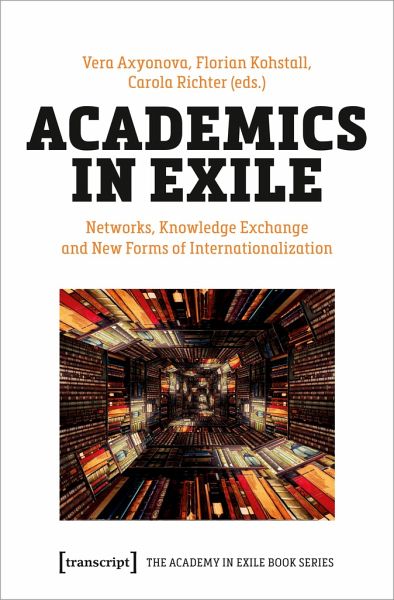
Restrictions on academic freedom, persecution and armed conflict have forced many scholars into exile. So far, the professional trajectories of these scholars and their contributions to knowledge exchange have not been studied comprehensively. The contributors to this volume address the situations and networks of scholars in exile, the challenges they face in their host countries and the opportunities they use. These issues are highly relevant to discussions about the moral economies of higher education institutions and support programs. Although the contributions largely focus on Germany as a…mehr
Restrictions on academic freedom, persecution and armed conflict have forced many scholars into exile. So far, the professional trajectories of these scholars and their contributions to knowledge exchange have not been studied comprehensively. The contributors to this volume address the situations and networks of scholars in exile, the challenges they face in their host countries and the opportunities they use. These issues are highly relevant to discussions about the moral economies of higher education institutions and support programs. Although the contributions largely focus on Germany as a host country, they also offer telling examples of forced mobility in the Global South, including both contemporary and historical perspectives. Hinweis: Dieser Artikel kann nur an eine deutsche Lieferadresse ausgeliefert werden.
Vera Axyonova is a Marie Curie REWIRE fellow at the University of Vienna and principal investigator of the project »Expert Knowledge in Times of Crisis«. Previously, she worked in research, science management and policy consulting. She is co-founder of the ECPR Research Network on Statehood, Sovereignty and Conflict. Her research interests include expert knowledge production, international conflict management and norm transfer as well as the role of civil society actors in policy processes, focusing mainly on the post-Soviet space. Florian Kohstall (Dr.) heads the Global Responsibility Unit at the Center for International Cooperation at Freie Universität Berlin. In 2016, he founded Academics in Solidarity, a transnational peer-to-peer mentoring program for displaced scholars. Since 2020, he is responsible for the Berlin Center for Global Engagement, the platform of the Berlin University Alliance. From 2010 to 2015 he directed Freie Universität Berlin's Cairo Office. His research focuses on varieties of internationalization and the politics of higher education reform in the Middle East and North Africa. He has taught political science in Aix-en-Provence, Cairo and Lyon. He is a former research fellow of CEDEJ, the French research center in Cairo, and an alumnus of AGYA, the Arab-German Young Academy of Sciences and Humanities. His recent publications include: "Academics in Exile: Networks, Knowledge Exchange and New Forms of Internationalization", co-edited with Vera Axyonova and Carola Richter, transcript 2022. Carola Richter is a professor for international communication at Freie Universität Berlin. In her research, she focuses on media systems and communication cultures in the MENA region (Middle East and North Africa), foreign news coverage, media and migration as well as on public diplomacy. She is the co-founder of AREACORE, the Arab-European Association of Media and Communication Researchers, and director of the Center for Media and Information Literacy (CeMIL) at Freie Universität Berlin.
Rezensionen
Perlentaucher-Notiz zur F.A.Z.-Rezension
Claus Leggewie entdeckt den Kosmopolitismus akademsicher Lehre und Forschung in dem von V. Axyonova, F. Kohstall und C. Richter herausgegebenen Band. Allerdings muss er sich erst durch die wenig rosigen Erfahrungsberichte von Exilautoren und die Fallstudien über die indonesische, die türkische oder die syrische Diaspora lesen. Letztere lehren ihn die Mühen des Exil-Alltags, aber auch, wie schwierig sich das akademische Milieu mitunter tut, sich Geflüchteten zu öffnen. Dass es dennoch auch anders geht, davon erzählt im Band etwa ein Text von Nahed Ghazzoul über akademische Netzwerke zwischen Syrien, Jordanien, Libanon und der Türkei, freut sich Leggewie.