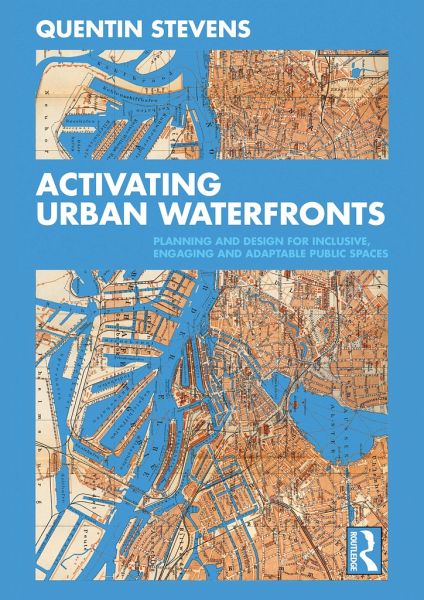
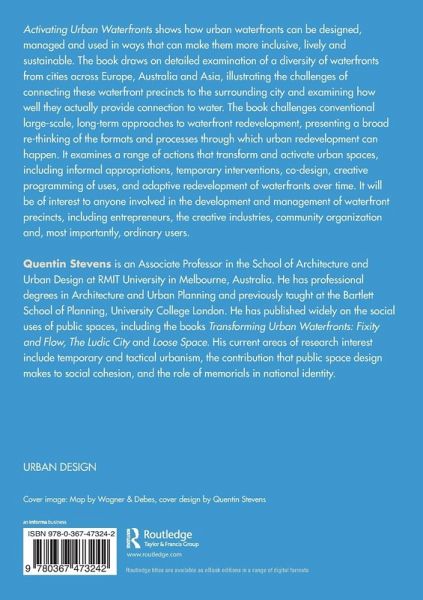
Activating Urban Waterfronts shows how urban waterfronts can be designed, managed and used in ways that can make them more inclusive, lively and sustainable.
Activating Urban Waterfronts shows how urban waterfronts can be designed, managed and used in ways that can make them more inclusive, lively and sustainable.
Quentin Stevens is an Associate Professor in the School of Architecture and Urban Design at RMIT University in Melbourne, Australia. He has professional degrees in Architecture and Urban Planning and previous taught at the Bartlett School of Planning, University College London. He has published widely on the social uses of public spaces, including the books Transforming Urban Waterfronts: Fixity and Flow, The Ludic City, and Loose Space. His current areas of research interest include temporary and tactical urbanism, the contribution that public space design makes to social cohesion, and the role of memorials in national identity.
Inhaltsangabe
Introduction Part 1: Plugging the Waterfront into the City 1. Three 'Southbanks' 2. Postcolonial Waterfronts: Global Imagery and Local Realities Quentin Stevens, Marek Kozlowski and Norsidah Ujang 3. Tracing the Shifting Waterfront 4. Artificial Waterfronts Part 2: Switching the Waterfront On 5. Appropriating the Spectacle Quentin Stevens and Kim Dovey 6. The 'City Beach' as a New Waterfront Development Model 7. Post-Fordist Placemaking Quentin Stevens and Mhairi Ambler 8. Sandpit Urbanism 9. A Temporary Waterfront: Prompting Public Engagement Jacob Mikkelsen, Quentin Stevens, Catherine Hills and Florian 'Floyd' Mueller Conclusion
Introduction Part 1: Plugging the Waterfront into the City 1. Three 'Southbanks' 2. Postcolonial Waterfronts: Global Imagery and Local Realities Quentin Stevens, Marek Kozlowski and Norsidah Ujang 3. Tracing the Shifting Waterfront 4. Artificial Waterfronts Part 2: Switching the Waterfront On 5. Appropriating the Spectacle Quentin Stevens and Kim Dovey 6. The 'City Beach' as a New Waterfront Development Model 7. Post-Fordist Placemaking Quentin Stevens and Mhairi Ambler 8. Sandpit Urbanism 9. A Temporary Waterfront: Prompting Public Engagement Jacob Mikkelsen, Quentin Stevens, Catherine Hills and Florian 'Floyd' Mueller Conclusion
Es gelten unsere Allgemeinen Geschäftsbedingungen: www.buecher.de/agb
Impressum
www.buecher.de ist ein Internetauftritt der buecher.de internetstores GmbH
Geschäftsführung: Monica Sawhney | Roland Kölbl | Günter Hilger
Sitz der Gesellschaft: Batheyer Straße 115 - 117, 58099 Hagen
Postanschrift: Bürgermeister-Wegele-Str. 12, 86167 Augsburg
Amtsgericht Hagen HRB 13257
Steuernummer: 321/5800/1497
USt-IdNr: DE450055826